Hyundai cars made are produced in several key locations around the world. Notably, you will find manufacturing plants in South Korea, the United States, China, India, and more. The Ulsan facility in South Korea stands out as the world’s second-largest auto plant, producing 1.6 million units annually. In the United States, the Alabama plant plays a crucial role in meeting local demand. Understanding where Hyundai cars made helps you appreciate their global reach and the impact on American consumers.
Key Takeaways
Hyundai operates major manufacturing plants in South Korea, the USA, China, and India, with the Ulsan plant being the largest in the world.
The Alabama plant produces up to 400,000 vehicles annually, including popular models like the Tucson and Santa Fe, supporting local demand.
Hyundai’s investment of $26 billion in the U.S. from 2025 to 2028 will expand production capacity and create thousands of jobs.
The Georgia plant focuses on electric vehicles, reflecting Hyundai’s commitment to sustainability and innovation in the automotive market.
Understanding where Hyundai cars are made helps consumers assess quality, reliability, and the economic impact on local communities.
Global Manufacturing Locations
Hyundai operates manufacturing plants in various countries, each contributing to its global footprint. Understanding these locations helps you see how Hyundai meets local demands and adapts to market trends.
Hyundai Cars Made in the USA
In the United States, Hyundai has established significant manufacturing facilities. The Hyundai Motor Manufacturing Alabama (HMMA) plant plays a crucial role. This facility produces up to 400,000 vehicles annually, including popular models like the Hyundai Tucson, Santa Fe, Santa Cruz, and Genesis GV70.
The Georgia plant also contributes to Hyundai’s production capabilities. It focuses on integrating advanced manufacturing techniques, emphasizing the need for a skilled workforce and local supply chains. This approach enhances operational efficiency and supports the growing demand for electric vehicles (EVs).
Here’s a quick overview of Hyundai’s manufacturing plants in the USA:
Plant Location | Annual Production Capacity |
|---|---|
Alabama | 400,000 units |
Georgia | Not specified |
Hyundai’s commitment to the U.S. market is evident. The company has invested billions in local operations, which positions it as a leader in advanced manufacturing. This investment not only boosts the local economy but also strengthens Hyundai’s competitiveness in the automotive industry.
Hyundai Cars Made in South Korea
South Korea remains the heart of Hyundai’s manufacturing strategy. The country hosts several major production facilities, including the Ulsan, Asan, and Jeonju plants. The Ulsan plant is particularly noteworthy, as it is one of the largest auto plants in the world. It produces a vast number of vehicles, contributing significantly to Hyundai’s global supply chain.
Hyundai exported approximately 637,000 vehicles from South Korea to the U.S. last year. This export volume highlights the importance of South Korea in Hyundai’s overall production strategy. The company adapts its manufacturing processes to meet local preferences and trends, enhancing its market reach.
Here’s a list of major production facilities in South Korea:
Ulsan
Asan
Jeonju
Hyundai’s geographic distribution of manufacturing plants allows it to respond quickly to market demands. The company relies on just-in-time delivery, especially due to its proximity to Chinese suppliers. However, this strategy also presents challenges, as disruptions in China can impact operations in South Korea and beyond.
USA Manufacturing
Models Produced in Alabama
The Hyundai Motor Manufacturing Alabama (HMMA) plant is a cornerstone of Hyundai’s operations in the U.S. Located in Montgomery, Alabama, this facility plays a vital role in producing several popular models. Here are some key features of the HMMA plant:
Feature | Detail |
|---|---|
Location | Montgomery, Alabama |
Employment | Approximately 4,200 full-time workers |
Annual Vehicle Production | Approximately 400,000 vehicles |
Annual Engine Production | More than 700,000 engines |
Investment in Alabama | Upwards of $1.7 billion |
Production Start Date | Regular production began in spring 2005 |
Current Models Produced | Sonata, Elantra, Santa Fe, Santa Cruz |
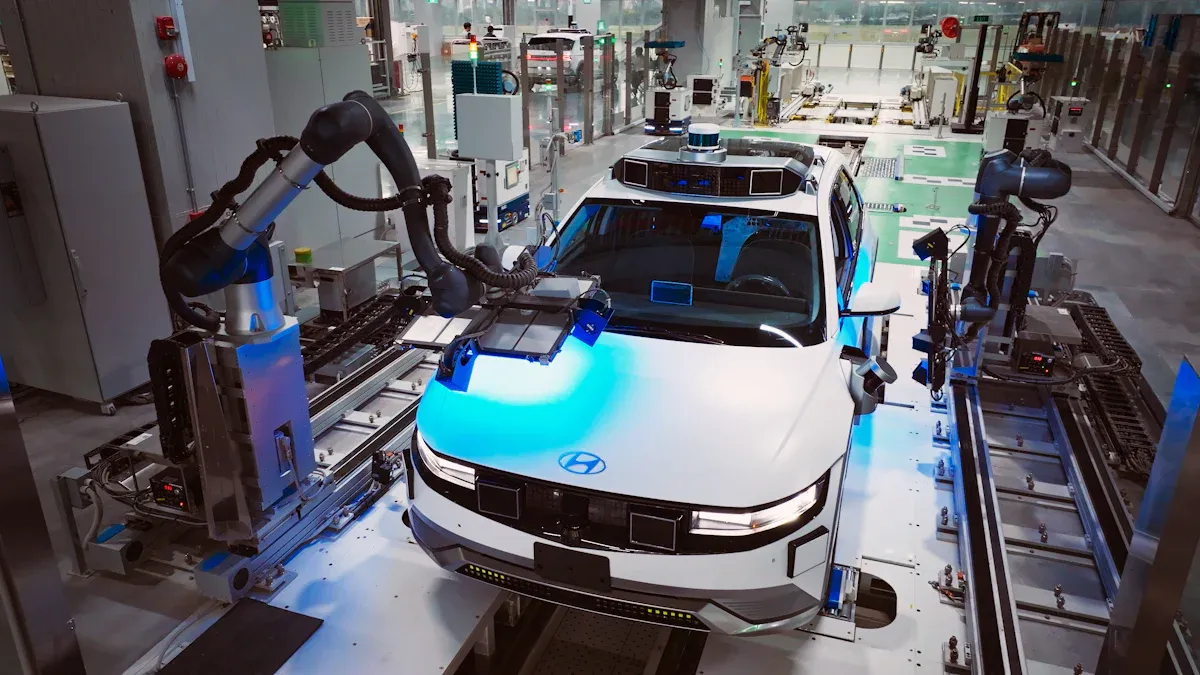
The HMMA plant occupies 3.2 million square feet on 1,744 acres. It features advanced facilities for stamping, welding, painting, general assembly, and engine production. You will find over 400 industrial robots working in welding and painting areas. The assembly line includes more than 7,000 linear feet of self-adjusting conveyor belts. A 2.3-mile test track and a high-pressure water test booth ensure quality testing for every vehicle produced.
Ellen McNair, Secretary of the Alabama Department of Commerce, noted that Hyundai has been a “transformational engine” for Montgomery. The plant contributes over $5 billion annually to the Alabama economy, providing thousands of well-paying jobs.
Models Produced in Georgia
Hyundai’s manufacturing facility in Georgia also plays a significant role in the company’s North American operations. This plant focuses on producing electric vehicles, which are becoming increasingly important in today’s market. Here’s a look at the production capacity and models produced at the Georgia facility:
Model | Production Capacity |
|---|---|
Ioniq 5 | Produced at the plant |
Ioniq 9 | Produced at the plant |
Total | 500,000 vehicles/year |
The Georgia plant represents a strategic commitment to growth in North America. Hyundai invested $2.7 billion to expand production capacity, creating 3,000 jobs in the process. The location in Georgia offers advantages, such as a strong technical college system that supports workforce development. This environment enhances operational efficiency and positions Hyundai favorably in the competitive automotive market.
Hyundai’s focus on local manufacturing allows you to enjoy vehicles tailored to your preferences. The company’s investments in both Alabama and Georgia demonstrate its commitment to meeting the needs of American consumers while contributing to the local economies.
Comparison of Models
When you consider Hyundai cars made in the USA, you will find several popular models that cater to American consumers. These models often feature specifications tailored to local preferences. Here are some of the most popular Hyundai models produced in the United States:
Hyundai Elantra (Manufactured in Alabama)
Hyundai Sonata (Manufactured in Alabama)
Hyundai Tucson (Manufactured in Alabama)
Hyundai Santa Cruz (Manufactured in Alabama)
Hyundai Santa Fe (Manufactured in Georgia)
These models reflect Hyundai’s commitment to quality and innovation. The Alabama plant produces vehicles like the Tucson and Santa Cruz, which are known for their ruggedness and advanced technology. Meanwhile, the Georgia facility focuses on electric models like the IONIQ 5 and IONIQ 9, which emphasize sustainability and modern design.
In contrast, Hyundai models made overseas, particularly in South Korea, often adhere to high global standards for safety and quality. Here’s a comparison of some key features between models produced in the USA and those made in South Korea:
Model | Assembly Location | Features/Specifications |
|---|---|---|
Hyundai Santa Fe | Alabama, USA | Rugged and adventurous |
Hyundai Santa Fe Hybrid | Alabama, USA | Family-friendly smart SUV |
Hyundai Tucson | Alabama, USA | Smart tech high-end compact SUV |
Hyundai Santa Cruz | Alabama, USA | Blend of SUV comfort and pickup capabilities |
Hyundai IONIQ 5 | Georgia, USA | Striking design and lightning-fast charging speeds |
Hyundai IONIQ 9 | Georgia, USA | Versatile electric vehicle built for comfort |
Hyundai Models (Overseas) | Ulsan, South Korea | Built to high global standards for safety and quality |
This comparison highlights how Hyundai adapts its models to meet the needs of different markets. For you as a consumer, this means you can choose from a variety of options that suit your lifestyle and preferences. Whether you prefer a rugged SUV or a sleek electric vehicle, Hyundai offers choices that cater to your needs.
Understanding where Hyundai cars are made and the differences in features can help you make informed decisions. The models produced in the USA often focus on practicality and technology, while international models may emphasize safety and quality. This knowledge empowers you to select the right vehicle for your lifestyle.
Future Manufacturing Plans
Hyundai has ambitious plans for future manufacturing that will significantly impact the automotive landscape. The company aims to expand its operations in the United States and innovate globally.
Expansion in the USA
Hyundai’s commitment to growth in the U.S. is evident through substantial investments. The company plans to invest a total of $26 billion from 2025 to 2028. This investment will enhance production capacity and create thousands of jobs. Here’s a breakdown of the planned investments:
Investment Amount | Purpose | Details |
|---|---|---|
$21 billion | U.S. Growth | Deepening partnership and expanding operations in the U.S. |
$9 billion | Production Capacity | Establishing annual production capacity of 1.2 million vehicles. |
$6 billion | Parts Localization | Increasing localization rate of automotive components, including EV parts. |
$6 billion | Future Industries | Investing in autonomous driving, robotics, AI, and energy infrastructure. |
N/A | Job Creation | Anticipated creation of 14,000 new direct jobs by 2028. |
N/A | Economic Impact | Expected to generate over 100,000 direct and indirect job opportunities. |
Additionally, the Georgia plant will eventually assemble 10 different electric and hybrid models, increasing from the current two. Hyundai aims to produce more than 80% of the vehicles sold in the U.S. domestically by 2030.
Global Manufacturing Innovations
Hyundai is also focusing on global manufacturing innovations to improve efficiency and sustainability. The company has set ambitious goals, including:
Initiative | Description | Impact/Goal |
|---|---|---|
Carbon Emissions Reduction | Targets to cut Scope 1 and 2 emissions by 75% by 2040 and Scope 3 by 50% by 2045. | Significant reduction in overall emissions. |
Investment in EV Development | $18 billion committed to battery electric vehicle development by 2030. | Transition away from internal combustion engines. |
Hydrogen Fuel Cell Technology | Development of zero-emission fuel cell trucks and vehicles like Hyundai NEXO. | Diversified pathways to decarbonization. |
Circular Economy Practices | Closed-loop battery recycling system recovers 95% of materials. | Promotes resource efficiency and waste reduction. |
Use of Eco-friendly Materials | Incorporation of biodegradable plastics and natural fibers in vehicle interiors. | Reduces dependency on virgin materials. |
AI and Technology in Operations | AI-powered logistics and predictive analytics optimize production. | Minimizes waste and enhances supply chain efficiency. |
Renewable Energy Transition | Aiming for 100% renewable energy by 2035, with 15% already achieved. | Reduces reliance on fossil fuels. |
Investment in Hydrogen Infrastructure | $7.4 billion investment in hydrogen fuel cell research and infrastructure. | Positions Hyundai as a leader in alternative fuel solutions. |
These initiatives not only enhance Hyundai’s manufacturing capabilities but also align with global trends toward sustainability. As Hyundai continues to innovate, you can expect more choices and lower costs in the automotive market.
Understanding where Hyundai cars are made is essential for you as a consumer. It impacts your choices regarding quality, reliability, and value. Here are some key aspects to consider:
Key Aspect | Description |
|---|---|
Build Quality | Hyundai is known for its strong build quality, contributing to reliability. |
Warranty Coverage | The brand offers industry-leading warranty coverage, enhancing consumer trust. |
Safety and Technology | Hyundai focuses on safety and technology, setting it apart in the market. |
Customer Satisfaction Ratings | Positive ratings highlight Hyundai’s strong position among manufacturers. |
Innovation and Value Proposition | Ongoing innovation makes Hyundai an attractive choice for consumers. |
Looking ahead, Hyundai plans to expand production capacity and focus on electrified vehicles. The company aims for a significant increase in electric vehicle production by 2030. These developments will shape the future of Hyundai’s manufacturing strategy and enhance your options as a consumer.
FAQ
Where are Hyundai cars manufactured?
Hyundai manufactures cars in several countries, including South Korea, the United States, China, and India. The Ulsan plant in South Korea is the largest, while Alabama and Georgia facilities serve the North American market.
What models are made in the USA?
In the USA, Hyundai produces popular models like the Tucson, Santa Fe, Santa Cruz, Elantra, and Sonata. The Georgia plant focuses on electric vehicles, including the Ioniq 5 and Ioniq 9.
How does Hyundai ensure quality in its manufacturing?
Hyundai employs advanced technology and rigorous testing processes at its plants. Each vehicle undergoes quality checks, including a 2.3-mile test track and high-pressure water tests, ensuring reliability and safety.
What is Hyundai’s future manufacturing strategy?
Hyundai plans to invest $26 billion in U.S. operations from 2025 to 2028. This investment aims to expand production capacity, create jobs, and increase electric vehicle manufacturing.
Why is it important to know where Hyundai cars are made?
Understanding where Hyundai cars are made helps you assess quality, reliability, and value. It also informs you about local economic impacts and the company’s commitment to sustainability and innovation.