

You’ll want kits that bolt on, cut dust, and resist fade: Power Stop’s Civic Z23 for 2016–2021 Civics gives drilled/slotted rotors and carbon-fiber ceramic pads; Power Stop Z23 for select Subarus adds zinc-plated rotors for corrosion resistance; R1 Concepts’ G3000 kit fits 2015–2020 Mustangs with drilled/diamond-slotted rotors and ceramic pads; MAX Advanced’s carbon-ceramic kit suits 2015–2020 F‑150s; MAX’s PerformanceMAX fits 2013–2023 Altimas—keep going to see fitment, materials, and install tips.
| Power Stop Brake Kit for 2016–2021 Honda Civic |

| Best for Civics | Fitment (Vehicle-specific): 2016–2021 Honda Civic (specific trims and engines; excludes some Si/performance trims) | Includes Rotors: Front and rear drilled & slotted rotors (2 front, 2 rear) | Includes Brake Pads: Front and rear carbon-fiber ceramic brake pad sets with hardware | VIEW LATEST PRICE | Read Our Analysis |
| Power Stop Z23 Carbon Fiber Brake Kit for Subaru |
| Low-Dust Performer | Fitment (Vehicle-specific): Various Subaru models (2011–2014 Forester/WRX/Legacy/Outback; confirm fit) | Includes Rotors: Drilled-and-slotted rotors (front and rear, zinc-plated) | Includes Brake Pads: Front and rear Z23 carbon-fiber ceramic brake pads | VIEW LATEST PRICE | Read Our Analysis |
| R1 Concepts Brake Kit for 2015–2020 Ford Mustang |

| Sporty Daily Driver | Fitment (Vehicle-specific): 2015–2020 Ford Mustang (specific V6/EcoBoost configs; excludes Performance Package) | Includes Rotors: Front and rear drilled & slotted rotors (4 total; black finish) | Includes Brake Pads: Front and rear ceramic brake pads (8 total) | VIEW LATEST PRICE | Read Our Analysis |
| MAX Advanced Carbon Ceramic Brake Kit for Ford F-150 |

| Heavy-Duty Towing | Fitment (Vehicle-specific): 2015–2020 Ford F-150 (with electric parking brake); also fits 2018–2021 Expedition/Navigator | Includes Rotors: Front and rear cross-drilled rotors (2 front + 2 rear) | Includes Brake Pads: 8 low-dust carbon-infused ceramic brake pads (front and rear) | VIEW LATEST PRICE | Read Our Analysis |
| MAX Advanced Carbon Ceramic Brake Kit for Nissan Altima |
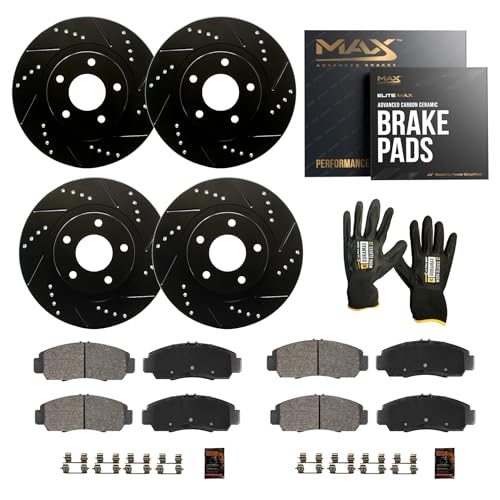
| Long-Life Upgrade | Fitment (Vehicle-specific): 2013–2023 Nissan Altima (FWD; specific rear rotor diameter noted) | Includes Rotors: Front and rear e-coated slotted & drilled rotors (2 front + 2 rear) | Includes Brake Pads: 8 dust-free carbon-ceramic brake pads (front and rear) | VIEW LATEST PRICE | Read Our Analysis |
More Details on Our Top Picks
Power Stop Brake Kit for 2016–2021 Honda Civic
In case you want a direct, bolt-on stopping upgrade for a 2016–2021 Civic that balances everyday drivability with track-ready performance, the Power Stop Z23 Evolution Sport kit delivers drilled-and-slotted rotors plus carbon-fiber ceramic pads to cut heat, reduce fade and minimize dust while fitting a wide range of Civic sedans, coupes and hatchbacks—just double-check trim and 2.0L engine particulars before ordering. You get front and rear drilled-and-slotted rotors plus matched carbon-fiber ceramic pad sets with hardware, engineered to enhance stopping power, lower dust, and extend pad life. Confirm exact model years and excluded performance trims (like Si) before buying.
- Fitment (Vehicle-specific):2016–2021 Honda Civic (specific trims and engines; excludes some Si/performance trims)
- Includes Rotors:Front and rear drilled & slotted rotors (2 front, 2 rear)
- Includes Brake Pads:Front and rear carbon-fiber ceramic brake pad sets with hardware
- Drilled and/or Slotted Design:Drilled & slotted rotors
- Low-Dust / Ceramic Pad Technology:Carbon-fiber ceramic pads (reduced dust)
- Hardware / Installation Accessories Included:Brake pad hardware included (front and rear)
- Additional Feature:Carbon-fiber ceramic pads
- Additional Feature:Front+rear drilled rotors
- Additional Feature:Trim-specific 2.0L fitments
Power Stop Z23 Carbon Fiber Brake Kit for Subaru
Should you want a direct upgrade over stock brakes that cuts dust and holds up under spirited driving, the Power Stop Z23 Carbon Fiber Brake Kit for Subaru delivers—with carbon-fiber ceramic pads and drilled-and-slotted, zinc-plated rotors built to improve stopping power and resist corrosion. You get front and rear Z23 pads formulated to outperform OE ceramic material and produce about 30% less dust per third-party Los Angeles testing. Drilled-and-slotted rotors aid heat dissipation and consistency while zinc plating fights rust. Kit includes stainless steel hardware and high-temp ceramic lubricant. Fitment covers select 2011–2014 Forester, WRX, Legacy, and Outback models; confirm fit.
- Fitment (Vehicle-specific):Various Subaru models (2011–2014 Forester/WRX/Legacy/Outback; confirm fit)
- Includes Rotors:Drilled-and-slotted rotors (front and rear, zinc-plated)
- Includes Brake Pads:Front and rear Z23 carbon-fiber ceramic brake pads
- Drilled and/or Slotted Design:Drilled-and-slotted rotors
- Low-Dust / Ceramic Pad Technology:Carbon-fiber ceramic compound (low-dust; ~30% less in tests)
- Hardware / Installation Accessories Included:Stainless steel installation hardware + high-temp ceramic lubricant
- Additional Feature:Zinc-plated rotors
- Additional Feature:Includes ceramic lubricant
- Additional Feature:Third-party dust test
R1 Concepts Brake Kit for 2015–2020 Ford Mustang
Choose the R1 Concepts brake kit provided you want a bolt‑on upgrade that cuts noise and dust while supplying confident stops—its drilled & diamond‑slotted G3000 iron rotors and ceramic pads give daily‑driven 2015–2020 Mustangs a durable, low‑maintenance braking improvement without mods. You’ll get four black eLINE drilled/slotted rotors and eight ceramic pads sized for front and rear service. The ceramic compound reduces wheel dust and cabin noise, while G3000 iron keeps rotors stable under repeated stops. It’s a direct OEM fit for specified V6 and EcoBoost models (verify with Amazon ConfirmFit), installs without modification, and includes a one‑year defect warranty.
- Fitment (Vehicle-specific):2015–2020 Ford Mustang (specific V6/EcoBoost configs; excludes Performance Package)
- Includes Rotors:Front and rear drilled & slotted rotors (4 total; black finish)
- Includes Brake Pads:Front and rear ceramic brake pads (8 total)
- Drilled and/or Slotted Design:Cross-drilled and diamond-slotted rotors
- Low-Dust / Ceramic Pad Technology:Ceramic formulation (reduces dust and noise)
- Hardware / Installation Accessories Included:Direct-fit; includes necessary pads/rotors (implied hardware); 1-year defect coverage
- Additional Feature:G3000 iron rotors
- Additional Feature:Black finished rotors
- Additional Feature:1-year defect warranty
MAX Advanced Carbon Ceramic Brake Kit for Ford F-150
Provided that you tow frequently or want cleaner wheels without sacrificing bite, the MAX Advanced Carbon Ceramic Brake Kit for the Ford F-150 delivers stronger stopping power with 60% less brake dust. You get a direct bolt-on kit for 2015–2020 F-150s (with electric parking brake) that also fits 2018–2021 Expedition and Navigator, no modifications required. The set includes cross-drilled front and rear rotors, eight carbon-infused ceramic pads, and stainless hardware. Pads cut low-speed noise, keep a crisp pedal feel, and the rotors improve heat dissipation to reduce fade—ideal for daily driving, highway commutes, and heavy towing.
- Fitment (Vehicle-specific):2015–2020 Ford F-150 (with electric parking brake); also fits 2018–2021 Expedition/Navigator
- Includes Rotors:Front and rear cross-drilled rotors (2 front + 2 rear)
- Includes Brake Pads:8 low-dust carbon-infused ceramic brake pads (front and rear)
- Drilled and/or Slotted Design:Cross-drilled rotors (non-directional finish)
- Low-Dust / Ceramic Pad Technology:Carbon-infused ceramic pads (reduce brake dust by 60%)
- Hardware / Installation Accessories Included:Stainless steel installation hardware included
- Additional Feature:Electric parking brake compatible
- Additional Feature:Heavy-duty towing capability
- Additional Feature:60% dust reduction claim
MAX Advanced Carbon Ceramic Brake Kit for Nissan Altima
Should you tow, haul or tackle steep, winding roads in a Nissan Altima, the MAX Advanced Carbon Ceramic Brake Kit delivers fade-resistant stopping power and low-dust operation designed for heavy-duty use. You get a vehicle-specific PerformanceMAX kit (KT191383) with two front and two rear e-coated, slotted and cross-drilled rotors (rear 11.50″), eight carbon-ceramic dust-free pads, hardware, anti-seize and gloves for straightforward installation. Directional slots and cross-drills enhance pad bite, gas and water ejection, and cooling. Black e-coating resists corrosion and keeps wheels tidy. It’s rated 4.3/5 from 2,480 reviews and suits 2013–2023 FWD Altimas.
- Fitment (Vehicle-specific):2013–2023 Nissan Altima (FWD; specific rear rotor diameter noted)
- Includes Rotors:Front and rear e-coated slotted & drilled rotors (2 front + 2 rear)
- Includes Brake Pads:8 dust-free carbon-ceramic brake pads (front and rear)
- Drilled and/or Slotted Design:Cross-drilled & slotted (directional slots + cross-drilled)
- Low-Dust / Ceramic Pad Technology:Carbon-ceramic pads (low dust, thermal-stable)
- Hardware / Installation Accessories Included:Installation hardware, anti-seize lubricant, work gloves included
- Additional Feature:Black e-coated rotors
- Additional Feature:Includes work gloves
- Additional Feature:Directional slot design
Factors to Consider When Choosing Performance Brake Kits
Upon choosing a performance brake kit, you’ll want to compare pad material choices and rotor design types to match your driving style. Check heat dissipation capacity and fitment and compatibility with your Altima so the system performs reliably under load. Also consider noise and dust levels to balance performance with everyday comfort.
Pad Material Choices
Choose pad material based on how and where you drive: everyday street use benefits from ceramic or organic blends for quiet, low dust operation, while spirited driving or track sessions call for semi-metallic, carbon-ceramic, or carbon-fiber-augmented compounds that handle high heat and deliver stronger initial bite. You’ll pick ceramic provided you want quiet, low dust, stable day-to-day performance, accepting a milder initial bite and lower peak friction than metallics. Organic/NAO pads suit comfort-focused street cars but fade sooner and wear faster under heavy loads. Semi-metallic pads (30–70% metal) give strong initial bite, heat tolerance, and durability for spirited driving, though they’re noisier and increase rotor wear. Carbon-ceramic or carbon-fiber options resist fade at high temps and excel on track, but cost more and can be less effective cold.
Rotor Design Types
Because rotors directly manage heat, gases, and contact with the pads, picking the right design matters for how your car stops and how long components last. You’ll choose solid rotors for consistent, simple braking and lower cracking risk in everyday driving, though they’re less ventilated. Vented rotors add internal vanes to enhance airflow and cut fade during repeated heavy stops. Drilled rotors evacuate gases, water, and reduce heat build-up through holes, but those holes can concentrate stress and raise cracking risk under extreme use. Slotted rotors use surface channels to sweep pad deposits and gas, improving bite and wet performance while keeping structural integrity better than drilled options. Two-piece rotors separate ring and hub to cut unsprung weight and resist thermal warping.
Heat Dissipation Capacity
Although heat is the invisible enemy of braking, you can manage it through matching rotor design, mass, materials, and venting to your driving style and pad compound. You should favor rotors with cross-drilled holes or directional/diamond slots whenever you need increased surface area and airflow to reject heat during repeated stops. Heavier rotors made from high-grade cast iron or iron alloys raise thermal capacity, absorbing more heat before fade. Check thermal conductivity of rotor and pad materials: higher conductivity moves heat away from the friction interface faster, lowering peak pad temperatures and keeping friction consistent. Evaluate venting too—internal vanes or multi-piece construction channel air and a more aggressive vane profile enhances convective cooling at speed. Finally, match caliper force and pad contact area to dissipation needs.
Fitment And Compatibility
Whenever you pick a performance brake kit, verify it’s explicitly listed for your vehicle’s make, model, year, body style, and engine/transmission option—rotor size, caliper type, and mounting points can differ even within the same year. Also confirm compatibility with factory electronics like ABS, ESC, and electric parking brakes; some kits need electronic adapters or caliper swaps. Check rotor diameter, thickness, hat height, caliper piston count, and pad shape to guarantee a direct bolt‑on fit without hub machining or bracket mods. Observe exclusions for performance or specialty trims, and confirm wheel clearance for larger rotors or multi‑piston calipers. Should you buy a front‑and‑rear kit, verify rear rotor diameter and parking‑brake integration match your vehicle to avoid mismatched fitment.
Noise And Dust Levels
While you’re choosing a performance brake kit, consider noise and dust as part of the package since pad material and rotor treatments strongly influence both—ceramic and carbon‑ceramic pads typically shed 20–60% less visible dust than semi‑metallic compounds, whereas semi‑metallics are more prone to low‑speed squeal and vibration. You’ll want low-dust pads provided keeping wheels clean matters; expect a tradeoff where some low-dust, milder compounds give slightly reduced initial bite compared with aggressive, high-friction formulations that can throw more fine particulates and noise under heavy use. Look for rotors with e-coatings, zinc plating or smart slot/drill patterns to cut adhesion and buildup. Finally, follow proper bed-in steps and fit high-temp anti-squeal shims or lubricants to reduce squeal and uneven dust after pad changes.
Brake Fade Resistance
Because brake performance can drop suddenly as temperatures climb, you’ll want to prioritize components and practices that delay or prevent fade. Choose high-mass or vented rotors and drilled or slotted designs to increase heat capacity and airflow, lowering surface temps during repeated stops. Match rotor choice with pad compound: ceramic or carbon-ceramic formulations maintain friction at much higher temperatures than organic pads and suffer less fade under sustained use. Use brake fluid with high dry and wet boiling points—DOT 4 or DOT 5.1 rated above roughly 500°F (260°C)—to avoid hydraulic fade from vaporization. Finally, condition the system properly: bed pads correctly, size calipers appropriately, provide effective cooling ducts, and avoid glazing pads so friction stays consistent and fade onset is minimized.
Installation And Hardware
Getting a performance brake kit bolted on correctly matters as much as picking the right rotors and pads. You should verify the kit includes caliper bolts, shims, clips, and rotor bolts so you don’t pause mid-job for missing parts. Confirm pads and rotors are direct-fit replacements to avoid modifications—they must match OE mounting points and clearances. Check for supplied high-temperature lubricant and anti-seize for pad backs and slide pins; proper lubrication prevents noise and uneven wear. Inspect caliper hardware: replace worn slide pins, seized guide bolts, or damaged brackets to maintain even pad contact. Finally, record any torque specs or torque-to-yield fasteners and use a calibrated torque wrench to tighten to OEM values.
Warranty And Coverage
Assuming you’re comparing performance brake kits, warranty and coverage can be as vital as material and fit—so read the fine print before you buy. Confirm warranty length and terms (1 year, 2 years, lifetime) and whether it covers parts, labor, or only component defects. Check which failure modes qualify—manufacturer defects, premature wear, corrosion—and observe exclusions like racing, abuse, or improper installation. Verify required proof: purchase receipts, maintenance records, or certified-technician installation to keep coverage valid. Look for prorated versus full replacement policies and whether you’ll get replacement parts, a refund, or credit toward new components. Finally, confirm registration steps, break-in procedures, or mileage limits needed to activate and maintain protection.
