

Want simple, reliable ways to check tire pressure? Carry three rugged analog gauges to cover every tire on your vehicle fleet.
Use a low-range Milton S-931 for specialty low-pressure tires, a 60–75 PSI JACO Elite or Slime large-face for everyday cars and bikes, and a 100 PSI JACO ElitePro or Vondior for trucks, performance tires, and RVs.
Choose brass internals, a swivel chuck, a glow or large dial for night use, and a bleeder or HybridFlex hose for fine tuning.
| JACO Elite Tire Pressure Gauge – 60 PSI |

| Mechanic Recommended | Measurement range: 0–60 PSI (60 PSI scale) | Dial (face) — readout style: Dial gauge (glow-in-the-dark) | Accuracy / Calibration: ANSI-calibrated to ±1.5% | VIEW LATEST PRICE | Read Our Analysis |
| JACO ElitePro Tire Pressure Gauge – 100 PSI |
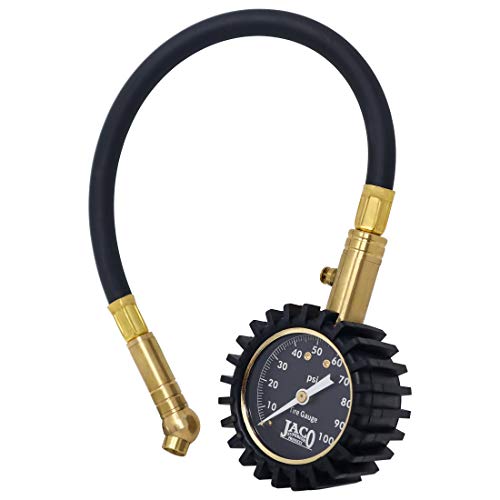
| Heavy-Duty Accuracy | Measurement range: 0–100 PSI (100 PSI scale) | Dial (face) — readout style: Large 2″ glow dial | Accuracy / Calibration: ANSI-accredited calibration ±1.5% | VIEW LATEST PRICE | Read Our Analysis |
| JACO ElitePro Tire Pressure Gauge – 60 PSI |
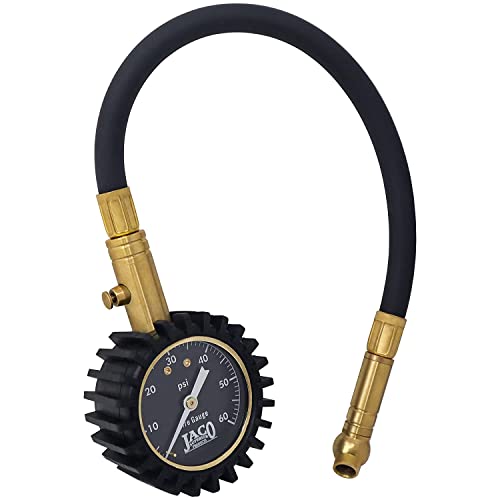
| Everyday Durability | Measurement range: 0–60 PSI (60 PSI scale) | Dial (face) — readout style: Dial gauge (glow-in-the-dark) | Accuracy / Calibration: ANSI-accredited calibration ±1.5% | VIEW LATEST PRICE | Read Our Analysis |
| Slime 20049 Tire Pressure Gauge Large Face Dial Analogue Gauge 5-60 PSI |

| Easy-Read Budget | Measurement range: 5–60 PSI | Dial (face) — readout style: Large 56 mm face analogue dial | Accuracy / Calibration: (Not specified to ANSI) general brass gauge (no numeric accuracy given) | VIEW LATEST PRICE | Read Our Analysis |
| Vondior 0-100 PSI Tire Pressure Gauge with Glow Dial |
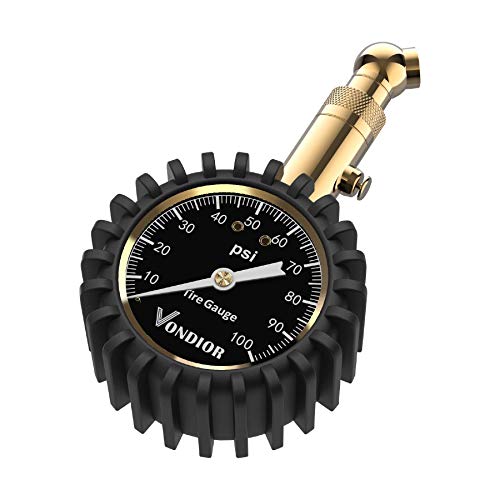
| Precision Performance | Measurement range: 0–100 PSI (0–60 PSI accuracy note) | Dial (face) — readout style: Large 2″ glow dial (analog) | Accuracy / Calibration: ANSI-certified ±1% (full-scale within 0–60 PSI) | VIEW LATEST PRICE | Read Our Analysis |
| Milton S-931 Dial Tire Gauge |

| Low-Pressure Specialist | Measurement range: 0–15 PSI (listed range 0–15 PSI) | Dial (face) — readout style: Dial-type gauge | Accuracy / Calibration: (No numeric ANSI spec provided) durable diaphragm design (implicit accuracy for low-range) | VIEW LATEST PRICE | Read Our Analysis |
| ETENWOLF Tire Pressure Gauge 0-75 PSI (Glow Dial) |

| All-Weather Reliable | Measurement range: 0–75 PSI | Dial (face) — readout style: Large glow dial | Accuracy / Calibration: ANSI B40.1 Grade A (±1% of span) | VIEW LATEST PRICE | Read Our Analysis |
| Glow-in-the-Dark Analog Tire Pressure Gauge (ANSI) |
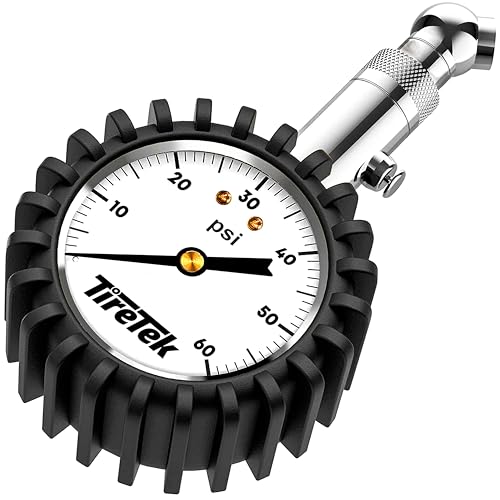
| ANSI-Certified Standard | Measurement range: (Not explicitly numeric in summary) Commonly 0–? — described as full-scale ANSI analog; (product model TT-GS06 typically covers automotive range similar to 0–60 PSI) | Dial (face) — readout style: Glow-in-the-dark analog circular dial | Accuracy / Calibration: Calibrated to ANSI B40.1 Grade A (±2%) | VIEW LATEST PRICE | Read Our Analysis |
More Details on Our Top Picks
JACO Elite Tire Pressure Gauge – 60 PSI
Should you want a simple, tough analog gauge that feels like it will last, the JACO Elite 60 PSI is built for you. You’ll appreciate the solid brass stem and swivel chuck that let you reach any valve with ease. It glows in the dark, so you won’t fumble at night, and the dial holds readings until you press the reset button. You won’t need batteries, and the built-in bleeder lets you lower pressure smoothly. Mechanics like its ANSI calibrated accuracy, and the rubber guard protects it from drops. With a lifetime warranty, you’ll feel confident using it every time.
- Measurement range:0–60 PSI (60 PSI scale)
- Dial (face) — readout style:Dial gauge (glow-in-the-dark)
- Accuracy / Calibration:ANSI-calibrated to ±1.5%
- Chuck / Valve connection:360-degree swivel chuck (Schrader)
- Pressure release / bleeder:Built-in air bleeder valve / pressure reset button
- Construction materials / protective guard:Brass components; shock-resistant rubberized guard; brass shield
- Additional Feature:Lifetime warranty
- Additional Feature:Glows in dark
- Additional Feature:360° swivel chuck
JACO ElitePro Tire Pressure Gauge – 100 PSI
Should you’re the kind of driver who wants reliable, shop-grade readings without fuss, the JACO ElitePro 100 PSI gauge is a smart choice for you. You’ll feel confident using its solid brass body and shock-resistant gear-style guard. The large 2″ glow dial shows single-increment readings that lock until you reset them, so you won’t guess. The HybridFlex leak-proof hose bends easily, and the 360-degree swivel chuck reaches tight angles. You can bleed air with the built-in valve to avoid overinflation. It’s ANSI-calibrated to ±1.5%, needs no batteries, weighs 5.6 ounces, and includes a lifetime warranty.
- Measurement range:0–100 PSI (100 PSI scale)
- Dial (face) — readout style:Large 2″ glow dial
- Accuracy / Calibration:ANSI-accredited calibration ±1.5%
- Chuck / Valve connection:360-degree swivel chuck (Schrader)
- Pressure release / bleeder:Built-in air bleeder valve
- Construction materials / protective guard:Solid brass construction; shock-resistant gear-style protective guard; HybridFlex hose
- Additional Feature:HybridFlex leak-proof hose
- Additional Feature:2″ large glow dial
- Additional Feature:Gear-style protective guard
JACO ElitePro Tire Pressure Gauge – 60 PSI
In case you want a simple, tough gauge that gives fast, reliable readings, the JACO ElitePro 60 PSI is made for drivers who value precision and durability. You’ll hold a solid brass core that feels reassuring in your hand, wrapped in a shock-resistant guard that stands up to drops. Its 60 PSI dial reads to ±1.5% accuracy and locks until you press the reset, so you won’t lose a number while checking tires. The HybridFlex hose and 360-degree swivel chuck reach any valve, and the bleeder valve prevents overinflation. It’s mechanical, glow-in-the-dark, and supported with a lifetime warranty.
- Measurement range:0–60 PSI (60 PSI scale)
- Dial (face) — readout style:Dial gauge (glow-in-the-dark)
- Accuracy / Calibration:ANSI-accredited calibration ±1.5%
- Chuck / Valve connection:360-degree swivel chuck
- Pressure release / bleeder:Built-in air bleeder valve
- Construction materials / protective guard:Solid brass core; shock-resistant gear-style protective guard; HybridFlex hose
- Additional Feature:HybridFlex leak-proof hose
- Additional Feature:Glow-in-the-dark dial
- Additional Feature:Rugged ergonomic feel
Slime 20049 Tire Pressure Gauge Large Face Dial Analogue Gauge 5-60 PSI
Should you want a simple, reliable tool for checking everyday tire pressure, the Slime 20049 Large Face Dial Gauge fits the bill and makes reading easy. You’ll like its 56 mm dial because the numbers are clear, so you won’t squint in a dim garage. It measures 5 to 60 PSI and snaps onto standard Schrader valves, so you can use it on cars, bikes, and light trucks. The brass build feels solid and the pressure release button helps you fine tune pressure quickly. It’s lightweight, smooth to hold, and backed with a voluntary 30 day return guarantee.
- Measurement range:5–60 PSI
- Dial (face) — readout style:Large 56 mm face analogue dial
- Accuracy / Calibration:(Not specified to ANSI) general brass gauge (no numeric accuracy given)
- Chuck / Valve connection:Fits standard Schrader valve stem
- Pressure release / bleeder:Pressure release button for adjustments
- Construction materials / protective guard:Brass construction
- Additional Feature:Extra-large 56 mm face
- Additional Feature:Fits Schrader valves
- Additional Feature:Compact brass construction
Vondior 0-100 PSI Tire Pressure Gauge with Glow Dial
Should you want a simple, reliable gauge that lets you check tire pressure anywhere, the Vondior 0-100 PSI with its glow dial is a great pick for drivers who value accuracy and ease of use. You’ll get ANSI certified accuracy to ±1% in the 0–60 PSI range, so readings are trustworthy. The large 2 inch glow dial is easy to read at night, and the analog design needs no batteries. The swivel valve connector and protective rubber shield make checks fast and rugged. The hold feature and release button let you deflate precisely. A 10 year warranty backs your purchase.
- Measurement range:0–100 PSI (0–60 PSI accuracy note)
- Dial (face) — readout style:Large 2″ glow dial (analog)
- Accuracy / Calibration:ANSI-certified ±1% (full-scale within 0–60 PSI)
- Chuck / Valve connection:Swiveling valve connector (rotates on axis)
- Pressure release / bleeder:Built-in release button (controlled deflation)
- Construction materials / protective guard:Brass (internal) with protective rubber shield
- Additional Feature:±1% ANSI accuracy
- Additional Feature:10-year warranty
- Additional Feature:Swiveling valve connector
Milton S-931 Dial Tire Gauge
Should you want a simple, tough dial gauge you can trust for low-pressure work, the Milton S-931 is built for you. You’ll like its clear dial and durable rubber boot that protect the gauge whenever you toss it in your trunk. It uses an internal diaphragm for reliable readings and a 45-degree single-head air chuck with a deflator valve so you can adjust tire pressure easily. The 0–15 PSI range fits low-pressure tires and specialty gear. It’s light, made in the United States, and backed through manufacturer support and a 30-day return option for peace of mind.
- Measurement range:0–15 PSI (listed range 0–15 PSI)
- Dial (face) — readout style:Dial-type gauge
- Accuracy / Calibration:(No numeric ANSI spec provided) durable diaphragm design (implicit accuracy for low-range)
- Chuck / Valve connection:45-degree single-head air chuck (Schrader-style)
- Pressure release / bleeder:Deflator valve on chuck (45-degree head)
- Construction materials / protective guard:Rubber (boot) with durable internal diaphragm (rubber exterior)
- Additional Feature:45° angled chuck
- Additional Feature:Internal diaphragm design
- Additional Feature:Durable rubber boot
ETENWOLF Tire Pressure Gauge 0-75 PSI (Glow Dial)
Should you want a simple, tough gauge that reads clearly at night, the ETENWOLF Tire Pressure Gauge 0–75 PSI is a great pick for drivers who value accuracy and ease of use. You’ll like the large glow dial that lets you check pressure in dim light without fumbling. It measures 0 to 75 PSI and meets ANSI B40.1 Grade A calibration, so you can trust readings in cold or hot weather. The 360° swivel Schrader chuck helps you reach awkward valves. Built from brass and rubber, it feels sturdy in your hand and fits cars, trucks, bikes, RVs and ATVs.
- Measurement range:0–75 PSI
- Dial (face) — readout style:Large glow dial
- Accuracy / Calibration:ANSI B40.1 Grade A (±1% of span)
- Chuck / Valve connection:360° swivel Schrader chuck
- Pressure release / bleeder:(Summary lists 360° chuck; bleeder implied by standard design but not explicitly stated)
- Construction materials / protective guard:Brass and rubber heavy-duty construction
- Additional Feature:ANSI Grade A calibration
- Additional Feature:Maintains accuracy extremes
- Additional Feature:Multi-vehicle compatibility
Glow-in-the-Dark Analog Tire Pressure Gauge (ANSI)
Should you want a simple, dependable gauge that works any time of day, the glow-in-the-dark analog tire pressure gauge is a great choice for drivers who value ease and accuracy. You’ll like that it needs no batteries and glows so you can check pressure at night without fumbling. It meets ANSI B40.1 Grade A accuracy so readings are trustworthy. The angled swiveling chuck and extended 5 mm tip help you seal valves and avoid leaks. Built from alloy steel, brass, and rubber, it resists drops and bad weather. Mechanics recommend it, and you can carry it anywhere for quick, precise checks.
- Measurement range:(Not explicitly numeric in summary) Commonly 0–? — described as full-scale ANSI analog; (product model TT-GS06 typically covers automotive range similar to 0–60 PSI)
- Dial (face) — readout style:Glow-in-the-dark analog circular dial
- Accuracy / Calibration:Calibrated to ANSI B40.1 Grade A (±2%)
- Chuck / Valve connection:45-degree angled, fully swivelling chuck
- Pressure release / bleeder:Built-in relief (bleed) valve
- Construction materials / protective guard:Alloy steel and brass internal components with rubber surround
- Additional Feature:Extended 5 mm chuck tip
- Additional Feature:Steel/brass internal parts
- Additional Feature:45° fully swivelling chuck
Factors to Consider When Choosing Analog Tire Pressure Gauges
Whenever you pick an analog tire pressure gauge, consider initially about accuracy and calibration so you can trust every reading. Also check the pressure range and dial size for the tires you use, and inspect the chuck, hose design, and build material so the tool feels sturdy and fits your routine. I’ll walk you through how each feature affects performance and ease of use so you can choose with confidence.
Accuracy And Calibration
Even in case you don’t consider about calibration often, choosing an analog tire pressure gauge with proper accuracy will save you time, money, and worry down the road. Pick a gauge certified to an ANSI or equivalent standard so the maker backs the accuracy, often within ±1–2% of full scale. Match the gauge’s full scale to the pressures you use most because accuracy is a percent of that span and is better near the dial midrange. Check whether calibration was done at an accredited facility and notice the stated tolerance. Prefer mechanical gauges with a locking dial or hold feature and a large, clear face so you can read small changes consistently. Plan periodic checks or annual recalibration to keep readings reliable over time.
Pressure Range Selection
Picking the right pressure range starts with what you actually drive and how you use your tires, and it builds on the accuracy and calibration points you just read about. Consider your vehicle initially. Most passenger cars need gauges that read to 60 to 75 PSI, while heavy trucks or performance cars could need 100 PSI or more. Next, match the scale to your normal pressure. Choose 1 PSI increments for daily car tires so you can spot small changes. Don’t buy a gauge with a full-scale far above your needs because wider ranges cut accuracy where you drive. Should you care for bikes, ATVs, trailers, or multiple vehicles, pick a gauge that covers the highest required PSI or carry separate low-range and high-range gauges for better precision.
Dial Size Visibility
Because a clear dial helps you trust each reading, dial size and visibility should be high on your list while choosing an analog tire pressure gauge. You want a larger dial, around 2 inches, because bigger numerals and finer tick marks cut down on squinting and guessing. High contrast markings, dark on light or light on dark, make numbers pop in bright sun and on cloudy days. Glow in the dark faces help you check tires at night without fumbling for a light. A bigger face also spreads increments farther apart so you can see 1 PSI changes more easily on common 0 to 60 or 0 to 100 scales. Check how the dial sits and whether it tilts toward your normal standing view to reduce parallax error.
Build Material Quality
Whenever you want a gauge that lasts and gives steady readings, the materials inside and out matter a lot. You’ll prefer brass internals and a brass stem because they resist corrosion far better than zinc or plastic, so they keep working through wet weather and road salt. Pair that with a steel or alloy housing and you get strength and dimensional stability, which helps accuracy whenever you use the gauge a lot. A rubber or thermoplastic boot soaks up shocks from drops and helps preserve calibration and moving parts. Look for precision machined brass or stainless fittings that seal tightly on Schrader valves to avoid leaks. In case the hose is nylon or braided reinforced, it won’t kink or crack and readings stay consistent.
Chuck And Hose Design
Start via checking the chuck and hose, because they’re the parts that actually touch the valve and decide how cleanly you get a reading. You’ll want a 360-degree swivel chuck so you can reach Schrader valves at any angle without twisting your wrist or breaking the seal. Also look for a slightly extended tip, about 4–5 mm, to seat well on recessed or worn stems and cut down air loss while you read pressure. A flexible, leak-proof hose keeps readings steady whenever the valve is awkward and shields the dial from knocks. Choose brass or steel chucks with a secure threaded or snug push-on fit to limit wear and keep results repeatable. Built-in bleed controls let you drop pressure precisely without breaking the connection.
Ease Of Use
You’ll want a gauge that feels simple to use so checking tire pressure becomes quick and stress free. Pick a gauge with a large, high-contrast dial about 2 inches across and clear single-PSI marks so you read numbers fast without guessing. In low light, a glow-in-the-dark or backlit face keeps you from fumbling and saves time. A swiveling chuck or 360° connector plus a flexible hose makes it easy to reach awkward valve stems and reduces wrist strain. Look for a pressure-locking dial that holds the reading until you press to release so the needle doesn’t jump while you look. Built-in bleeder valves let you let out small amounts of air right there, so you can fine tune pressure without extra tools.
Durability And Protection
Consider the gauge as a tool you rely on every day, not a throwaway gadget, and pick one built to take knocks and keep accurate readings. You want metal internals like brass or steel and a reinforced stem so the core resists bending and corrosion. A rubber boot or shock-absorbing guard will protect the dial and housing from drops and impacts, so you don’t dread a simple slip. Sealed or gasketed housings stop moisture and dust from ruining sensitive parts, and that keeps readings honest over time. Also choose a sturdy, flexible hose or a swiveling chuck to cut stress where the hose meets the gauge. Check the maker’s stated durability features to feel confident in your choice.
Warranty And Support
As you’re choosing an analog tire pressure gauge, check the warranty and support right away so you won’t be stuck with a dud or an expensive repair later. You want a clear warranty length and scope, like limited-time or lifetime, so you know how long defects are covered. Also verify whether calibration drift and internal repairs are included, not just cosmetic issues. Ask what support channels exist, such as phone, email, or online guides, and how fast they respond to warranty claims. Read exclusions and what proof you must keep, like receipts, serial numbers, or calibration records, so you stay eligible. Finally, see whether the maker offers recalibration, parts, or repairs after purchase and whether those services cost extra.
