

Time delay relays control the timing of electrical circuits with precision, reliability, and easy setup.
This list highlights five relays that blend rugged build quality with fine timing adjustments and broad voltage compatibility.
Each selection suits control panels, industrial machines, or DIY automation, focusing on long-term performance and safety.
Read on for quick guidance to match a relay to your project’s voltage, timing range, and mounting preferences.
| Multifunction Time Relay GRT6 M1 (24-240V) |

| Best All-Rounder | Mounting: 35 mm DIN-rail | Supply Voltage Range: AC/DC 24–240 V (wide) | Timing Range: 0.1 s to 10 days | VIEW LATEST PRICE | Read Our Analysis |
| DROK Digital Time Delay Relay Module (DC 6-30V) |

| Best for Hobbyists | Mounting: Module (panel/PCB/module style) — not DIN-rail (module form) | Supply Voltage Range: DC 6–30 V (also AC 220 V version available) | Timing Range: 0.01 s to 9,999 minutes (~0.01 s to ~6.94 days) | VIEW LATEST PRICE | Read Our Analysis |
| Baomain TBT7-C1 DIN-Rail Time Relay (1-SPDT) |

| Professional Grade | Mounting: DIN-rail | Supply Voltage Range: AC/DC 12–240 V (model-dependent; TBT7-C1 series) | Timing Range: 0.1 s to 10 days | VIEW LATEST PRICE | Read Our Analysis |
| DROK Adjustable Time Delay Relay with LCD Display |
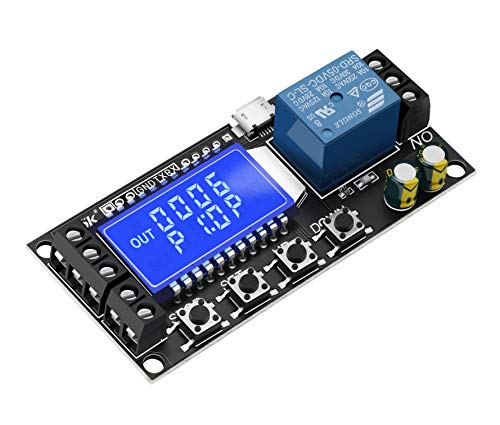
| Most Feature-Rich | Mounting: Module (panel/module, micro USB) — not DIN-rail | Supply Voltage Range: DC 6–30 V (micro USB 5 V supported) | Timing Range: 0.01 s to 9,999 minutes (~0.01 s to ~6.94 days) | VIEW LATEST PRICE | Read Our Analysis |
| Delay-On Timer Relay GRT8 16A DIN Rail |

| Best High-Current Option | Mounting: 35 mm DIN-rail | Supply Voltage Range: AC/DC 12–240 V (wide) | Timing Range: 0.1 s to 10 days | VIEW LATEST PRICE | Read Our Analysis |
More Details on Our Top Picks
Multifunction Time Relay GRT6 M1 (24-240V)
Should you need a compact, dependable timer that can handle many jobs on a factory floor or in a workshop, the Multifunction Time Relay GRT6-M1 is built for you. You’ll appreciate its wide 24 to 240 V input so it fits most panels. It gives 1 SPDT output at 10 A and time ranges from 0.1 second to 10 days, so you can schedule short pulses or long delays. You’ll pick from many functions like delay on, delay off, cyclic and latching via selector and controls. LEDs show power and timing status. It mounts on a 35 mm DIN rail for quick setup.
- Mounting:35 mm DIN-rail
- Supply Voltage Range:AC/DC 24–240 V (wide)
- Timing Range:0.1 s to 10 days
- Output Type / Contact:1 SPDT (1 NO + 1 NC)
- User Interface / Controls:Function selector + time range knob + percentage fine adjustment; LEDs
- Parameter Memory / Power-off Behavior:Preset functions retained (manual/configurable); standard industrial relay (no explicit auto-save noted)
- Additional Feature:Latching relay function
- Additional Feature:Compact ABS housing
- Additional Feature:Green/red LED indicators
DROK Digital Time Delay Relay Module (DC 6-30V)
Should you need a simple, reliable digital timer that works with a wide range of DC systems, the DROK Digital Time Delay Relay Module is a smart choice for hobbyists and small-scale technicians who want precise control without fuss. You’ll like its wide DC range from 6 to 30 V, so it fits 12 V and 24 V systems. You can set timing from 0.01 seconds to 9,999 minutes and choose high or low trigger, button, or switching-value control. The LCD and switch buttons make adjustments easy. It saves settings on power loss, supports UART, and has reverse-connection protection.
- Mounting:Module (panel/PCB/module style) — not DIN-rail (module form)
- Supply Voltage Range:DC 6–30 V (also AC 220 V version available)
- Timing Range:0.01 s to 9,999 minutes (~0.01 s to ~6.94 days)
- Output Type / Contact:Relay module output (50 mA solid-state/logic-level output)
- User Interface / Controls:LCD display + buttons; parameter save; UART for setting
- Parameter Memory / Power-off Behavior:Parameters auto-saved on power loss (independent OP/CL/LOP stored)
- Additional Feature:UART parameter interface
- Additional Feature:0.01s–9,999min range
- Additional Feature:Input reverse protection
Baomain TBT7-C1 DIN-Rail Time Relay (1-SPDT)
Should you need a compact, reliable timer that fits neatly on a DIN rail and handles common control tasks, the Baomain TBT7-C1 is a strong choice for electricians, hobbyists, and small automation projects. You’ll like its wide 0.1 second to 10 day range, letting you set short pulses or long delays with ease. It runs on 12–240 V AC/DC, so you won’t worry about matching supplies. The single SPDT contact handles 16 A at up to 240 V, and copper contacts give decent durability. It mounts via DIN rail, uses screw connectors, and includes a manual for quick setup.
- Mounting:DIN-rail
- Supply Voltage Range:AC/DC 12–240 V (model-dependent; TBT7-C1 series)
- Timing Range:0.1 s to 10 days
- Output Type / Contact:1 SPDT (1‑SPDT relay, rated up to 16 A)
- User Interface / Controls:Selector/configuration via knobs/buttons (DIN-rail relay) + instruction manual; LEDs implied
- Parameter Memory / Power-off Behavior:Configuration retained per model (typical for DIN-rail relays; instruction/manual included)
- Additional Feature:16 A contact rating
- Additional Feature:Screw terminal connectors
- Additional Feature:94×18×64 mm compact size
DROK Adjustable Time Delay Relay with LCD Display
Should you need a compact, easy to set timer for DIY projects, small automation tasks, or lab experiments, the DROK adjustable time delay relay with LCD display fits the bill. You’ll like its wide DC 6–30V range and Micro USB 5V option. It accepts high or low triggers and guards against reverse input. The timing span runs from 0.01 seconds to 9,999 minutes, and you can pause with one button. The LCD and buttons make local setup simple, while UART lets you upload data and change settings remotely. It auto-saves parameters, sleeps to save power, and supports cycle timing.
- Mounting:Module (panel/module, micro USB) — not DIN-rail
- Supply Voltage Range:DC 6–30 V (micro USB 5 V supported)
- Timing Range:0.01 s to 9,999 minutes (~0.01 s to ~6.94 days)
- Output Type / Contact:Relay module output (time-delay relay output; module form)
- User Interface / Controls:LCD display + buttons; micro USB + UART; sleep/wake buttons
- Parameter Memory / Power-off Behavior:Parameters auto-saved on power-off (and sleep mode/backlight behavior)
- Additional Feature:Micro USB 5V input
- Additional Feature:LCD with sleep/backlight
- Additional Feature:Wake-on-button functionality
Delay-On Timer Relay GRT8 16A DIN Rail
Should you need a dependable, easy-to-install delay-on timer for industrial panels or smart lighting setups, the GRT8-A Delay ON relay is a great choice for electricians, maintenance techs, and DIYers who want precise timing without fuss. You’ll like its wide 12V to 240V AC/DC range, 16A rated contact, and compact DIN rail body that fits tight panels. You can set delays from 0.1 seconds to 10 days with two knobs and read status from intuitive green and red LEDs. It meets UL CE CB RoHS standards, comes with a three year warranty, and includes support and return options.
- Mounting:35 mm DIN-rail
- Supply Voltage Range:AC/DC 12–240 V (wide)
- Timing Range:0.1 s to 10 days
- Output Type / Contact:1 SPDT (1 NO + 1 NC)
- User Interface / Controls:Function selector + time range knob + percentage fine adjustment; LEDs
- Parameter Memory / Power-off Behavior:Preset functions retained (manual/configurable; typical industrial relay behavior)
- Additional Feature:16 A rated current
- Additional Feature:Asymmetric cycle option
- Additional Feature:UL/CE/CB/RoHS compliant
Factors to Consider When Choosing Time Delay Relays
Once you pick a time delay relay, start checking voltage and compatibility so it will work with your system without surprises. Consider the timing range and output current rating next, since those determine whether the relay can handle your sequence and load. Also consider mounting and size plus trigger and control modes to make sure installation is simple and the control behavior matches your needs.
Voltage And Compatibility
Choosing the right time delay relay starts with matching its voltage and compatibility to your system, because a correct match keeps your equipment safe and working smoothly. You should confirm the relay’s supply voltage range so it can be powered without converters. Also check whether it accepts AC and DC or is DC only, since that decides where you can use it. Verify control and trigger voltages and whether your controller’s signals will be tolerated. Make sure output contact ratings and maximum switching voltage suit your loads and rails. Look for protection features like wide working ranges, reverse connection protection, and UL CE ROHS approvals for safety and reliability. These checks work together to prevent surprises and keep things running.
Timing Range Needed
How long do you really need a relay to wait before it acts, and what happens provided that time is slightly off? You want a timing range that covers the shortest pulse and the longest delay your project could require. Match minimum and maximum limits so you don’t undersize or overbuy. Look for both wide coarse ranges and fine adjustment so you can pick broad capability then dial precise intervals. Consider long-term drift and cumulative accuracy for hours or days, and choose stable timing or external correction when you need tight accuracy. Should you need several intervals, pick relays with saved presets and independent settings. Also check how triggers behave during timing, such as restart, one-shot, latch, or pause, since that affects real operation.
Output Current Rating
Pick a relay that clearly handles the full current your device will draw and then some, because undersizing leads to heat, welded contacts, and premature failure. You want a relay with a continuous output current rating at or above your load’s steady and surge currents, including motor stall or inrush. Also check both the rated switching current and the maximum make and break current, since steady ratings can hide weaker transient capability. Look at contact type and material and their rated current at your operating voltage, because wear and voltage drop grow with higher currents. Give yourself a 20 to 30 percent safety margin to cover unexpected surges and lengthen contact life. Finally, confirm thermal and enclosure limits so the relay can carry its rated current in your environment.
Mounting And Size
At the moment you plan where a time delay relay will live, consider about both the space it takes and how you’ll work with it later. Check mounting type like DIN-rail, panel, PCB, or socket so it fits your enclosure and accessories. Observe the relay footprint and height because compact DIN-rail modules can be under 3 in long and less than 1 in thick while panel or PCB relays could need more clearance. Also verify terminal style and spacing so your wiring and tools reach screw, plug-in, or solder pins safely. Consider ventilation and clearance for heat dissipation whenever cabinets are dense or whenever relays sit side by side. Finally pick standard 35 mm DIN-rail or plug-in sockets to make replacement and service easy.
Trigger And Control Modes
Upon your selection of a time delay relay, the manner it’s triggered shapes everything that follows, from wiring to reliability and user interaction. You should check which trigger modes a relay offers: power-on, high or low electronic levels, manual pushbutton, and contact or switching-value triggers. Verify control input type and voltage range so your control circuit matches, whether low-voltage DC logic or mains AC. Consider latching or memory triggers whenever you want a toggle that stays until reset. Advanced modules let you pick edge, level, or manual triggers and save separate parameter sets so each trigger recalls a different timing behavior. Finally, confirm response needs like minimum pulse width, debounce, and wake latency to avoid false cycles from noisy sensors.
Protection And Certifications
At the time you’re choosing a time delay relay, consider about protection and certifications as the safeguards that keep your system running and people safe. You’ll want to check safety marks like UL, CE, CB, and RoHS so the relay meets regional wiring and hazardous material limits. Also look at ingress and housing ratings such as IP20 or IP40 and the housing material to confirm dust, moisture, and impact protection for your site. Next verify contact ratings, peak switching capacities, and breaking capacity markings to avoid overheating or welded contacts. Built in protections like reverse polarity, surge suppression, and short circuit tolerance enhance reliability during transients. Finally confirm operating temperature range and derating curves are certified so performance holds across conditions.
