

The best engine oil additives for 2026 help cut smoke, reduce wear, lower friction, handle heat, and protect hard-working engines. I picked five strong options that match common engine problems without making things complicated.
This guide covers where each additive works best, along with a few quick notes on viscosity and formula type. By the end, you’ll have a clear idea of which bottle belongs in your crankcase.
| Liqui Moly Oil Smoke Stop (2122) |

| Best for Smoke | Product Type: Oil smoke stop additive | Engine Compatibility: Petrol and diesel engines | Primary Benefit: Reduces blue smoke | VIEW LATEST PRICE | Read Our Analysis |
| REV-X Zinc ZDDP Oil Additive – 2 fl. oz. |

| Best Break-In Additive | Product Type: ZDDP oil additive | Engine Compatibility: Various automotive engines | Primary Benefit: Anti-wear protection | VIEW LATEST PRICE | Read Our Analysis |
| Slick 50 Original Engine Treatment | 32 oz. Single |
| Best Friction Fighter | Product Type: Engine treatment | Engine Compatibility: Gasoline engines | Primary Benefit: Reduces friction/wear | VIEW LATEST PRICE | Read Our Analysis |
| Liqui Moly 2009 Anti-Friction Oil Treatment -pk6 |

| Best for Heavy Loads | Product Type: Anti-friction oil treatment | Engine Compatibility: High-load engines | Primary Benefit: Reduces wear | VIEW LATEST PRICE | Read Our Analysis |
| Liqui Moly 4T 10w-40 Street 4-Liter |

| Best Oil Upgrade | Product Type: Fully synthetic motor oil | Engine Compatibility: 4-stroke engines | Primary Benefit: Optimum lubrication | VIEW LATEST PRICE | Read Our Analysis |
More Details on Our Top Picks
Liqui Moly Oil Smoke Stop (2122)
For smoke control, Liqui Moly Oil Smoke Stop (2122) suits high-mileage engines that burn oil and puff blue exhaust. You add this 300 ml formula to petrol or diesel engines whenever wear lets oil sneak past internal clearances and burn.
It helps through:
- reducing blue exhaust smoke
- lowering oil consumption
- sealing worn gaps under load
And its very high viscosity matters, because the thicker additive supports sealing as heat rises and parts loosen up.
Use it provided your engine:
- burns oil
- smokes blue
- runs hot or works hard
It’s compatible with all common engine oils, so fitment headaches stay off your weekend list.
- Product Type:Oil smoke stop additive
- Engine Compatibility:Petrol and diesel engines
- Primary Benefit:Reduces blue smoke
- Oil Compatibility:Compatible with all common oils
- Usage Scenario:Worn engines/high heat
- Container Size:300 ml
- Additional Feature:Reduces blue exhaust smoke
- Additional Feature:Seals wear-related gaps
- Additional Feature:Very high viscosity
REV-X Zinc ZDDP Oil Additive – 2 fl. oz.
REV-X slips in as a top break-in additive for flat tappet engines and fresh valvetrain builds. Should you’re protecting a new camshaft and lifters, this 2 fl. oz. bottle delivers concentrated ZDDP, the anti-wear chemistry that forms a protective layer at friction points and helps stop metal-to-metal contact before expensive noises become expensive repairs.
Use it like this:
- Mix 2 ounces with 6 quarts of oil.
- You’ll reach roughly 3000 to 3200 ppm ZDDP.
- Pair it with synthetic or conventional oil.
It’s a universal-fit liquid additive, part number ZINC0201, and yes, tiny bottle, big job.
- Product Type:ZDDP oil additive
- Engine Compatibility:Various automotive engines
- Primary Benefit:Anti-wear protection
- Oil Compatibility:Synthetic and mineral oils
- Usage Scenario:Break-in and flat tappet
- Container Size:2 fl. oz.
- Additional Feature:ZDDP anti-wear chemistry
- Additional Feature:Flat tappet essential
- Additional Feature:Break-in cam protection
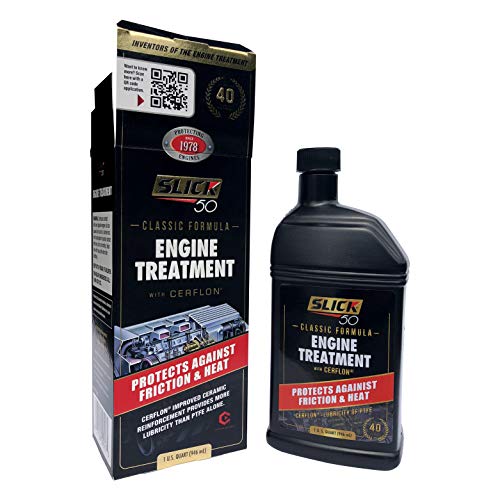
Slick 50 Original Engine Treatment | 32 oz. Single
Slick 50 stands out as a friction fighter for drivers who want extra wear protection in gasoline engines. You get a 32 oz treatment built around Cerflon® PTFE, which adds Boron Nitride for better lubricity, durability, and resistance to breakdown.
Use it with any oil type:
- conventional
- semi-synthetic
- full synthetic
- blends
- mineral-based
It helps reduce friction, heat, drag, and sludge while supporting smoother operation and engine efficiency.
For use:
- Shake well.
- Replace 1 quart in engines holding 5 quarts or less.
- In larger engines, replace 20% of oil volume.
Use it yearly or at every oil change. Simple, not mysterious!
- Product Type:Engine treatment
- Engine Compatibility:Gasoline engines
- Primary Benefit:Reduces friction/wear
- Oil Compatibility:All oil types
- Usage Scenario:Yearly or oil change
- Container Size:32 oz.
- Additional Feature:Cerflon® PTFE technology
- Additional Feature:Boron Nitride reinforced
- Additional Feature:Helps prevent sludge
Liqui Moly 2009 Anti-Friction Oil Treatment -pk6
Liqui Moly 2009 shines whenever your engine works under heavy loads, especially during towing or full-throttle runs. Should you ask a lot from your vehicle, this anti-friction oil treatment, sold in a convenient pk6, helps your engine cope without acting dramatic.
You’ll notice benefits like:
- substantially reduced wear
- less heat generation
- smoother running
- lower fuel consumption
And that matters whenever you’re hauling, climbing, or keeping your foot planted.
It also helps extend engine life while supporting the life of your engine oil and other oil treatments. In short, provided your driving is demanding, this formula is optimized for exactly that job.
- Product Type:Anti-friction oil treatment
- Engine Compatibility:High-load engines
- Primary Benefit:Reduces wear
- Oil Compatibility:Use with engine oil
- Usage Scenario:Towing/high-load driving
- Container Size:Pack of 6
- Additional Feature:Reduces heat generation
- Additional Feature:Smoother engine running
- Additional Feature:Supports extended towing
Liqui Moly 4T 10w-40 Street 4-Liter
For riders wanting the smartest oil upgrade, this 10W-40 synthetic formula fits daily commuting and hard weekend miles alike. You get a fully synthetic, high-performance oil designed for air- and water-cooled 4-stroke engines, even under extreme heat.
Why it stands out:
- Smooth wet-clutch operation
- Clean shifting and strong friction behavior
- Excellent engine cleanliness
- Minimal wear, with a 230 °C flash point
You’re getting 4 liters, or 4000 milliliters, in a sturdy jug, enough for many motorcycles needing a full change. And because it’s a medium-to-high viscosity SAE J300 10W-40, you’ll keep lubrication consistent without turning your gearbox into a coffee grinder.
- Product Type:Fully synthetic motor oil
- Engine Compatibility:4-stroke engines
- Primary Benefit:Optimum lubrication
- Oil Compatibility:Fully synthetic oil
- Usage Scenario:Normal to extreme conditions
- Container Size:4 liters
- Additional Feature:Wet clutch compatible
- Additional Feature:Smooth gear shifting
- Additional Feature:Excellent engine cleanliness
Factors to Consider When Choosing an Engine Oil Additive
Whenever I choose an engine oil additive, I start with a short checklist so you don’t end up pouring the wrong chemistry into the right engine. I look at 1) engine type compatibility, 2) the additive’s purpose, whether that’s cleaning, friction reduction, or wear control, and 3) wear protection level and oil compatibility, because even a good formula has to match the base oil already in your crankcase. And I also factor in operating conditions, like hot weather, stop-and-go traffic, heavy loads, or high RPM use, since your engine doesn’t care about marketing claims, it cares about the conditions you put it through.
Engine Type Compatibility
Because engine oil additives aren’t universal, I always start matching the product to the exact engine and oil setup in front of me: petrol and diesel engines have different combustion-derived products and lubrication demands, 4 stroke motorcycle engines often add wet clutch and gearbox concerns to the mix, and even the base oil matters, whether you run conventional, semi synthetic, or full synthetic, since some additive chemistries don’t play nicely with certain base stocks or synthetic dispersants.
I check four things:
- Engine label compatibility.
- Wet clutch safe wording, provided applicable.
- Flat tappet or high pressure valve train suitability, often meaning adequate ZDDP anti-wear chemistry.
- OEM guidance and warranty limits.
And yes, I read the fine print. Modern engines can be picky, like toddlers with expensive tastes, about aftermarket chemistry.
Additive Purpose
Start with the job you need the additive to do, not the flashiest label on the bottle, since engine oil additives are built for specific problems: some improve anti-wear protection with chemistry like ZDDP for flat-tappet cams or break-in, some aim to cut oil consumption and visible blue smoke through helping worn rings and valve seals, some use friction modifiers to reduce drag and improve efficiency, and others focus on restoring sealing or film strength for hard-working, high-mileage engines.
I match purpose to need:
- Break-in or flat-tappet valvetrains: targeted anti-wear chemistry.
- Blue smoke or consumption: sealing and smoke-control formulas.
- Efficiency goals: friction modifiers.
I also check oil compatibility, catalyst-sensitive systems, and operating stress. Towing, heat, and full-throttle use can justify stronger film strength claims. Quantifiable targets matter!
Wear Protection Level
Prioritize wear protection level through looking past the marketing shine and into the additive’s actual anti-wear chemistry, since I want to know what’s forming the sacrificial film at high-contact points like cam lobes, lifters, and bearings, and that usually means checking for ZDDP or similar phosphorus-zinc compounds, the stated ppm of those protective elements, and any quantified wear data such as 4-Ball Wear reductions or wear scar diameter in mm.
I also check:
- Dose rate, because oz per quart or mixed ppm tells me whether the formula delivers enough anti-wear material.
- Intended use. Break-in additives often hit harder, while maintenance formulas sustain protection longer.
- Shear and heat stability, so the film stays intact under load.
Too little protection is risky. Too much can upset detergency or emissions hardware. Balance matters.
Oil Compatibility
While wear chemistry matters a lot, I also make sure an additive actually plays nicely with the oil already in my crankcase, since even a strong anti-wear package can create problems provided it clashes with the base oil, shifts the SAE viscosity grade, or fights the detergent, dispersant, and seal-conditioning chemistry already in the formula.
I check five things:
- Base oil match: conventional, semi-synthetic, or full synthetic.
- Viscosity stability: it shouldn’t thicken or thin the oil.
- Additive harmony: detergents, dispersants, and seal conditioners must coexist.
- Emissions safety: low phosphorus and no metallic junk that can hurt catalysts or filters.
- Dose and miscibility: follow mL-per-quart directions so it stays blended, not sludge.
And yes, seals matter. Some swellers puff them up like overfed balloons, which nobody wants.
Operating Conditions
Compatibility tells me whether an additive can live with the oil, but operating conditions tell me whether it can survive the job I’m asking it to do. I match the additive to heat, load, and engine wear, because those stresses decide what protection matters most.
- High-mileage or worn engines under heat and load benefit from additives that improve sealing and cut oil burn, which helps curb blue smoke and consumption.
- Towing, full-throttle driving, and heavy hauling call for friction and wear reducers to limit heat and extend component life.
- Hot-running engines need formulas that hold anti-wear protection together under thermal stress.
- During break-in, or with flat-tappet camshafts, I want higher ZDDP to protect cam lobes and lifters.
- Wet clutches demand additive chemistry that won’t upset engagement. No one wants surprise slippage.
Viscosity Impact
Because an additive can change how thick or thin my oil acts, I always check viscosity impact before I pour anything in. A thicker blend can enhance film strength as heat climbs, but should it push oil past my engine’s SAE grade, cold starts can get sluggish fast.
I watch a few things:
- Target kinematic viscosity at 100°C, measured in cSt.
- Whether the final mix still fits specs like 5W-30 or 10W-40.
- Base oil compatibility, since synthetic and conventional formulas don’t always play nicely.
And I recall that many viscosity improvers are polymeric, which means shear can wear down their effect over time. Thicker oil might cut consumption and blue smoke, nice bonus, but too much thickness adds drag, hurts fuel economy, and can upset lifters or cams.
Treatment Dosage
After I’ve checked how an additive will affect viscosity, I move straight to dosage, since the right amount determines whether I get the benefit on the label or a sump full of unintended side effects.
I always follow the bottle’s ratio, like 2 fl oz per 6 quarts, then scale it to my engine’s exact oil capacity. Guessing per vehicle class is how people end up making soup.
My checklist:
- Measure total oil volume accurately.
- Match the manufacturer’s per-quart or per-liter dose.
- Never exceed the maximum dose.
Too much additive can thicken oil, upset the additive package, and trigger chemical interactions that hurt performance. For maintenance treatments, I dose at every oil change, or the stated annual interval. And for break-in or high-ZDDP needs, I target the recommended ppm carefully.
Frequently Asked Questions
Can Engine Oil Additives Void a Vehicle’s Manufacturer Warranty?
Yes, they can provided I use an additive that causes damage or conflicts with the manufacturer’s specifications. I’d check the warranty terms, oil requirements, and approvals initially, because the company must link the additive to failure.
How Often Should Engine Oil Additives Be Used Between Oil Changes?
I use engine oil additives only as directed, usually once per oil change or only if problems appear. I don’t add them routinely between changes unless your manual or the product label specifically says it’s safe.
Are Engine Oil Additives Safe for Hybrid or Electric Vehicles?
Like a town crier, I’d say: hybrids sometimes can use engine oil additives, but only provided your manual allows them; I wouldn’t use any in electric vehicles, because they don’t have conventional engines needing engine oil.
Can Different Engine Oil Additives Be Mixed Together Safely?
Usually, I wouldn’t mix different engine oil additives unless the manufacturer explicitly says it’s safe. I risk chemical incompatibility, reduced performance, or engine harm. I’d check your owner’s manual and product labels before combining anything.
Do Engine Oil Additives Affect Fuel Economy or Emissions Testing?
Yes—they can, and the result can surprise you: I see some additives reduce friction and slightly improve mileage, while others raise ash or alter catalysts, risking emissions failures. I’d check your manual before using anything.
