

The best spark plugs for lawn mowers in 2026 are the ones that match your engine exactly and fire reliably every time. A good plug helps your mower start easier, run smoother, and keep blade speed steady for cleaner cuts. The wrong one can cause rough starts, weak performance, and extra fuel use.
Here are the top picks and what to check before buying.
| Honda 2 Pack Genuine 98079-56846 Spark Plug Fits NGK BPR6ES OEM |
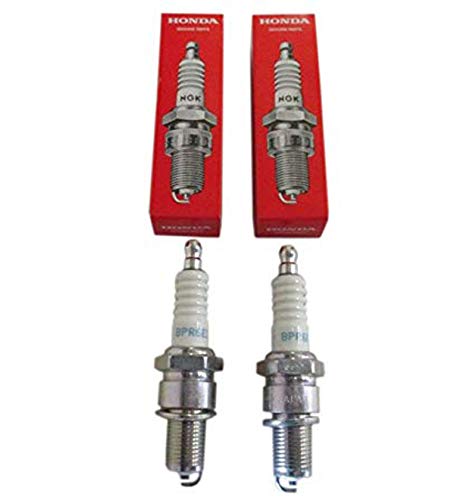
| OEM Replacement Pick | Part Type: Spark plugs | Engine Use: Small engines | Quantity: 2-pack | VIEW LATEST PRICE | Read Our Analysis |
| F6RTC BPR6ES Spark Plug 2-Pack |

| Best Value | Part Type: Spark plugs | Engine Use: Small engines | Quantity: 2-pack | VIEW LATEST PRICE | Read Our Analysis |
| MAXPOWER 334058 Spark Plug for Riding Mowers |

| Bulk Buy Pick | Part Type: Spark plug | Engine Use: Riding mowers | Quantity: 10-count | VIEW LATEST PRICE | Read Our Analysis |
| Powtol RJ19LM Spark Plug (2-Pack) |

| Briggs-Compatible Pick | Part Type: Spark plugs | Engine Use: Small engines | Quantity: 2-pack | VIEW LATEST PRICE | Read Our Analysis |
| Air Filter Kit for B&S Engines (2-Pack) |

| Best Tune-Up Kit | Part Type: Air filter kit with spark plugs | Engine Use: Lawn mower small engines | Quantity: 2 spark plugs included | VIEW LATEST PRICE | Read Our Analysis |
More Details on Our Top Picks
Honda 2 Pack Genuine 98079-56846 Spark Plug Fits NGK BPR6ES OEM
Should you want an OEM replacement pick, this Honda 2-pack is a smart fit for many small engines. You get two brand-new genuine Honda spark plugs, part number 98079-56846, cross-referenced to NGK BPR6ES, so matching specs is pleasantly painless.
It fits popular Honda engines used on mowers, generators, and pressure washers, including:
- GC135, GC160, GCV160, GC190
- GX120, GX160, GX200, GX240
- GX270, GX340, GX390, GXV160
If your mower calls for this plug, you’ll like the easy swap and OEM reliability. And yes, having a spare plug nearby can save a Saturday, because grass rarely waits patiently for maintenance.
- Part Type:Spark plugs
- Engine Use:Small engines
- Quantity:2-pack
- Replacement Fit:Honda 98079-56846 / NGK BPR6ES
- Fitment Guidance:Specific Honda engine list
- Brand:Honda
- Additional Feature:Genuine Honda OEM
- Additional Feature:NGK BPR6ES reference
- Additional Feature:Brand new condition
F6RTC BPR6ES Spark Plug 2-Pack
For budget-friendly upkeep, the F6RTC BPR6ES 2-pack fits you well in case you want two direct replacement plugs in one purchase. You get two plugs for mower or generator maintenance, which saves time and prevents the classic “one spare short” problem.
It cross-references neatly:
- Torch F6RTC, F6TC
- NGK BPR6ES, BP6ES
- Honda 98079-56846, 98079-56811
- Campion RN9YC, N9YC, RN9YCC
- Stens 131-039
You can use it with compatible MTD, Cub Cadet, and Troy-Bilt equipment. But verify your engine model and part number initially, because small engines love making simple jobs oddly specific. That check keeps substitution straightforward and avoids fit headaches later.
- Part Type:Spark plugs
- Engine Use:Small engines
- Quantity:2-pack
- Replacement Fit:F6RTC / NGK BPR6ES / Honda 98079-56846
- Fitment Guidance:Verify model/part number
- Brand:F6RTC
- Additional Feature:Broad cross-reference coverage
- Additional Feature:Fits generators too
- Additional Feature:Straightforward substitution
MAXPOWER 334058 Spark Plug for Riding Mowers
MAXPOWER 334058 stands out as a bulk buy pick for riding mower owners who like to stay prepared. You get 10 resistor spark plugs, so you can stock the shelf and skip last-minute parts runs.
It fits many riding mowers with a universal-fit 14mm thread size and replaces:
- Champion RC12YC
- Autolite 3924
- NGK BKR5E
You’ll also like the alloy steel construction, light 1.6-ounce listed weight, and defect warranty. In the event your mower manual calls for one of those cross-reference numbers, installation stays simple. And with a 10-count pack, you’re set for routine maintenance, because grass never waits politely.
- Part Type:Spark plug
- Engine Use:Riding mowers
- Quantity:10-count
- Replacement Fit:Champion RC12YC / Autolite 3924 / NGK BKR5E
- Fitment Guidance:Universal fit; many riding mowers
- Brand:Maxpower
- Additional Feature:Resistor spark plug
- Additional Feature:14mm thread size
- Additional Feature:Defect warranty included
Powtol RJ19LM Spark Plug (2-Pack)
Powtol’s briggs-compatible pick gives you two RJ19LM replacement plugs in one handy pack. Should your mower’s small engine calls for RJ19LM or J19LM, you’ll appreciate the straightforward fit and the extra plug waiting in the garage.
Before you order, check your engine model and part numbers. This plug matches:
- Champion RJ19LM, J19LM (868)
- Briggs & Stratton 796112, 802592, and 5095K
That cross-compatibility makes replacement simpler, but fit still matters. Confirming the exact model helps you avoid misfires, rough starts, and the classic mower tantrum nobody asked for. For full specs, you should still review the manufacturer’s product page carefully initially.
- Part Type:Spark plugs
- Engine Use:Small engines
- Quantity:2-pack
- Replacement Fit:Champion RJ19LM / Briggs 796112, 802592, 5095K
- Fitment Guidance:Verify model/part number
- Brand:Powtol
- Additional Feature:Champion RJ19LM compatible
- Additional Feature:Briggs part compatible
- Additional Feature:Replacement part design
Air Filter Kit for B&S Engines (2-Pack)
This versatile tune-up kit suits a wide range of Briggs & Stratton walk-behind mowers. You get:
- 2 air filters
- 2 pre-filters
- 2 spark plugs in two sizes
It replaces 593260, 798452, 798339, and 334404, and fits B&S 500 through 725EXI 09P000, plus select Toro Recycler 22-inch and Troy-Bilt models. The pre-filter enhances filtration, while uniform pleats trap more grit before it chews up your engine.
Installation is pleasantly quick, usually 5 to 10 minutes. You’ll like the premium rubber and filter paper construction, OEM-grade durability, and Amazon support within 24 hours. Because mowing downtime is annoying, and grass never waits.
- Part Type:Air filter kit with spark plugs
- Engine Use:Lawn mower small engines
- Quantity:2 spark plugs included
- Replacement Fit:Briggs 593260, 798452, 798339, 334404 systems
- Fitment Guidance:Verify mower model compatibility
- Brand:Not specified
- Additional Feature:Includes pre-filters
- Additional Feature:Includes two spark plugs
- Additional Feature:Improved particle trapping
Factors to Consider When Choosing Spark Plugs for Lawn Mowers
Whenever I choose a spark plug for a lawn mower, I start with the basics that matter most to you:
1. engine compatibility, 2. correct part numbers, and 3. the right heat range.
And I also look at electrode and resistor type, plus whether an OEM or aftermarket plug makes more sense, because those small details can affect starting, combustion, and long-term engine health more than you’d reckon!
Engine Compatibility
Because even a small mismatch can cause hard starts, poor sealing, or in the worst case a damaged cylinder head, I always start engine compatibility through checking the spark plug’s exact specs against the mower engine manual, not just the brand name on the box.
I focus on four fit-critical details:
- Thread size and reach. Common diameters are 10mm, 12mm, or 14mm, with reach often 12mm to 19mm.
- Heat range. Hotter plugs suit lighter-duty engines; cooler plugs fit high-compression, hard-working ones.
- Electrode gap. Many small engines call for 0.020 to 0.035 inch, or 0.5 to 0.9 mm.
- Resistor versus non-resistor design, plus features like projected tips or tapered seats.
Get one of those wrong, and combustion gets messy fast. Spark plugs are tiny, but they don’t forgive guessing!
Correct Part Numbers
Start with the part number, not the packaging hype, since the OEM code in your engine manual or stamped on the engine label is the fastest way I know to land on the right plug for thread size, reach, and heat range all at once.
If that exact plug is unavailable, I cross reference equivalent numbers carefully. I also verify these specs:
- thread diameter
- thread pitch
- reach, meaning insert length
- electrode gap
- resistor or non-resistor type
Get one of those wrong and the plug might seat incorrectly, interfere with ignition components, or even nick the combustion chamber, which is an expensive way to learn basic math. I keep the manual nearby and match every code exactly, because a compatible alternative only counts provided its dimensions and required gap line up perfectly with the engine spec.
Heat Range Match
Although part numbers get you into the right family fast, I always make sure the heat range matches the engine spec too, since heat range tells you how quickly the plug can shed combustion heat, with a hotter plug holding more heat at the tip and a colder plug moving it into the cylinder head faster.
Get this wrong, and problems pile up quickly:
- Too hot: pre-ignition, knock, excess heat.
- Too cold: fouling, weak combustion, harder starts.
Most mower engines like a mid-to-cold range because they run high RPM under steady load. I also consider:
- Heavy, continuous mowing versus lighter, stop-start use.
- Compression ratio and ignition timing.
- Hot weather, which can push temperatures upward.
I stick with the manufacturer’s specified heat range, or a verified equivalent chart. Guessing here is expensive, and mowers hate expensive surprises.
Electrode And Resistor Type
While part numbers and heat range get most of the attention, I also pay close attention to electrode style and whether the plug is a resistor type, since those details affect spark quality, fouling resistance, service life, and even whether the mower’s ignition system plays nicely with nearby electronics.
Here’s what I watch:
- Electrode material and gap. Nickel-alloy or plated copper works well in small engines, and I want the gap in the usual 0.028 to 0.035 inch range.
- Ground electrode count. A single ground strap is simple, while multiple electrodes can resist fouling longer but may spread spark energy slightly.
- Resistor type. An internal 5 to 10 kΩ resistor cuts EMI. Solid plugs can spark a hair sharper, but static and electronic weirdness aren’t worth the drama.
OEM Vs Aftermarket
Whenever I’m considering OEM against aftermarket spark plugs, I don’t get hung up on branding initially, I drill down into whether the plug matches the engine’s original specifications, because exact thread size, reach, seat type, heat range, and recommended gap matter far more than the logo on the box.
Here’s how I narrow it down:
- OEM gives me the safest baseline. It’s built to the engine designer’s specs, so fit and sealing are usually spot on.
- Aftermarket can save money and offer upgrades like platinum or iridium. But I verify dimensions first.
- I compare part numbers, thread diameter, reach, hex size, heat range, and gap.
In the event an aftermarket plug matches OEM specs exactly, I’m comfortable with it. Should it not, I walk away. Spark plugs are cheap; cylinder damage isn’t cheap.
Pack Size Value
In many cases, pack size is where the real value shows up, because a 2-pack, 4-pack, or even a 6 to 10 pack often cuts the per-plug cost roughly approximately 10 to 50 percent compared with purchasing singles, and that matters provided I’m planning routine maintenance rather than making one last-minute replacement.
I match quantity to how many engines I service:
- 1 mower: a 2-pack gives me one now and one spare.
- Several machines: 6 to 10 plugs usually improve unit economics.
I also check:
- Warranty and return terms on bulk packs.
- Storage life in dry, clean, original packaging.
- My maintenance cadence.
For a seasonal mower needing one plug per season, a small multi-pack can cover years. Bigger isn’t always better. Extra plugs aren’t bananas, but they still age badly.
Installation And Maintenance
Because a spark plug is cheap but an engine repair isn’t, I pay close attention to installation and maintenance before I ever thread a new plug into a lawn mower. Initially, I disconnect the plug wire and let the engine cool 15 to 30 minutes. Burns are overrated.
Then I handle the basics:
- I check the gap with a feeler gauge, usually 0.028 to 0.035 inch, and match the manual.
- I use anti-seize on threads only in case the engine manual allows it.
- I tighten to spec, often 12 to 20 ft·lb, or finger-tight plus 1/4 to 1/2 turn.
I replace plugs yearly or around 100 hours if I see carbon buildup, cracked porcelain, worn electrodes, or weak performance. After installation, I reconnect the wire and recheck for secure fit and misfiring.
Final Thoughts
To wrap it up, I’d keep my pick simple:
- Match the plug to the manual.
- Confirm thread, reach, resistor type, and a 0.028 to 0.035 inch gap.
- Replace it on schedule.
That’s the whole ballgame, and honestly, it can make your mower run like thunder in a bottle! Whether you choose Honda OEM, F6RTC, MAXPOWER, or Powtol, the right spark plug helps starts stay easy, combustion stay clean, and your cut look sharp.
