

A spark plug feeler gauge checks and sets the gap on spark plugs. The right tool helps the job go faster and smoother. Blade count, material, and shape all matter. Below, we cover the best picks for 2026.
| Universal Spark Plug Gap Tool with Feeler Gauge |
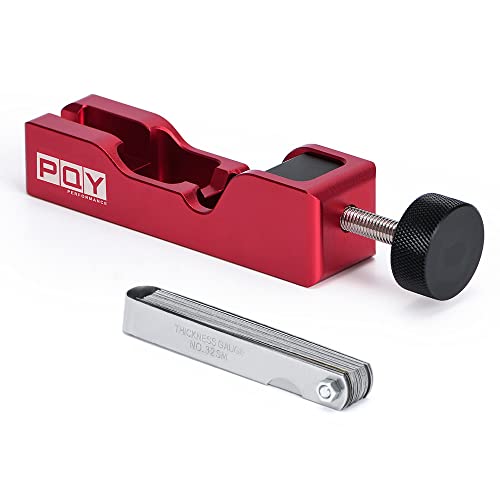
| Best Gapper Combo | Product Type: Spark plug gap tool + feeler gauge | Blade Count: 32 blades | Measurement Range: 0.0015–0.035 in | VIEW LATEST PRICE | Read Our Analysis |
| Feeler Gauge Set Stainless Steel 32 Blades |

| Best Value | Product Type: Feeler gauge set | Blade Count: 32 blades | Measurement Range: 0.04–0.88 mm | VIEW LATEST PRICE | Read Our Analysis |
| Toolwiz Spark Plug Gap Tool with Feeler Gauge |
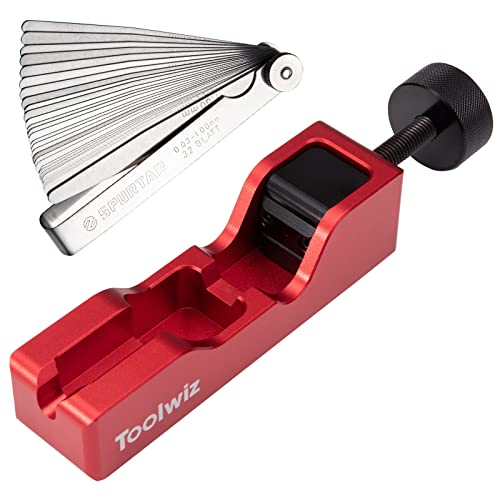
| Best Overall | Product Type: Spark plug gap tool + feeler gauge | Blade Count: 32 blades | Measurement Range: 0.001–0.040 in | VIEW LATEST PRICE | Read Our Analysis |
| 2pcs Feeler Gauges Set SAE/Metric Dual Marked |
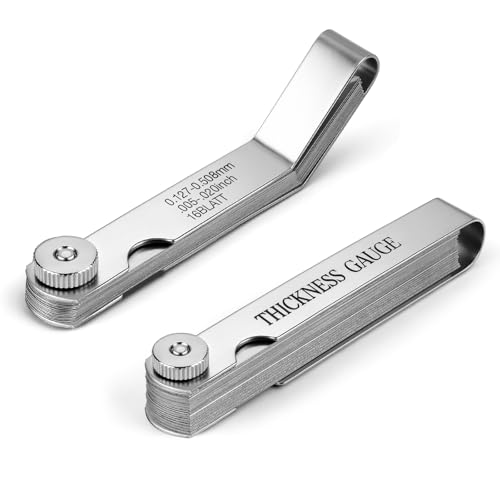
| Best Dual Set | Product Type: Feeler gauge set | Blade Count: 32 + 16 blades | Measurement Range: 0.0008–0.04 in | VIEW LATEST PRICE | Read Our Analysis |
| GEARWRENCH Feeler Gauge Set – 12 Blade & 6 Wire Spark Plug Gap – 164 |

| Best Classic Pick | Product Type: Feeler gauge set + wire gap tools | Blade Count: 12 blades + 6 wires | Measurement Range: Thickness/gap set | VIEW LATEST PRICE | Read Our Analysis |
| Stainless Steel Feeler Gauge Set for Gaps and Thickness |

| Best Premium Set | Product Type: Feeler gauge set | Blade Count: 32 + 16 blades | Measurement Range: 0.04–0.88 mm | VIEW LATEST PRICE | Read Our Analysis |
More Details on Our Top Picks
Universal Spark Plug Gap Tool with Feeler Gauge
Should you want a tidy best gapper combo, this Spark Plug Feeler Gauge fits the job nicely. You can use it on most standard 10mm, 12mm, 14mm, and 16mm plugs, but not 18mm, long-reach, or short-reach types, so check your plug size beforehand. The aluminum body feels solid, and the 32 manganese steel blades cover 0.0015 inch to 0.035 inch.
One brass 0.010 inch blade suits electronic ignition systems. Just place the plug in, select a blade, and turn the knob slowly for quick, easy gap adjustments. A little smaller often lands you on target!
- Product Type:Spark plug gap tool + feeler gauge
- Blade Count:32 blades
- Measurement Range:0.0015–0.035 in
- Spark Plug Fit:10–16 mm
- Material:Aluminum / manganese steel
- Dual Marking:Metric & imperial
- Additional Feature:Aluminum matte body
- Additional Feature:Brass electronic-ignition blade
- Additional Feature:Quick gap adjustment
Feeler Gauge Set Stainless Steel 32 Blades
Need one versatile gauge? You’ll like this 32-blade stainless set. It covers 0.04 to 0.88 mm, or 0.0015 to 0.035 inch, so you can check spark plug gaps, tappet clearance, bearing clearance, and piston rings with one foldable tool.
Each blade is etched, which saves you from squinting like a detective at a tiny clue. The #65 manganese steel gives solid strength, while the anti-rust oil coating helps prevent pitting. Keep a cloth handy, though, because a little blade oil is part of the package!
- Product Type:Feeler gauge set
- Blade Count:32 blades
- Measurement Range:0.04–0.88 mm
- Spark Plug Fit:Spark plug compatible
- Material:#65 manganese steel
- Dual Marking:Metric & imperial
- Additional Feature:Foldable blade design
- Additional Feature:Anti-rust oil coating
- Additional Feature:Hard-to-reach use
Toolwiz Spark Plug Gap Tool with Feeler Gauge
Toolwiz’s gap tool nails the sweet spot for most standard plugs. You get a red, manual adjuster plus a 32-blade steel feeler gauge, so you can set gaps cleanly instead of guessing. It fits most 10mm, 12mm, 14mm, and 16mm standard-thread plugs, but skip 18mm, long-reach, and short-reach types.
Use it like this: 1) seat the plug, 2) choose the blade, 3) turn the knob slowly. It only reduces gap, and springy electrodes might require a slightly smaller blade. Handier than eyeballing it, which is a bold plan!
- Product Type:Spark plug gap tool + feeler gauge
- Blade Count:32 blades
- Measurement Range:0.001–0.040 in
- Spark Plug Fit:10–16 mm
- Material:65 manganese steel
- Dual Marking:Metric & imperial
- Additional Feature:Red finish
- Additional Feature:Gap reduction only
- Additional Feature:Manual mirror adjustment
2pcs Feeler Gauges Set SAE/Metric Dual Marked
For tight, precise gaps, this dual-marked set gives you the right blade fast. You get a 32-blade straight gauge for 0.0008 to 0.04 in, plus a 16-blade angled tool for 0.005 to 0.02 in, so you can reach spark plugs, valves, piston rings, and other fiddly spots without muttering at the engine.
Each stainless blade is laser-etched in SAE and metric, so you won’t juggle conversions. It resists rust, wear, and fading, which is nice whenever tools live in a real toolbox, not a museum!
- Product Type:Feeler gauge set
- Blade Count:32 + 16 blades
- Measurement Range:0.0008–0.04 in
- Spark Plug Fit:Spark plug compatible
- Material:Stainless steel
- Dual Marking:Metric & imperial
- Additional Feature:Straight and angled tools
- Additional Feature:Fade-proof laser etching
- Additional Feature:Narrow-space access
GEARWRENCH Feeler Gauge Set – 12 Blade & 6 Wire Spark Plug Gap – 164
GEARWRENCH’s 164 gauge set is the classic pick for precise spark plug gaps. You get 12 blades for clearance checks and 6 wire gauges for spark plug adjustment, so you can handle tune-ups without hunting for extra tools.
The markings are clear, the case stays compact at 3.9 x 1.3 x 0.9 inches, and the 1.6-ounce build won’t weigh down your box. Use it to match specs, improve combustion, and keep your engine happier. And yes, organized tools do save time, which is nice whenever you’d rather be under the hood than fishing around.
- Product Type:Feeler gauge set + wire gap tools
- Blade Count:12 blades + 6 wires
- Measurement Range:Thickness/gap set
- Spark Plug Fit:Spark plug gap tools
- Material:Durable metal
- Dual Marking:Clearly marked measurements
- Additional Feature:Six wire gauges
- Additional Feature:Compact storage case
- Additional Feature:All-in-one solution
Stainless Steel Feeler Gauge Set for Gaps and Thickness
Should you want precision, this stainless steel set feels like a premium pick. You get 2 gauges: a 32-blade straight tool and a 16-blade angled one, so you can check tight gaps without contorting like a mechanic in a circus.
The straight gauge covers 0.04 to 0.88 mm, and the offset gauge handles 0.127 to 0.508 mm. Laser-etched metric and imperial markings make size checks quick. Use blades solo or stacked, and adjust the knurled pivot for steady pressure. It’s built for spark plugs, valves, pistons, and humid garages.
- Product Type:Feeler gauge set
- Blade Count:32 + 16 blades
- Measurement Range:0.04–0.88 mm
- Spark Plug Fit:Spark plug compatible
- Material:Hardened stainless steel
- Dual Marking:Metric & imperial
- Additional Feature:Two-piece set
- Additional Feature:Removable blade angles
- Additional Feature:24-hour support
Factors to Consider When Choosing a Spark Plug Feeler Gauge
When you pick a spark plug feeler gauge, make sure the thread size matches your plugs, the measuring range covers your target gap, and the blade count gives you enough options without turning your toolbox into a hardware forest. You’ll also want tough material that won’t bend up promptly, plus clear dual markings, so metric and inch readings don’t leave you doing math before coffee. In short, choose a gauge that fits your engine, reads easily, and feels solid in your hand!
Thread Size Compatibility
In spark plug gap tools, thread size compatibility matters just as much as the gap itself, because the plug has to seat cleanly in the holder or adapter before you can read or set anything accurately. Check the plug’s thread diameter initially: 10 mm, 12 mm, 14 mm, or 16 mm are common. Also confirm the tool doesn’t exclude sizes like 18 mm, unless you enjoy forcing metal parts together, which nobody does!
Should you work on several engines, pick a gauge or adapter set that covers the thread sizes you see most often. And make sure it matches standard-reach plugs, since long-reach and short-reach designs can sit differently. Whenever you’re unsure, use calipers or the plug’s spec sheet so the fit’s right the first time.
Measuring Range
Once the plug’s thread size fits the holder properly, the next thing to check is the measuring range, because a gauge that can’t reach your plug’s actual gap is just a fancy bookmark. You want blades that cover about 0.04 mm to 0.88 mm, since most spark plugs live somewhere between 0.0015 in and 0.035 in. Aim for these basics:
- A thin end near 0.04 mm for tight, factory-close gaps.
- A thick end around 0.8 to 0.9 mm for larger automotive or motorcycle specs.
- Plenty of steps, ideally 30+ blades, so you can match the target without awkward leaps.
And should you work on mixed engines, make sure the set includes both delicate low-end blades and sturdy upper-end ones. Gap math shouldn’t need a headache!
Blade Count
Blade count matters more than it initially looks, because more blades usually mean finer increments and a better chance of landing right on your spark plug’s target gap. With a 32-blade set, you can make tiny adjustments instead of jumping in big steps, which helps whenever the spec is tight. Fewer blades can leave you stuck between sizes, so you might end up stacking blades or settling for close enough, which is a polite way of saying not quite right.
- More blades = more versatility across common gap specs.
- A wider spread of sizes cuts down on improvisation.
- Look for both fine and larger increments, so you can handle small tweaks and wider clearances without juggling extra gauge sets. Clean, simple, and less annoying!
Material Durability
A feeler gauge can look like a simple stack of shiny strips, but the material behind those strips makes a big difference in how long the tool stays accurate. You want hardened manganese or stainless steel, because they hold thickness, resist bending, and keep the gap reading honest after repeated use. Rust is the silent saboteur here, so pick blades with anti-rust treatment or a naturally corrosion-resistant alloy.
A polished, heat-treated finish also helps, since smoother blades slide with less wear between tight surfaces. Pay attention to edge stability too: thicker, properly hardened blades resist mushrooming or necking, which can slowly distort the nominal size. In short, durable metal keeps your spark plug gap tool useful longer, and your measurements less annoying!
Dual Markings
Durable blades are great, but dual markings make a spark plug feeler gauge much easier to use in the real world. You can read metric and imperial values on the same blade, so you skip awkward unit math and get straight to the gap. That matters whenever your vehicle lists 0.7 mm and an aftermarket chart says 0.028 in, because both numbers point to the same blade.
Look for clear etched or laser-etched graduations, such as 0.04 to 0.88 mm and 0.0015 to 0.035 in. Those markings stay readable through oil, grease, and repeated use. In practice, dual scales speed things up, reduce guesswork, and help you choose the right thickness without flipping between charts like a confused accountant.
Spark Plug Fit
As you’re selecting a spark plug feeler gauge, fit matters just as much as the numbers on the blade. You want blades that cover common gaps, from 0.04 mm to 0.88 mm, so OEM and aftermarket specs aren’t a guessing game. Make sure the gauge works with your plug’s thread size or gap tool, especially unless you use 10 mm, 12 mm, 14 mm, or 16 mm plugs.
Specialty plugs can be fussy, because naturally they can.
- Choose fine increments, like 32 blades, for exact selection.
- Pick hardened steel with etched or stamped sizes.
- Account for springback through using a blade slightly smaller than target, such as 0.42 mm for a 0.44 mm gap.
Adjustment Precision
In the moment you’re chasing the right spark plug gap, precision matters more than guesswork, so pick a feeler gauge set with fine blade steps, usually 0.01 mm or 0.02 mm, to keep you within the engine’s tolerance. You’ll want hardened blades with clear metric and imperial markings, so 0.25 mm and 0.010 in never turn into a conversion comedy.
Use:
- single blades for exact gaps
- stacked blades only when you’ve confirmed the total thickness
- a slight under-set, about 0.02 mm, in case your electrodes spring back
Keep the blades clean and dry, and hold steady pressure while adjusting. That consistency helps you avoid errors of a few hundredths of a millimeter, which is plenty to annoy an engine and your patience!
Reach Limitations
Even with perfect gap precision, the gauge still has to physically get to the spark plug, and that’s where reach limitations can make or break the job. Straight blades often project only a few centimeters from the pivot, so they might miss deep, recessed electrodes. Choose offset or angled gauges whenever plugs sit in narrow wells; a few millimeters of offset can save your knuckles and your patience.
Check long-reach and short-reach compatibility too, because a standard flush-plug gauge won’t seat correctly on inward or outward electrodes. In cramped engine bays, the handle and pivot can block alignment, even though the blade itself is long enough. Should the blade can’t fully seat, stack thinner blades from a better angle, or use a purpose-built extension.
Simple, but effective!
Final Thoughts
So, once you pick your spark plug feeler gauge, focus on blade range, material, and access. A stainless 32-blade set gives you the most flexibility, while angled or wire-style tools help in tight wells where straight blades get awkward fast. One useful stat: a 0.010-inch gap can matter on electronic ignition systems, so small accuracy really pays off! Choose the tool that fits your engine bay, and you’ll keep adjustment simple, neat, and reliable.
