

A brake rotor kit drivers rely on in 2026 starts with the right fit, smooth rotors, and pads that stay quiet and clean.
The best kits pair vehicle-specific rotors with low-dust ceramic pads and rust-resistant coating.
Blank rotors usually suit daily driving best, while drilled-and-slotted styles fit heavier heat and harder use.
Pick the right setup, and that pedal pulse can turn into calm, confident stops again.
| Front Brake Kit for Cadillac Escalade Silverado Tahoe Yukon |

| Performance Upgrade | Vehicle Fit: Cadillac Escalade / Silverado 1500 / Tahoe / Yukon | Kit Coverage: Front | Rotor Design: Drilled & slotted | VIEW LATEST PRICE | Read Our Analysis |
| PowerStop Front Brake Kit KOE4713 for Lexus/Toyota |

| Best Overall | Vehicle Fit: Lexus NX/RX, Toyota Highlander/Sienna | Kit Coverage: Front | Rotor Design: OE replacement blank | VIEW LATEST PRICE | Read Our Analysis |
| PowerStop Front Brake Kit KOE2316 for Corolla/Vibe/Matrix |
| Budget-Friendly Pick | Vehicle Fit: Toyota Corolla/Matrix, Pontiac Vibe | Kit Coverage: Front | Rotor Design: OE replacement blank | VIEW LATEST PRICE | Read Our Analysis |
| R1 Concepts Front Brake Kit for Nissan Sentra |

| Daily Driver Pick | Vehicle Fit: Nissan Sentra | Kit Coverage: Front | Rotor Design: Blank | VIEW LATEST PRICE | Read Our Analysis |
| Acinoparts Front and Rear Brake Kit |
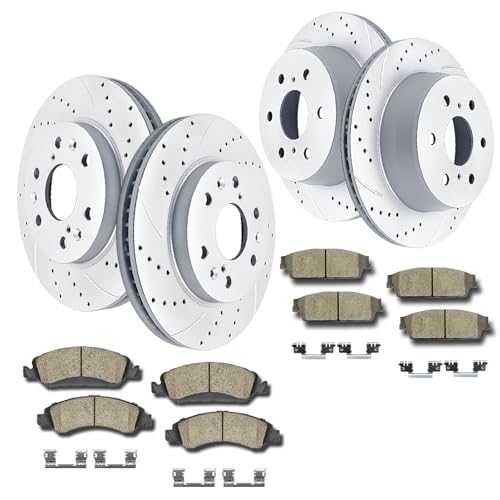
| Full Kit Upgrade | Vehicle Fit: Cadillac Escalade / Silverado 1500 / Tahoe / Yukon | Kit Coverage: Front and rear | Rotor Design: Drilled & slotted | VIEW LATEST PRICE | Read Our Analysis |
More Details on Our Top Picks
Front Brake Kit for Cadillac Escalade Silverado Tahoe Yukon
Should you want a performance upgrade, this front brake kit fits full-size GM SUVs and trucks beautifully. You get coverage for Escalade, Silverado 1500, Tahoe, and Yukon, plus a practical package:
- 2 drilled and slotted front rotors, part 55097, 12.99 inches or 330 mm
- 4 front ceramic pads, part D1363, with hardware included
You’ll like what that means on the road:
- Cleaner, quieter braking from the ceramic formula
- Better dust evacuation and heat control from the rotor design
- More stable stopping initially
But read the compatibility chart first, and let a professional handle installation. Inspect pads and rotors regularly, replace worn parts promptly.
- Vehicle Fit:Cadillac Escalade / Silverado 1500 / Tahoe / Yukon
- Kit Coverage:Front
- Rotor Design:Drilled & slotted
- Pad Material:Ceramic
- Included Hardware:Hardware included
- Installation Type:Professional install recommended
- Additional Feature:Stable braking performance
- Additional Feature:Better heat dissipation
- Additional Feature:Professional installation recommended
PowerStop Front Brake Kit KOE4713 for Lexus/Toyota
For many Lexus and Toyota drivers, the PowerStop KOE4713 is the all-around smart front brake kit pick. You get:
- 2 Z17 ceramic pads
- 2 OE-style, precision-milled rotors
- shims and stainless hardware
It fits Lexus NX, RX, plus Toyota Highlander and Sienna front applications, but confirm fitment initially.
You’ll like how the low-dust ceramic formula keeps wheels cleaner, while thermal scorching, chamfers, slots, and rubberized shims help deliver quick break-in and quieter stops. The mill-balanced, non-coated rotors support a smooth daily-driving feel. Installation stays simple too:
- Bolt it on
- Use the included hardware
- Expect possible multiple boxes
And yes, 47.5 pounds means business.
- Vehicle Fit:Lexus NX/RX, Toyota Highlander/Sienna
- Kit Coverage:Front
- Rotor Design:OE replacement blank
- Pad Material:Ceramic
- Included Hardware:Stainless hardware + shims
- Installation Type:Bolt-on direct replacement
- Additional Feature:Fast pad break-in
- Additional Feature:Precision milled rotors
- Additional Feature:Daily driving tuned
PowerStop Front Brake Kit KOE2316 for Corolla/Vibe/Matrix
PowerStop’s KOE2316 is a budget-friendly pick for 2003 to 2008 Corolla, Matrix, and Vibe drivers who want an easy front brake refresh.
You get:
- 2 Z17 ceramic front pads
- 2 OE replacement front rotors
- Rubberized shims
- Stainless-steel hardware
And it’s a true bolt-on kit, so you won’t need modifications or garage-floor improvisation. The thermal-scorched, chamfered, slotted pads help break-in happen faster, keep braking quiet, and cut dust, which means cleaner wheels. Mill-balanced rotors support a smoother ride for daily driving. Before you buy, confirm fitment, because brake parts don’t reward guessing. You’re also covered under a 24-month, 24,000-mile limited warranty.
- Vehicle Fit:Toyota Corolla/Matrix, Pontiac Vibe
- Kit Coverage:Front
- Rotor Design:OE replacement blank
- Pad Material:Ceramic
- Included Hardware:Stainless hardware + shims
- Installation Type:Bolt-on direct replacement
- Additional Feature:Fast pad break-in
- Additional Feature:Smooth ride rotors
- Additional Feature:Multiple-box shipping possible
R1 Concepts Front Brake Kit for Nissan Sentra
R1 Concepts makes a strong daily driver pick for Sentra owners who want an easy, direct-fit front brake refresh.
You get a vehicle-specific front kit for 2013 to 2019 Sentra trims, with:
- 2 eLINE 11.0-inch blank rotors
- 4 semi-metallic pads
Because it’s built to O.E.M. specs, installation stays simple, with no modifications or assembly drama. The mill-balanced G3000 iron rotors help deliver smooth, vibration-free stops, while the semi-metallic pads cut down dust and noise for everyday commuting. And at 33.3 pounds, it’s a substantial kit, not mystery metal in a box. Before you buy, confirm fitment, then enjoy the one-year manufacturer warranty.
- Vehicle Fit:Nissan Sentra
- Kit Coverage:Front
- Rotor Design:Blank
- Pad Material:Semi-metallic
- Included Hardware:Not specified
- Installation Type:Direct fit, no mods
- Additional Feature:G3000 iron construction
- Additional Feature:Vibration-free stopping
- Additional Feature:One-year defect warranty
Acinoparts Front and Rear Brake Kit
Acinoparts delivers a full kit upgrade for SUV and truck drivers who want matched braking parts front and rear.
You get coverage for Escalade, Silverado 1500, Tahoe, and Yukon models, plus:
- Front: 2 rotors, 12.99-inch, part 55097
- Rear: 2 rotors, 13.58-inch, part 55133
- Pads: ceramic sets D1363 front, D1194 rear, hardware included
The drilled and slotted rotor design helps evacuate dust, shed heat, and keep braking stable whenever your vehicle’s working hard. And the ceramic pads stay cleaner and quieter, which your ears will appreciate. Before ordering, confirm fitment carefully. For safety, use professional installation and inspect components routinely, because brakes hate neglect.
- Vehicle Fit:Cadillac Escalade / Silverado 1500 / Tahoe / Yukon
- Kit Coverage:Front and rear
- Rotor Design:Drilled & slotted
- Pad Material:Ceramic
- Included Hardware:Hardware included
- Installation Type:Professional install recommended
- Additional Feature:Complete four-wheel kit
- Additional Feature:Better heat dissipation
- Additional Feature:Professional installation recommended
Factors to Consider When Choosing a Brake Rotor Kit
As soon as you choose a brake rotor kit, you’ll want to check 5 basics: vehicle fitment accuracy, rotor design type, pad material choice, whether you need a front or full kit, and expected noise and dust. Get fitment right initially, because even a rotor that’s off a few millimeters in diameter, thickness, bolt pattern, or hat height can turn a simple brake job into a garage-floor headache. And once that’s covered, you can match drilled, slotted, or solid rotors with the right pads for how you drive, while keeping daily annoyances like squeal and black wheel dust in check.
Vehicle Fitment Accuracy
Although brake rotor kits can look nearly identical in a listing, fitment accuracy is where you save yourself from noise, clearance issues, and the classic “almost fits” headache. Start with your exact vehicle details, then confirm these basics:
- Make, model, year, and drivetrain. A 2WD version can use different rotor diameter, hub bore, or bolt pattern than 4WD or AWD.
- OEM specs. Match replacement diameter and thickness to your service manual, including minimum thickness tolerances.
- Axle position. Front and rear rotors often differ in size, venting, and mounting, so don’t swap them mentally or physically.
And check the small stuff too:
- ABS tone ring or wheel speed sensor compatibility
- Caliper bracket alignment
- VIN-based part numbers or fitment tools
Because “close enough” in brake parts usually isn’t. Ever.
Rotor Design Type
Since rotor design changes how your brakes shed heat, clear water and dust, and interact with the pad face, it’s worth choosing a style that matches how you actually drive instead of just picking the most aggressive-looking disc in the box.
Keep this quick guide in mind:
- Plain rotors give you the most uniform thermal mass and strength, so they’re excellent whenever durability and crack resistance matter most.
- Drilled rotors evacuate water and gas well, but those holes can create stress points under repeated extreme heat.
- Slotted rotors use grooves to clear deposits and keep the friction surface clean for steadier braking.
- Drilled-and-slotted designs combine those benefits, though you’ll usually pay more and carry extra weight.
Also check thickness, venting, and machining quality. Those details often matter just as much.
Pad Material Choice
Balance matters here: the pad material you pair with your rotor kit shapes pedal feel, heat tolerance, dust output, noise, and even how quickly the rotors themselves wear, so it’s smart to match the compound to your real-world driving instead of chasing the most aggressive label on the box.
Choose based on how you drive:
- Ceramic pads keep things quiet, clean, and consistent for commuting, though initial bite is softer and heat capacity is lower.
- Semi-metallic pads give you stronger friction and better resistance to heat for towing or spirited runs, but expect more dust and some squeal.
- Organic pads stay gentle on rotors and quiet, yet they wear faster and can fade sooner.
- Sintered compounds handle extreme heat well, but they’re louder and tougher on rotors. No free lunch here!
Front Or Full Kit
Once you’ve matched your pad compound to the way you drive, the next call is whether you need a front-only rotor kit or a full set for all four corners.
Check wear first, then replace rotors in pairs for balanced braking:
- Should only your front pads and rotors be worn, a front kit usually does the job.
- In case both axles are warped, cracked, or below minimum thickness, go full kit. That spec is stamped on the rotor or listed in your service manual.
A full kit can also save money long term and keeps friction and heat management matched at every corner. Front-heavy vehicles, and anything that tows, often chew through front brakes faster. But should wear look even front to rear, replace all four. And should you’re only doing one axle, keep pad and rotor materials matched.
Noise And Dust
Don’t overlook noise and dust while you pick a brake rotor kit, because rotor finish and design play a bigger role than most drivers expect.
Focus on three things:
- Surface style. Blank or smoothly milled rotors usually stay quieter, while drilled or slotted faces can clear debris and limit glazing, though they sometimes add a sharper squeal.
- Coating. Rust-resistant coatings and painted hats help prevent corrosion flakes, which means less ugly wheel dust, especially whether you drive in rain or snow.
- Fit and pairing. Precision-matched, mill-balanced rotors reduce runout, and that matters because vibration enhances squeal and leaves more pad material as dust.
And don’t ignore pad compatibility. Ceramic pads usually pair best with smoother rotors, while semi-metallic pads often need more aggressive surfaces. Mismatches get noisy, fast.
Heat Dissipation Performance
While you’re comparing a brake rotor kit, heat dissipation deserves a close look because excess temperature is what pushes brakes from confident and consistent to soft, noisy, and fade-prone in a hurry. You want rotors that shed heat fast, not ones that hang onto it like a bad mood.
Look for:
- Drilled holes and machined slots, which vent gases and water and add cooling surface area.
- Thicker rotors or vented internal vanes, which absorb more thermal energy and cut peak temps during repeated stops.
- Higher-conductivity cast iron, which pulls heat away from the friction face faster.
Also, pay attention to precision milling and mill balancing. A truer rotor stays stable whenever hot, reducing vibration, hot spots, and warping. And with enough rotor mass plus airflow, your brakes stay happier longer.
Installation Hardware Included
Start with the hardware list, because a brake rotor kit that arrives with the right bolts, clips, shims, and pad hardware can save you a mid-job parts run and a lot of unnecessary muttering in the garage.
Check for:
- Caliper bolts
- Rotor screws
- Anti-rattle clips
- New shims and pad hardware
Then look closer. You want stainless-steel or coated pieces, especially provided that you drive through rain, snow, or salted roads, because corrosion can seize fasteners and loosen confidence fast.
Also confirm the hardware is vehicle-specific, or at least OE-equivalent, including size and thread pitch. That helps you avoid stripped threads, poor fitment, and unnecessary drama.
And don’t overlook rubberized shims or anti-vibration parts. They keep pads aligned, reduce squeaks, and help braking stay smooth.
In the event hardware’s missing, budget for correct torque-spec replacements and single-use clips.
Warranty And Support
Because brake parts live a hard life, the warranty and support behind your rotor kit matter almost as much as the metal itself. Before you purchase, check how long coverage lasts, whether that’s 12 months, three years, or a mileage cap, so you know how long defects or premature wear are protected.
Look closely at the fine print:
- Confirm whether it covers manufacturer defects, premature wear, or both.
- Check whether pads and rotors are included, since some brands exclude consumables.
And don’t skip the process details:
- Read the return window, such as 30 days.
- Keep your receipt and follow any pre-authorization steps.
- Verify whether professional installation is required.
Also, make sure support is reachable via phone, email, or an online claims portal. Slow warranty help is its own brake problem.
Frequently Asked Questions
How Often Should Brake Rotor Kits Be Professionally Inspected?
You should have brake rotor kits professionally inspected at least once a year or every 12,000 miles. Should you hear grinding, feel vibration, or notice reduced braking, don’t wait—schedule an inspection right away for safety.
Can Weather Conditions Affect Brake Rotor Kit Lifespan?
Yes—weather can shorten your brake rotor kit’s lifespan; road salt can accelerate corrosion via up to 20%. You’ll see faster wear from moisture, extreme heat, and freezing cycles, so inspect components regularly and drive gently.
Are Brake Rotor Kits Covered Under Vehicle Warranties?
Usually, you won’t get brake rotor kits covered under a vehicle warranty because manufacturers treat them as wear items. You should check your warranty terms, though, since defects in materials or workmanship could qualify.
What Signs Indicate Improper Brake Kit Installation?
Nothing says “perfect installation” like squealing, grinding, pulling, vibration, uneven braking, or a soft pedal. You could also smell burning, see uneven pad wear, or hear clunking. Should that’s happening, you’ve likely got problems.
Do Brake Rotor Kits Require a Break-In Period?
Yes, brake rotor kits usually require a break-in period. You should bed them in with several controlled stops, because that transfers pad material evenly, improves braking performance, reduces noise, and helps prevent glazing or vibration.
