

The best brake rotors for a BMW in 2026 offer strong stopping power, solid heat control, and the right fit for your exact model.
BMW brake parts can vary a lot by chassis, so the right match matters.
Good rotor kits usually include quality coating, smart vane design, and durable materials.
This guide covers five standout options that bring smooth braking and solid value without the guesswork.
| Detroit Axle BMW Brake Kit Rotors & Pads |

| Best Long-Term Value | Vehicle Fitment: BMW 335d/335i/335i xDrive/335is/335xi/X1 xDrive35i | Kit Contents: 4 rotors, front/rear ceramic pads, cleaner, brake fluid | Rotor Design: Drilled & slotted | VIEW LATEST PRICE | Read Our Analysis |
| R1 Concepts BMW 528i Front/Rear Brake Kit |

| Best for Daily Driving | Vehicle Fitment: BMW 528i / 528i xDrive | Kit Contents: 4 rotors, 8 ceramic pads, sensor wire | Rotor Design: Cross-drilled & diamond-slotted | VIEW LATEST PRICE | Read Our Analysis |
| Detroit Axle Front Brake Kit with Rotors & Pads |
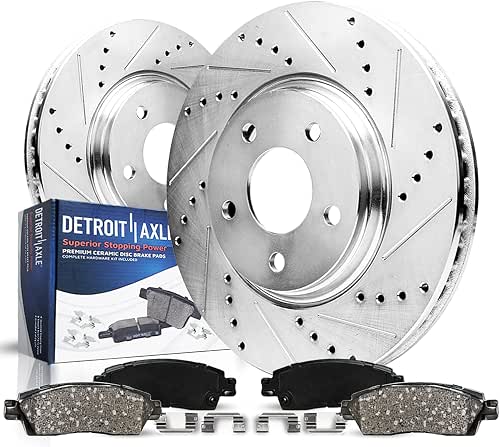
| Budget-Friendly Pick | Vehicle Fitment: BMW 228i/230i/320i/328i/328d/330i/428i/430i xDrive | Kit Contents: 2 front rotors, 2 front ceramic pads, hardware | Rotor Design: Drilled & slotted | VIEW LATEST PRICE | Read Our Analysis |
| R1 Concepts Front and Rear Brake Kit |

| Best OEM-Style Kit | Vehicle Fitment: BMW 228i/230i/320i/328i/328d/428i variants | Kit Contents: 4 blank rotors, 8 ceramic pads | Rotor Design: Blank | VIEW LATEST PRICE | Read Our Analysis |
| PowerStop BMW Front and Rear Brake Kit K6925 |
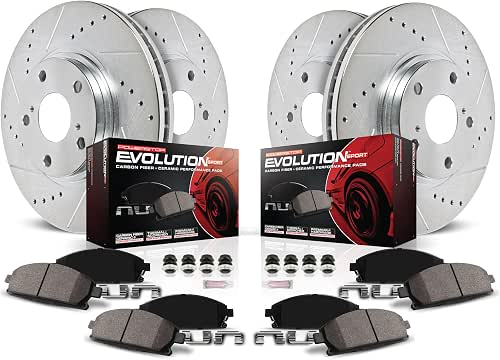
| Performance Upgrade Pick | Vehicle Fitment: BMW 320i xDrive/328d xDrive/328i/330i/428i/430i variants | Kit Contents: 4 rotors, Z23 pads, stainless hardware, shims | Rotor Design: Drilled & slotted | VIEW LATEST PRICE | Read Our Analysis |
More Details on Our Top Picks
Detroit Axle BMW Brake Kit Rotors & Pads
Should you want solid long-term value, this Detroit Axle kit fits a wide swath of BMW 3 Series drivers. You get coverage for 2007 to 2015 applications, including 335i, 335xi, 335d, 335is, select E92/E93 models, and X1 xDrive35i 3.0L.
Inside the box:
- 13.70-inch front drilled and slotted rotors
- 13.23-inch rear drilled and slotted rotors
- Front and rear ceramic pads
- 10 oz brake cleaner and 12 oz fluid
You also get zinc-coated finish, OEM-spec-or-better construction, and a 10-year warranty. At 98.2 pounds, it’s not exactly a gym substitute, but it is a complete, proper-fit braking refresh.
- Vehicle Fitment:BMW 335d/335i/335i xDrive/335is/335xi/X1 xDrive35i
- Kit Contents:4 rotors, front/rear ceramic pads, cleaner, brake fluid
- Rotor Design:Drilled & slotted
- Rotor Size:13.70 in front / 13.23 in rear
- Pad Material:Ceramic
- Warranty:10-year
- Additional Feature:Zinc exterior finish
- Additional Feature:Brake cleaner included
- Additional Feature:Brake fluid included
R1 Concepts BMW 528i Front/Rear Brake Kit
Provided that daily driving is your priority, this R1 Concepts BMW 528i front/rear brake kit gives you a well-rounded upgrade. You get:
- (4) eLINE drilled and slotted rotors
- (8) ceramic pads
- sensor wire
It fits 2011 to 2016 528i and 2012 to 2016 528i xDrive, but verify whether your car uses full cast or aluminum hat rotors initially. Both front and rear rotors measure 13.0 inches, use G3000 iron, and add strength, stability, and better heat management. And the ceramic pads keep dust and noise down. Installation is direct OEM-spec fitment, no modifications, no drama. You also get one-year defect coverage.
- Vehicle Fitment:BMW 528i / 528i xDrive
- Kit Contents:4 rotors, 8 ceramic pads, sensor wire
- Rotor Design:Cross-drilled & diamond-slotted
- Rotor Size:13.0 in front / 13.0 in rear
- Pad Material:Ceramic
- Warranty:1-year
- Additional Feature:Sensor wire included
- Additional Feature:G3000 iron construction
- Additional Feature:No modification required
Detroit Axle Front Brake Kit with Rotors & Pads
Should you want a budget-friendly pick, this Detroit Axle front kit fits a wide range of BMWs well. You get 12.28-inch, 312 mm drilled and slotted front rotors, ceramic pads, and hardware, so installation stays straightforward.
It suits:
- 228i, 230i
- 320i, 328i, 328d, 330i
- 428i, 430i xDrive
You’ll want to confirm the fitment chart initially, because BMW compatibility can be pickier than a valet at a country club.
Highlights include:
- OEM-spec fit and finish for solid stopping power
- 10-year warranty
- OE references 980654 and SP1561EU
You also get Amazon’s 30-day return coverage, plus 586 reviews.
- Vehicle Fitment:BMW 228i/230i/320i/328i/328d/330i/428i/430i xDrive
- Kit Contents:2 front rotors, 2 front ceramic pads, hardware
- Rotor Design:Drilled & slotted
- Rotor Size:12.28 in front
- Pad Material:Ceramic
- Warranty:10-year
- Additional Feature:Hardware included
- Additional Feature:OEM-spec fit and finish
- Additional Feature:Impact wear fatigue tested
R1 Concepts Front and Rear Brake Kit
Should you want an OEM-style complete refresh, this R1 Concepts front and rear kit fits the job neatly. You get 4 eLINE blank rotors and 8 ceramic pads, covering both axles for BMW 228i, 328i, 428i, 230i, 320i, and 328d applications.
Why it works:
- G3000 iron rotors add strength and durability.
- Mill-balanced blanks help you get smooth, vibration-free stops.
- Ceramic pads cut dust and noise for daily driving.
You also get OEM-spec fitment, so installation shouldn’t require modifications. Rotor sizing is 12.3 inches upfront and 11.8 rear. Verify fitment first, because BMW compatibility charts can be less funny than your repair bill. Warranty coverage lasts 1 year.
- Vehicle Fitment:BMW 228i/230i/320i/328i/328d/428i variants
- Kit Contents:4 blank rotors, 8 ceramic pads
- Rotor Design:Blank
- Rotor Size:12.3 in front / 11.8 in rear
- Pad Material:Ceramic
- Warranty:1-year
- Additional Feature:Mill-balanced rotors
- Additional Feature:Vibration-free stopping
- Additional Feature:Daily driving focused
PowerStop BMW Front and Rear Brake Kit K6925
PowerStop’s K6925 is a performance upgrade pick for BMW drivers who want sharper stops without a complicated install.
You get:
- Front and rear drilled, slotted rotors
- Z23 carbon-fiber ceramic pads
- Stainless hardware and rubberized shims
That means lower dust, quieter braking, and better heat management. The zinc-plated rotors resist corrosion, while the rounded slots help clear gas and debris.
Before you buy:
- Confirm vehicle-specific fitment, especially 1-piston front calipers and 312 mm front or 300 mm rear rotor specs.
- Expect delivery in two boxes.
- Keep in mind, it weighs 74.1 pounds, so your porch gets a workout too! Warranty coverage is solid.
- Vehicle Fitment:BMW 320i xDrive/328d xDrive/328i/330i/428i/430i variants
- Kit Contents:4 rotors, Z23 pads, stainless hardware, shims
- Rotor Design:Drilled & slotted
- Rotor Size:312 mm front / 300 mm rear spec applications
- Pad Material:Carbon-fiber ceramic
- Warranty:3-year / 36,000-mile limited
- Additional Feature:Carbon-fiber ceramic formula
- Additional Feature:Stainless-steel hardware included
- Additional Feature:Rubberized shims included
Factors to Consider When Choosing BMW Brake Rotors
Whenever I choose BMW brake rotors, I start with the basics, and you should too: exact vehicle fitment, the correct rotor diameter and thickness, and the right design type, whether that’s blank, drilled, or slotted. And I also look at pad material compatibility plus the rotor’s build quality, because ceramic, semi-metallic, and low-metallic pads can change noise, bite, and wear more than most people expect. Get those details right, and I can help you avoid the classic expensive mistake: buying rotors that look perfect in the box but don’t belong on my BMW.
Exact Vehicle Fitment
Because BMW fitment can change in surprisingly small ways from one trim or model year to the next, I always start rotor selection through confirming the exact vehicle details, not just the badge on the trunk.
I verify:
- Exact model year, engine, and drivetrain. xDrive and rear wheel drive can differ.
- VIN based OEM rotor specs, including front and rear thickness.
- Caliper setup, whether it’s single piston or multi piston, floating or fixed.
Then I confirm the rotor hat offset, centering dimensions, and bolt pattern match the hub. I also check clearance around dust shields, ABS hardware, and wheels, because tiny mismatches create big headaches. And in case your BMW has a sport or performance brake package, I make sure any factory upgrades are matched exactly. BMW fitment mistakes get expensive fast!
Rotor Size Match
Although rotor size sounds straightforward, I always match it to the exact OEM specs for the BMW in front of me, since even a small diameter difference, roughly 0.3 to 0.5 inch, can throw off caliper clearance and braking mechanical advantage in a hurry.
I also check:
- Rotor thickness and minimum thickness, so piston travel and pad contact stay where BMW intended.
- Hat height, offset, and bolt pattern, because hub fitment and wheel backspacing don’t forgive sloppy math.
- aggregate rotor height and correct venting style, which keep caliper alignment and cooling capacity in line.
And should I’m replacing both axles, I never mix front and rear sizes. Each axle uses its own designated dimensions, and crossing them up can disturb brake bias, ABS behavior, and traction control. BMWs hate shortcuts, honestly.
Rotor Design Type
While rotor size gets the parts physically lined up, rotor design type determines how the brakes manage heat, water, pad dust, and repeated hard stops, so I always choose the rotor’s construction with the BMW’s weight, axle position, and driving demands in mind.
Here’s how I narrow it down:
- Solid rotors fit lighter cars or many rear axles, where heat loads stay lower.
- Vented rotors use internal vanes to move air, shed heat faster, and resist fade on heavier or performance BMWs.
- Drilled rotors clear water and gas well for sharper initial response, but holes can concentrate stress.
- Slotted rotors sweep away debris and keep friction more consistent, without the same crack risk.
- Drilled and slotted combos improve wet performance, though they sacrifice some strength and wear faster.
Pad Material Choice
Choose the pad compound as carefully as the rotor itself, since pad material shapes bite, dust, noise, heat control, and even how quickly the rotor wears.
I match pads to how you drive:
- Ceramic pads keep wheels cleaner, stay quiet, and deliver stable friction in normal temperatures, but they usually give less peak bite than semi-metallic options.
- Semi-metallic pads use metal fibers, so they handle heat well and hit harder initially, great for spirited driving, heavy BMWs, or towing, but they create more dust and wear rotors faster.
- Organic, or NAO, pads run softer and quieter, with gentle rotor wear, yet they fade sooner in repeated hard stops and wear out faster.
And don’t ignore pad thickness, metallic content, and backing plate stiffness. Those details influence pedal feel and fade resistance markedly.
Build Material Quality
As I look at rotor build material quality, I start with the iron itself, because that foundation decides how well the rotor handles heat, resists cracking, and stays smooth through thousands of stop-and-go miles. I recommend high-grade cast iron, like G3000 or equivalent, because it delivers better strength and thermal stability under repeated heat cycles.
I also check these details:
- Balanced metallurgy and fatigue-tested construction for even wear and a predictable service life.
- Zinc or similar coatings, which help fight corrosion in rain, snow, and salty winter roads.
- Proper rotor mass and OEM thickness specs, since thermal mass matters provided you want to avoid warping.
- Precision machining, operational balancing, and stress-relieved or cryo-treated finishing to reduce vibration, tighten runout tolerance, and help pads live longer.
Included Kit Components
Good iron and precise machining set the foundation, but I also pay close attention to what actually comes in the box, because a BMW brake rotor kit only makes sense provided the components work together and fit without surprises.
I look for:
- Front and rear rotors, plus matching pads, so braking feel and wear stay balanced.
- Correct rotor orientation and exact diameters for my BMW, because close enough is how weekends get ruined.
- Hardware like caliper bolts, shims, and stainless clips.
- Brake fluid or cleaner, which saves an extra parts run.
- Pad material details, such as ceramic, so I know dust, noise, and heat behavior.
- Protective coatings or anti-corrosion finishes, and fitment documentation.
Those extras matter. A complete, clearly specified kit saves time, reduces guesswork, and helps everything bolt on neatly.
Warranty Coverage Length
Often, I treat warranty coverage length as a quick read on rotor quality, because whenever a manufacturer backs a BMW brake rotor for 3, 5, or even 10 years, that usually signals real confidence in the casting, machining, and long-term durability, not just optimistic packaging.
But I never stop at the headline term. I check:
- Full vs. prorated coverage
- Mileage or time caps, like 36,000 miles or 3 years
- Registration and proof-of-purchase rules
And I read exclusions carefully, because they matter more than the bold print:
- Premature cracking or warping could be covered.
- Pad wear usually isn’t.
- Racing, misuse, and corrosion from road salt often nullify coverage.
I also confirm any maintenance conditions, like specified pad compounds or required bed-in procedures. Fine print loves surprises.
Installation Requirements
Before I even consider about bolting on a new BMW brake rotor, I make sure the installation requirements line up with the car, because a rotor that’s technically high quality can still give me noise, vibration, or uneven wear in the event the fit and setup are off.
I check:
- Diameter, thickness, and hat dimensions against factory specs, with rotor diameter usually needing about ±0.5 mm accuracy and minimum thickness matching the stamp.
- Hub faces, wheel bearings, and hardware, because corrosion or wear can create runout above 0.05 to 0.10 mm.
- Torque values. I use a torque wrench, not guesswork! Hub bolts often sit around 70 to 150 Nm, caliper pins 20 to 60 Nm.
And I always clean rotors, bed pads with moderate 30 to 60 mph stops, and bleed fluid.
Frequently Asked Questions
How Often Should BMW Brake Rotors Be Replaced?
I replace BMW brake rotors once they reach minimum thickness, warp, or wear unevenly—often around 50,000 to 70,000 miles. I’d have you inspect them at every brake service, since driving style and conditions change lifespan.
Can Warped Rotors Damage Other Braking Components?
Yes, I’ve seen warped rotors damage other braking components. They can accelerate pad wear, stress calipers, overheat wheel bearings, and cause vibration that loosens hardware. I’d fix them quickly so you avoid bigger, costlier problems.
Are Drilled Rotors Better for Daily Driving?
No, I don’t believe drilled rotors are better for daily driving. I’d choose quality blank or slotted rotors instead, because they usually last longer, stay quieter, and resist cracking better while still giving you dependable braking.
Do Aftermarket Rotors Affect BMW Warranty Coverage?
Yes, aftermarket rotors can affect your BMW warranty provided I install non-approved parts and they cause a failure. I’d tell you Magnuson-Moss usually protects you, so BMW must prove the rotor caused the problem.
What Causes Brake Rotors to Wear Unevenly?
Uneven rotor wear happens from stuck calipers, warped hubs, pad deposits, or poor bedding. I’ve checked the theory that rotors “just warp,” and you should know heat variation and braking imbalance usually cause the real problem.
