

The best disc brake rotors for 2026 offer strong stopping power, quiet performance, and a precise fit.
Top picks stand out through durable materials, smart venting, and coatings that fight rust.
Brand choices like PowerStop, Detroit Axle, and ACDelco each bring different strengths to daily driving and heavy use.
A small fitment detail can turn a quick install into a long afternoon, so the right match matters from the start.
| PowerStop Front Brake Kit KOE1043 |

| Daily Driver Pick | Fitment: Front fit; Acura/Honda models | Rotor Design: OE replacement, non-coated | Pad Material: Ceramic pads | VIEW LATEST PRICE | Read Our Analysis |
| Front Brake Kit for Cadillac Escalade Silverado Yukon |

| Truck Brake Upgrade | Fitment: Front fit; Cadillac/Chevy/GMC trucks & SUVs | Rotor Design: Drilled and slotted | Pad Material: Ceramic pads | VIEW LATEST PRICE | Read Our Analysis |
| Detroit Axle 10pc Brake Kit for Acura MDX |

| Complete Kit Pick | Fitment: Front & rear fit; Acura MDX 2014–2016 | Rotor Design: Drilled and slotted | Pad Material: Ceramic pads | VIEW LATEST PRICE | Read Our Analysis |
| Detroit Axle Brake Kit for Toyota Camry Avalon Lexus |
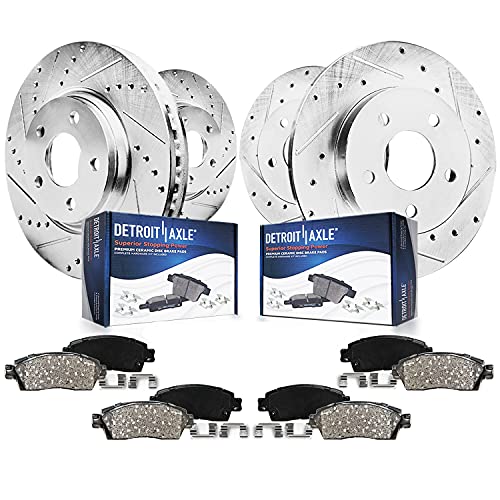
| Sedan Upgrade Pick | Fitment: Front & rear fit; Toyota/Avalon/Lexus ES | Rotor Design: Drilled and slotted | Pad Material: Ceramic pads | VIEW LATEST PRICE | Read Our Analysis |
| ACDelco Silver Front Brake Rotor 18A1705A |

| OE Replacement Pick | Fitment: Front fit; Cadillac/Chevy/GMC models | Rotor Design: Non-coated front rotor | Pad Material: No pads included; pair with brake pads | VIEW LATEST PRICE | Read Our Analysis |
More Details on Our Top Picks
PowerStop Front Brake Kit KOE1043
PowerStop’s KOE1043 is a smart daily driver pick for solid, quiet front-brake replacement. You get two OE-style front rotors, two Z17 ceramic pads, plus stainless hardware and rubberized shims, so installation stays bolt-on and drama-free.
Why it works:
- Low-dust ceramic pads help keep wheels cleaner.
- Thermal scorched, chamfered, slotted pads bed in quickly and stay quiet.
- Mill-balanced, precision-milled rotors support smooth braking.
It fits several Acura and Honda models, including many Civic, Accord, CR-V, and Element years, but confirm fitment initially. And yes, the 30.65-pound box might arrive in multiple packages. Handy, not glamorous.
- Fitment:Front fit; Acura/Honda models
- Rotor Design:OE replacement, non-coated
- Pad Material:Ceramic pads
- Included Components:2 rotors, front pads, hardware
- Warranty:2-year limited warranty
- Item Weight:30.65 lb
- Additional Feature:Thermal scorched pads
- Additional Feature:Chamfered slotted pads
- Additional Feature:Mill-balanced rotors
Front Brake Kit for Cadillac Escalade Silverado Yukon
Provided that you want a truck brake upgrade, this front kit fits full-size GM SUVs and pickups with useful hardware included. Acinoparts’ ABK00203 targets your Cadillac Escalade, Chevy Silverado 1500, Tahoe, or GMC Yukon with vehicle-specific fit.
You get:
- 2 drilled and slotted 12.99-inch front rotors
- 4 ceramic pads, reference D1363
- Installation hardware
Why it works:
- Ceramic pads keep braking cleaner and quieter.
- Drilled and slotted rotors move dust out, shed heat faster, and help stabilize stopping.
At 54.7 pounds, it’s substantial, not exactly a featherweight surprise. Use a professional installer, inspect pads and rotors regularly, and heed the 10-year warranty plus 30-day Amazon returns.
- Fitment:Front fit; Cadillac/Chevy/GMC trucks & SUVs
- Rotor Design:Drilled and slotted
- Pad Material:Ceramic pads
- Included Components:2 front rotors, 4 pads, hardware
- Warranty:10-year warranty
- Item Weight:54.7 lb
- Additional Feature:12.99-inch front rotors
- Additional Feature:Dust-exhaust rotor slots
- Additional Feature:Professional install recommended
Detroit Axle 10pc Brake Kit for Acura MDX
Should you want a complete kit pick for your 2014 to 2016 Acura MDX, this Detroit Axle package makes sense. You get 12.60-inch front rotors, 12.98-inch rear rotors, ceramic pads, hardware, brake cleaner, and fluid, so your refresh feels organized, not like a scavenger hunt.
What stands out:
- Drilled and slotted rotors front and rear
- Ceramic pads for both axles
- OEM-spec fit and finish for solid stopping power
- 10-year warranty
A few useful details:
- Part number: 10PR53400
- Weight: 45 pounds
- Reviews average 4.4 from 771 buyers
And yes, the 30-day Amazon return window helps in case garage plans go sideways.
- Fitment:Front & rear fit; Acura MDX 2014–2016
- Rotor Design:Drilled and slotted
- Pad Material:Ceramic pads
- Included Components:4 rotors, 4 pads, hardware, cleaner, fluid
- Warranty:10-year warranty
- Item Weight:45 lb
- Additional Feature:Includes brake cleaner
- Additional Feature:Includes brake fluid
- Additional Feature:Impact wear fatigue-tested
Detroit Axle Brake Kit for Toyota Camry Avalon Lexus
Detroit Axle’s sedan upgrade pick fits Camry, Avalon, and Lexus ES owners who want a full front-and-rear refresh. You get 4 drilled-and-slotted rotors plus 4 ceramic pads, covering 2012 to 2017 Camry, 2013 to 2018 Avalon, and 2013 to 2018 Lexus ES300h and ES350.
Why it stands out:
- OEM-spec fit and finish
- Ceramic pads for quieter, smoother stops
- Front and rear coverage in one box
You’ll also like the 10-year warranty, dual orientation, and Japan/USA assembly. At 57.1 pounds, this kit isn’t exactly featherweight, but brakes shouldn’t be. Part number 8PR3200037 helps you verify fit fast before ordering online.
- Fitment:Front & rear fit; Toyota/Avalon/Lexus ES
- Rotor Design:Drilled and slotted
- Pad Material:Ceramic pads
- Included Components:4 rotors, 4 pads
- Warranty:10-year warranty
- Item Weight:57.1 lb
- Additional Feature:Assembled in Japan/USA
- Additional Feature:Smooth quiet stopping
- Additional Feature:OEM-spec fit/finish
ACDelco Silver Front Brake Rotor 18A1705A
ACDelco’s oe replacement pick fits a wide swath of GM trucks and SUVs without making brake service complicated. In the event you drive a Tahoe, Yukon, Silverado, Escalade, or similar GM model, this cast-iron front rotor gives you OE-equivalent fit, but verify your VIN initially.
Why it works:
- Multi-alloy construction improves heat dissipation
- Application-specific vanes enhance airflow and reduce fade
- Non-directional ground finish promotes even pad contact
- Balanced design helps cut noise and vibration
You get one rotor per order, plus a 24-month unlimited-mile warranty. Pair it with ACDelco front pads, and consider rear rotors too. Your brakes, unlike your wallet, won’t protest much.
- Fitment:Front fit; Cadillac/Chevy/GMC models
- Rotor Design:Non-coated front rotor
- Pad Material:No pads included; pair with brake pads
- Included Components:1 front rotor
- Warranty:24-month limited warranty
- Item Weight:16 oz
- Additional Feature:Multi-alloy construction
- Additional Feature:Non-directional ground finish
- Additional Feature:Rounded radius edges
Factors to Consider When Choosing Disc Brake Rotors
Whenever you select disc brake rotors, start with the basics: make sure the fitment matches your exact vehicle, then compare rotor design, material, and pad compatibility so you don’t end up with noise, uneven wear, or a set that fights your brake setup. And heat matters more than you may suppose, because better heat dissipation helps your brakes stay consistent whenever temperatures climb fast in stop-and-go traffic or hard braking. Next, you’ll want to focus on 1) vehicle fitment accuracy, 2) rotor design style, 3) material and build, 4) pad compatibility, and 5) heat dissipation performance.
Vehicle Fitment Accuracy
Fitment is the gatekeeper here, because even an excellent rotor won’t help you provided its dimensions don’t match your hub, caliper, and wheel setup exactly. Start with OEM specs from your owner’s manual, VIN lookup, or fitment tool, then confirm:
- Rotor diameter, thickness, and bolt pattern.
- Front or rear placement, plus left or right orientation if required.
Next, check the details people skip, right up until the parts counter glare begins:
- Hat height and pilot diameter, so the rotor seats flush on the hub.
- Stud or lug-nut configuration, to avoid wobble and runout.
- Caliper and pad compatibility, including floating versus fixed, single versus dual piston layouts.
- ABS or wheel-speed sensor clearance, including any required tone ring and sensor-friendly rotor pattern details.
Rotor Design Style
Choose the rotor design style carefully, because this is where brake feel, heat control, noise, and long-term durability start to split into very different lanes.
Match the layout to how you drive:
- Solid rotors suit smaller cars and lighter duty. You get a simple, consistent contact surface and a lower price.
- Vented rotors use internal vanes to move air, shed heat faster, and fight fade, especially should you haul weight, tow, or drive hard.
- Drilled rotors add holes for water and gas evacuation, which can sharpen initial bite, but they could crack sooner under extreme stress.
- Slotted rotors use grooves to clear dust and pad deposits, helping friction stay steady and reducing glazing.
- Two-piece rotors cut unsprung weight and improve heat stability, but your wallet will notice.
Material And Build
Rotor style sets the basic personality, but material and build quality decide how well that rotor holds up once heat, moisture, road salt, and repeated stops start piling on. Cast iron dominates because you get strong thermal mass and solid wear resistance, though you also carry extra weight.
Look for:
- Vented or directional vanes should you want better airflow and less fade during repeated hard braking.
- Zinc, ceramic, or e-coat finishes should you drive through rain, slush, or salty winter roads.
Surface machining matters too. Tight tolerances help control runout and thickness variation, which means fewer vibrations and smoother braking. And while slots and drilled holes can clear gas and dust and improve cooling, drilled rotors can crack sooner under severe heat cycles. Physics can be rude like that.
Pad Compatibility
Pair your pads and rotors like they’re a team, because brake feel, heat control, dust, and long-term wear all depend on how well those two parts work together. Start with surface type:
- Smooth rotors usually pair best with low-dust ceramic pads.
- Slotted or drilled rotors can better manage metallic pad residue.
- Some semi-metallic pads wear faster on drilled faces, while ceramics usually work with all three.
Next, check coating and bedding requirements. Uncoated cast iron and coated rotors can need different break-in routines, so match pads whose bedding process fits. Also confirm rotor thickness meets minimum spec and clears the pad backing plate and caliper correctly. Too-thin rotors can skew pad contact, causing uneven wear. And should you choose aggressive, high-friction pads, use rotors built to support them.
Heat Dissipation Performance
Once your pad match makes sense, heat control is the next thing that decides whether your brakes stay consistent or start feeling cooked after a few hard stops.
Focus on three things:
- Ventilation. Vented rotors, directional vanes, and multi-vane designs move more air through the disc, so heat leaves faster during repeated braking.
- Material and mass. High-grade cast iron spreads heat better than lower-conductivity alloys, cutting hot spots. And thicker, heavier rotors absorb more energy per stop, which delays peak temperatures, though you pay with more unsprung weight.
- Surface and machining. Slots or drilled holes can clear gas and debris and add short-term cooling, but they also remove mass and can concentrate stress. Precision machining and low thickness variation help heat stay even, reducing warpage and brake judder from localized overheating.
Noise And Vibration
Often, the brake noise you blame on the pads actually starts with the rotors, because even small flaws in thickness, finish, or fitment can turn a smooth stop into pedal pulsation, steering wheel shake, or that lovely squeal that makes every parking lot stare your way.
When you shop, look for:
- RTV under about 0.001 to 0.002 inches, plus balanced machining.
- A smooth, non directional finish and lateral runout below about 0.002 inches.
- Heavier, well vented rotors with consistent vane design for better damping.
- Proper rotor to hat fitment, correct wheel and caliper torque, and fresh hardware.
And don’t ignore pad compatibility. Metallic or abrasive pads on glazed rotors love making noise. Pair compatible materials, then follow a proper bed in procedure so everything mates cleanly and quietly.
Warranty And Support
Because brake rotors live in a hot, high-stress part of your car, the warranty matters more than the fine print usually gets credit for. Start at checking term length and what’s actually covered: defects, structural failure, and, should you be lucky, premature wear.
Also confirm the rules for keeping coverage valid:
- Save your proof of purchase.
- Follow any maintenance intervals.
- Check whether everyday driving is covered, whereas racing, towing, or commercial use isn’t.
Then look at the money side. Some warranties replace the rotor only, while others might help with labor or shipping, which saves you from an annoying surprise.
Finally, review support details:
- online claim form or phone help
- photos or return authorization required
- typical response and turnaround times
Quick support matters once your car’s parked uselessly.
Installation Requirements
Although rotor materials and slot patterns get most of the attention, installation requirements can make or break your braking performance, so you’ll want to confirm fitment before you buy and prep the surrounding hardware before anything goes on the car.
Check the basics initially:
- Match make, model, year, diameter, thickness, bolt pattern, and offset or hat height.
- Measure rotor thickness with a micrometer. If it’s below minimum spec, it’s garage decor.
Then inspect supporting parts:
- Hub bearings
- Wheel studs
- Caliper hardware
- Pads and shims
Clean mounting surfaces until they’re flat and rust-free, then torque hub and caliper bolts to factory specs. And don’t ignore runout limits, because even a slight wobble can cause pulsation. After installation, bed the rotors and pads properly with several gentle stops, avoiding hard braking at the outset.
Frequently Asked Questions
How Often Should Brake Rotors Be Resurfaced or Replaced?
Like a heartbeat, you should resurface rotors only once they’re smooth enough and above minimum thickness, usually during pad changes; replace them whenever they’re warped, cracked, too thin, or every 50,000 to 70,000 miles.
Can Disc Brake Rotors Improve Fuel Efficiency?
Yes, disc brake rotors can slightly improve your fuel efficiency in case you choose lighter, properly matched rotors. You’ll reduce rotational weight and drag, helping your vehicle work less, though tire pressure and driving habits affect mileage more.
Do Premium Rotors Reduce Brake Dust Buildup?
Yes, premium rotors can reduce brake dust buildup provided you pair them with quality low-dust pads. You’ll get cleaner wheels because better materials and coatings resist wear, manage heat well, and shed fewer particles during braking.
Are Coated Rotors Better for Winter Driving Conditions?
Yes, coated rotors are better for winter driving because they resist salt, moisture, and rust. You’ll get longer rotor life, cleaner-looking hubs, and more consistent braking, though the coating won’t improve raw stopping power itself.
What Causes New Brake Rotors to Warp Prematurely?
You’ll usually warp new brake rotors prematurely through excessive heat, uneven lug nut torque, poor bedding-in, sticking calipers, or cheap materials. Should you ride brakes, overload your vehicle, or install rotors improperly, they’ll distort faster.
