

The best drilled brake rotors for 2026 stop hard, resist rust, and bolt on without a hassle. The top picks come as complete kits with ceramic pads, protective zinc or ceramic coatings, and stronger-than-basic OEM construction.
Small details matter too, from rotor size and hat bore to included hardware and warranty coverage. This guide covers five standout options and the fitment details that can save you a frustrating install.
| Front Brake Kit with Rotors and Ceramic Pads |

| Best Front Upgrade | Kit Coverage: Front only | Vehicle Fitment: Escalade/Silverado 1500/Tahoe/Yukon | Rotor Style: Drilled and slotted | VIEW LATEST PRICE | Read Our Analysis |
| Detroit Axle Brake Kit for Chrysler Pacifica/Voyager |
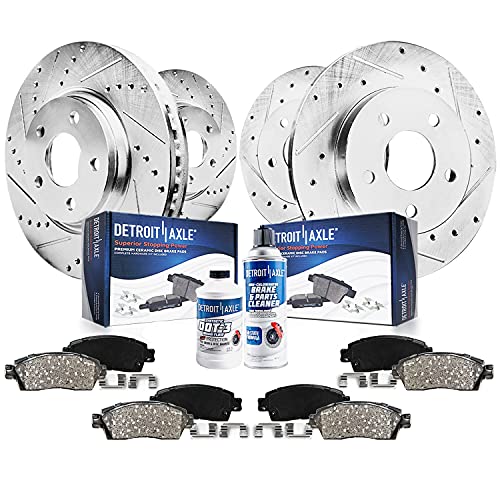
| Best Family Van Pick | Kit Coverage: Front and rear | Vehicle Fitment: Chrysler Pacifica/Voyager | Rotor Style: Drilled and slotted | VIEW LATEST PRICE | Read Our Analysis |
| Detroit Axle BMW Brake Kit Rotors & Pads |

| Performance Luxury Pick | Kit Coverage: Front and rear | Vehicle Fitment: BMW 335 series/X1 | Rotor Style: Drilled and slotted | VIEW LATEST PRICE | Read Our Analysis |
| R1 Concepts Front and Rear Brake Kit |

| Best Muscle Car Fit | Kit Coverage: Front and rear | Vehicle Fitment: Chrysler 300/Challenger/Charger/Magnum | Rotor Style: Drilled and slotted | VIEW LATEST PRICE | Read Our Analysis |
| PowerStop Honda Civic Brake Kit (K7574) |

| Best Civic Upgrade | Kit Coverage: Front and rear | Vehicle Fitment: Honda Civic | Rotor Style: Drilled and slotted | VIEW LATEST PRICE | Read Our Analysis |
More Details on Our Top Picks
Front Brake Kit with Rotors and Ceramic Pads
Should you want a smarter front upgrade for a full-size SUV or truck, this Acinoparts kit fits the bill.
You get:
- 2 drilled and slotted 12.99-inch front rotors
- 4 ceramic pads
- Hardware
It fits 2012 Escalade, Silverado 1500, Tahoe, and Yukon models. The drilled and slotted rotor design helps vent dust and heat, so braking stays more stable as traffic gets annoying. And the ceramic pads keep things cleaner and quieter, which your wheels and ears will appreciate. You also get a 10-year warranty and a 30-day return window. Install it professionally, inspect parts regularly, and replace worn components before your brake pedal starts negotiating.
- Kit Coverage:Front only
- Vehicle Fitment:Escalade/Silverado 1500/Tahoe/Yukon
- Rotor Style:Drilled and slotted
- Pad Material:Ceramic
- Rotor Sizes:12.99 in front
- Warranty:10 year
- Additional Feature:Front axle only
- Additional Feature:Hardware included
- Additional Feature:Professional install recommended
Detroit Axle Brake Kit for Chrysler Pacifica/Voyager
Detroit Axle’s family-van favorite kit fits your Pacifica or Voyager with a full front-and-rear refresh. You get:
- 2 front 12.99-inch drilled and slotted rotors
- 2 rear 12.60-inch drilled and slotted rotors
- Front and rear ceramic pads with hardware
That means you can replace everything at once, not piece it together like a weekend puzzle. And Detroit Axle includes a 10 oz brake cleaner spray plus a 12 oz bottle of brake fluid, which saves an extra parts-store run. It fits 2017 to 2021 Pacifica models and 2020 to 2021 Voyagers, meets or exceeds OEM specs, and backs you with a 10-year warranty.
- Kit Coverage:Front and rear
- Vehicle Fitment:Chrysler Pacifica/Voyager
- Rotor Style:Drilled and slotted
- Pad Material:Ceramic
- Rotor Sizes:12.99 in front / 12.60 in rear
- Warranty:10 year
- Additional Feature:Brake cleaner included
- Additional Feature:Brake fluid included
- Additional Feature:OEM-spec tested build
Detroit Axle BMW Brake Kit Rotors & Pads
For a performance luxury pick, this BMW brake kit fits drivers who want sharp braking without piecing parts together. You get fitment for 2007 to 2015 BMW 335 variants and X1 xDrive35i 3.0L models, plus 13.70 inch front and 13.23 inch rear rotors.
Inside the box:
- 2 front drilled and slotted rotors
- 2 rear drilled and slotted rotors
- Front and rear ceramic pads
- Brake cleaner and brake fluid
The zinc finish helps fight corrosion, and Detroit Axle builds these rotors to exceed OEM specs for fit and stopping power. You also get a 10-year warranty, which is reassuring because brake jobs shouldn’t become a hobby.
- Kit Coverage:Front and rear
- Vehicle Fitment:BMW 335 series/X1
- Rotor Style:Drilled and slotted
- Pad Material:Ceramic
- Rotor Sizes:13.70 in front / 13.23 in rear
- Warranty:10 year
- Additional Feature:Zinc exterior finish
- Additional Feature:Brake cleaner included
- Additional Feature:Brake fluid included
R1 Concepts Front and Rear Brake Kit
R1 Concepts delivers a muscle car-friendly fit with a full front and rear kit built for Mopar drivers. You get 4 drilled and slotted eLINE rotors, 8 ceramic pads, 13.6 inch front rotors, and 12.6 inch rears, all built as direct OEM-spec replacements with no modifications required.
Why it works:
- Cross-drilled, diamond-slotted rotors help improve bite, durability, and smooth stops.
- G3000 iron adds strength and stability.
- Ceramic pads keep dust and noise down.
Before you buy:
- Confirm fitment for your Chrysler 300, Charger, Challenger, or Magnum.
- Check package exceptions, especially Brembo, police, and Daytona trims.
You also get a 1-year defect warranty.
- Kit Coverage:Front and rear
- Vehicle Fitment:Chrysler 300/Challenger/Charger/Magnum
- Rotor Style:Drilled and slotted
- Pad Material:Ceramic
- Rotor Sizes:13.6 in front / 12.6 in rear
- Warranty:1 year
- Additional Feature:G3000 iron construction
- Additional Feature:Diamond slot pattern
- Additional Feature:OEM direct fit
PowerStop Honda Civic Brake Kit (K7574)
PowerStop’s K7574 is a smart Civic upgrade should you want sharper braking without turning your daily driver into a project.
You get a complete bolt-on kit for 2016 to 2021 Honda Civic models:
- 4 drilled and slotted rotors
- 4 Z23 carbon-fiber ceramic pads
- Rubberized shims, stainless hardware, and brake lube
Those carbon fibers help increase stopping power while keeping dust and noise down. The drilled holes and rounded slots improve cooling and clear gas and debris, so pedal feel stays more consistent. Zinc dichromate plating fights rust, too. Just confirm fitment to begin with. Warranty coverage reaches 36 months or 36,000 miles, with 30-day returns.
- Kit Coverage:Front and rear
- Vehicle Fitment:Honda Civic
- Rotor Style:Drilled and slotted
- Pad Material:Carbon-fiber ceramic
- Rotor Sizes:Front and rear included
- Warranty:36 months/36,000 miles
- Additional Feature:Carbon-fiber ceramic formula
- Additional Feature:Zinc dichromate plating
- Additional Feature:Brake lube included
Factors to Consider When Choosing Drilled Brake Rotors
Once I choose drilled brake rotors, I start with the basics: 1) exact vehicle fitment, so the rotor matches your year, make, model, and trim, and 2) correct rotor size, because diameter and thickness have to line up with your caliper and wheel setup. Then I look at 3) pad material, since ceramic, semi-metallic, and organic compounds affect bite, noise, and wear in different ways, and 4) heat dissipation design, because those drilled holes should help manage heat, not just look fast in a parking lot. And I always finish with 5) a corrosion-resistant finish, since a good coating helps fight rust and keeps the hat and edges from turning ugly too soon.
Vehicle Fitment Accuracy
For fitment, I always start with the hard numbers, because a drilled rotor that looks right in the box can still be completely wrong once it meets your hub, caliper, and wheels.
I cross-check:
- OEM diameter, thickness, and offset
- Hat bore diameter and bolt pattern
- Hub-centric or lug-centric mounting
Then I verify the details people skip. Some vehicles need directional left/right rotors, not a universal pattern, so installing the wrong side invites noise, odd wear, and avoidable frustration. I also check parking brake provisions, ABS tone ring or slot placement, and screw or bolt hole locations, because missing hardware alignment can break system function fast.
And I always confirm the part number against year, make, model, engine, and axle position. Boring? Yes. Cheaper than unearthing your “perfect fit” rotor definitely isn’t, onward a mile.
Rotor Size Compatibility
Why does rotor size compatibility deserve its own checklist? Because even a great drilled rotor can become an expensive paperweight when the dimensions are off. I always confirm these basics before purchasing:
- Diameter must match factory spec, often around 12.6 to 13.7 inches, so caliper clearance and braking feel stay correct.
- Thickness, plus minimum thickness, matters for factory clearance and future resurfacing.
- Center bore and bolt pattern must match the hub exactly. No adapters, no machine-shop drama.
- Hat height and overall depth need to align with the caliper bracket, dust shield, and parking brake hardware.
And should you be stepping up to a drilled or drilled/slotted rotor, check that any larger size or vent layout still clears your wheels and suspension. Fit prior to headaches later.
Pad Material Choice
Choose pad material carefully, because drilled rotors don’t work in a vacuum, and the wrong friction compound can turn a smart upgrade into extra noise, faster wear, and heat-related headaches. I’d match pads to how you drive:
- Ceramic for commuting. They run quiet, make less dust, and keep friction consistent for daily use.
- Semi-metallic for towing or hard braking. You’ll get stronger initial bite, but usually more noise and faster rotor wear.
- Organic for gentle street driving. They’re soft and rotor-friendly, yet they fade sooner under demanding use.
- Low-metallic should you want more stopping power than organic pads. But expect more dust and added wear.
I always check the pad’s friction material and temperature rating together. That pairing matters, unless rotor replacement sounds fun. It rarely does.
Heat Dissipation Design
Although drilled rotors are often sold on looks initially, I pay closest attention to how the heat dissipation design actually works, because that’s what helps the brakes stay consistent as repeated stops start piling heat into the system.
I look at:
- Hole count, size, and pattern. More or bigger holes can vent hot gases and move air better, but they also remove mass.
- Rotor thickness and overall thermal mass. A heavier rotor stores and sheds heat more steadily, so I avoid overly aggressive drilling.
- Vented construction and internal vanes. These pull cooling air through the core, not just across the face.
And in the event I see a drilled-and-slotted rotor, I know the slots can help sweep gas and debris away too. Balance matters here. Too many holes, and cooling gains can backfire.
Corrosion Resistance Finish
Beyond cooling, I pay close attention to the corrosion resistance finish, because drilled rotors expose more edges, hole walls, and bare surface area, and that extra metal can rust faster than a plain solid rotor provided it isn’t protected well.
I look for full-coverage finishes, not just a pretty hat section. Good options include:
- zinc plating
- dichromate or silver plating
- ceramic coatings
Those coatings slow oxidation and pitting from moisture and road salt, and in harsh climates they can keep visible rust away for years. But unfinished, or only partly finished, rotors can flash-rust almost immediately after a wet drive. I also watch for coating durability, because heavy flaking or uneven wear can upset balance, add vibration, and make braking feel rough. Should you drive near the coast or salted roads, inspect coating integrity regularly.
Kit Contents Included
Since a drilled rotor kit can look complete in the photos whilst still missing half the pieces you actually need, I always read the contents list line per line prior to my purchase.
I check:
- Two left/right rotors and four pads for one axle, unless I’m purchasing a full set.
- Rotor diameters and pad counts, so everything matches my vehicle exactly.
- Hardware like clips, shims, bolts, and anti-rattle pieces, because missing one tiny part can stall the whole job.
- Extras such as lubricant, brake cleaner, or even brake fluid should I want a more complete package.
And I confirm whether the box covers only the front or rear axle, or all four corners. A “complete kit” can still mean “surprise, you need another order.” That’s annoying.
Warranty And Returns
After I confirm the kit actually includes everything I need, I look just as hard at the warranty and return policy, because a nice photo and a low price won’t help me much whether a rotor shows up damaged, doesn’t fit, or develops a defect a few months later.
I check five things:
- Warranty length. Multi-year coverage usually signals confidence.
- Coverage details. I want defects, cracking, and warping included, not vague promises.
- Exclusions. Wear, bad installation, and track use often void coverage fast.
- Return terms. A 30-day window beats surprise restocking fees should fitment be wrong.
- Claims process. I read the fine print on shipping, inspections, installer approval, and out-of-pocket costs.
And I keep receipts, follow maintenance schedules, and utilize professional installation whenever required. Paperwork matters, annoyingly enough, for expensive brake parts.
Frequently Asked Questions
How Long Do Drilled Brake Rotors Typically Last Under Normal Driving?
They typically last about 30,000 to 70,000 miles under normal driving, though I’d tell you lifespan depends on pad quality, vehicle weight, braking habits, and heat cycles. I recommend checking them regularly for cracks, wear.
Are Drilled Brake Rotors Noisier Than Standard Rotors?
Yes, drilled brake rotors can be noisier—because apparently brakes needed more personality. I’d tell you they often create extra whirring or humming, especially under light braking, though quality pads, proper installation, and bedding can reduce noise.
Can Drilled Brake Rotors Be Resurfaced After Wear or Damage?
Yes, I can tell you drilled brake rotors usually shouldn’t be resurfaced after wear or damage, because machining weakens them around the holes. I recommend replacing them instead, unless your manufacturer specifically allows limited resurfacing.
Do Drilled Brake Rotors Improve Fuel Efficiency or Vehicle Performance?
Power, poise, and performance? I’d say drilled brake rotors can slightly improve braking feel and heat dissipation, but they won’t meaningfully enhance fuel efficiency. You’ll notice better stopping response more than any real speed gains.
Are Drilled Brake Rotors Suitable for Towing or Heavy-Duty Use?
No, I wouldn’t recommend drilled brake rotors for towing or heavy-duty use. I believe they can run hotter, crack under repeated stress, and wear faster. I’d tell you to choose high-quality slotted or solid rotors instead.
