

The best performance brakes and rotors for 2026 deliver strong stopping power, better heat control, and longer pad life. Top kits use quality metals, protective coatings, and pad compounds that stay clean and consistent.
Some are built for trucks and towing, while others suit daily drivers or spirited street use. Here are five standout options and the fitment details that really matter.
| Front Brake Kit for Cadillac Escalade Silverado 1500 |

| Budget-Friendly Pick | Kit Coverage: Front only | Rotor Type: Drilled and slotted | Pad Material: Ceramic | VIEW LATEST PRICE | Read Our Analysis |
| Detroit Axle Brake Kit for GMC Buick Chevrolet |
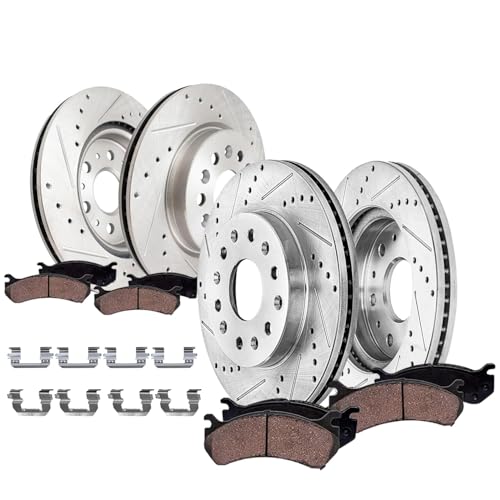
| Best Full Kit | Kit Coverage: Front and rear | Rotor Type: Drilled and slotted | Pad Material: Ceramic | VIEW LATEST PRICE | Read Our Analysis |
| PowerStop Front and Rear Brake Kit K5952 |

| Best for SUVs | Kit Coverage: Front and rear | Rotor Type: Drilled and slotted | Pad Material: Carbon-fiber ceramic | VIEW LATEST PRICE | Read Our Analysis |
| PowerStop Front and Rear Brake Kit K2164 |
| Best for Trucks | Kit Coverage: Front and rear | Rotor Type: Drilled and slotted | Pad Material: Carbon-fiber ceramic | VIEW LATEST PRICE | Read Our Analysis |
| PowerStop Front and Rear Brake Kit K6480 |
| Best for Sedans | Kit Coverage: Front and rear | Rotor Type: Drilled and slotted | Pad Material: Carbon-fiber ceramic | VIEW LATEST PRICE | Read Our Analysis |
More Details on Our Top Picks
Front Brake Kit for Cadillac Escalade Silverado 1500
Should you want a budget-friendly pick, this front brake kit fits big SUVs and trucks without skimping on core performance. You get vehicle-specific fitment for your Escalade, Silverado 1500, Tahoe, or Yukon, plus 12.99-inch drilled and slotted rotors that vent dust and shed heat for steadier stops.
Here’s what stands out:
- Ceramic pads keep braking cleaner and quieter.
- Two front rotors, four pads, and hardware come in the box.
- No assembly’s required, but professional installation’s smart.
And with Acinoparts’ 10-year warranty, you get welcome peace of mind. Just inspect pads and rotors regularly, because brakes aren’t great at giving second chances.
- Kit Coverage:Front only
- Rotor Type:Drilled and slotted
- Pad Material:Ceramic
- Included Components:2 front rotors, 4 front pads, hardware
- Warranty:10-year
- Vehicle Fitment:Escalade, Silverado 1500, Tahoe, Yukon
- Additional Feature:Low-noise pad operation
- Additional Feature:Improved heat dissipation
- Additional Feature:Professional installation recommended
Detroit Axle Brake Kit for GMC Buick Chevrolet
Detroit Axle’s full-kit value shines for GM SUV owners who want matched rotors, pads, and hardware in one box. Should you drive a 2017 to 2020 GMC Acadia, 2018 to 2020 Chevrolet Traverse, 2019 to 2020 Blazer, or 2018 to 2020 Buick Enclave with 12.64-inch front and 12.40-inch rear rotors, this kit fits neatly.
You get:
- 2 front drilled and slotted rotors
- 2 rear drilled and slotted rotors
- Front and rear ceramic pads
- Pad hardware for both axles
Those drilled and slotted rotors help heat and dust move out, while ceramic pads keep braking clean, quiet, and confident. And the 10-year warranty doesn’t hurt.
- Kit Coverage:Front and rear
- Rotor Type:Drilled and slotted
- Pad Material:Ceramic
- Included Components:4 rotors, front/rear pads, hardware
- Warranty:10-year
- Vehicle Fitment:Acadia, Traverse, Blazer, Enclave
- Additional Feature:Front/rear hardware included
- Additional Feature:Exceeds OEM specification
- Additional Feature:Impact wear fatigue tested
PowerStop Front and Rear Brake Kit K5952
PowerStop’s K5952 suits SUVs that need stronger, quieter braking without turning every stop into a project.
If you drive a 2011 to 2020 Dodge Durango or 2011 to 2016 Jeep Grand Cherokee, this kit gives you:
- Front and rear Z23 carbon-fiber ceramic pads
- Front and rear drilled and slotted rotors
- Installation hardware
You get more stopping power than basic OE-style replacements, plus quieter braking and long pad life. The drilled and slotted rotors shed heat, help reduce fade, and use a crack-resistant design. And the silver zinc dichromate plating fights rust. Check confirmed fit before ordering, and expect multiple boxes to arrive.
- Kit Coverage:Front and rear
- Rotor Type:Drilled and slotted
- Pad Material:Carbon-fiber ceramic
- Included Components:4 rotors, front/rear pads, hardware
- Warranty:36-month/36,000-mile limited
- Vehicle Fitment:Durango, Grand Cherokee
- Additional Feature:Carbon-fiber ceramic formula
- Additional Feature:Silver zinc plating
- Additional Feature:Crack-resistant rotor design
PowerStop Front and Rear Brake Kit K2164
Built for trucks, the PowerStop Front and Rear Brake Kit K2164 gives you a complete bolt-on upgrade in one box. You get Z23 carbon-fiber ceramic pads, drilled and slotted rotors, rubberized shims, and stainless hardware, so installation stays straightforward and your pedal feels civilized.
Best for these fits:
- Chrysler Aspen 2007 to 2009
- Dodge Durango 2007 to 2009
- Ram 1500, including many 2006 to 2024 Classic applications
Why you’ll like it:
- Low-dust, quiet pads handle severe-duty stops.
- Zinc-plated rotors resist rust, shed heat, and clear debris.
- No vehicle mods required.
Just confirm fitment beforehand, since K2164 is vehicle-specific.
- Kit Coverage:Front and rear
- Rotor Type:Drilled and slotted
- Pad Material:Carbon-fiber ceramic
- Included Components:4 rotors, front/rear pads, hardware
- Warranty:36-month/36,000-mile limited
- Vehicle Fitment:Aspen, Durango, Ram 1500
- Additional Feature:Rubberized shims included
- Additional Feature:Stainless-steel hardware
- Additional Feature:Bolt-on ready
PowerStop Front and Rear Brake Kit K6480
Should you drive a sedan and want a sharper brake upgrade, the PowerStop K6480 fits the brief. You get front and rear Z23 carbon-fiber ceramic pads, drilled and slotted rotors, hardware, and grease in one 58.7-pound box.
Why it works:
- Carbon-fiber ceramic pads cut dust, enhance bite, and stay quiet with rubberized shims, chamfers, and slots.
- G3000 rotors vent heat, clear debris, and fight fade.
- Silver zinc dichromate plating helps resist rust.
It bolts on with no mods, which your weekend schedule will appreciate. Fitment covers 2012 to 2017 Camry, 2013 to 2018 Avalon, and 2013 to 2018 Lexus ES models. Warranty: 36/36,000.
- Kit Coverage:Front and rear
- Rotor Type:Drilled and slotted
- Pad Material:Carbon-fiber ceramic
- Included Components:4 rotors, front/rear pads, hardware
- Warranty:36-month/36,000-mile limited
- Vehicle Fitment:ES300h, ES350, Avalon, Camry
- Additional Feature:G3000 metallurgy construction
- Additional Feature:Brake grease included
- Additional Feature:Chamfered slotted pad faces
Factors to Consider When Choosing Performance Brakes and Rotors
Whenever I choose performance brakes and rotors, I start with the basics you and I can’t afford to get wrong: exact vehicle fitment, the right rotor design type, and brake pad material that matches how the car actually gets driven. And from there, I look at stopping power needs and heat dissipation performance, because a daily commuter, a tow rig, and a weekend canyon car all punish brakes in very different ways. Get those factors lined up, and you won’t just buy shiny parts, you’ll buy braking hardware that makes sense!
Vehicle Fitment Accuracy
Nailing fitment up front saves a lot of grief later, because performance brakes and rotors only work properly provided every core dimension matches your vehicle exactly.
I always confirm:
- Rotor diameter, thickness, and bolt pattern match factory specs, because even a few millimeters can upset caliper clearance.
- The kit fits the correct axle, front, rear, or both, and uses the exact pad shape, backing plate size, and hardware.
- Model year, trim, and drivetrain match. FWD, AWD, and 4WD versions often hide different brake assemblies. Sneaky, right?
I also cross-reference vehicle-specific fitment claims or OE-equivalent part numbers with the VIN or OEM catalog. And I check hub bore, offset, and lug pattern against the wheel hub and wheels, because runout and interference are terrible surprises.
Rotor Design Type
Because rotor design changes how a brake system sheds heat, clears debris, and hangs onto consistent friction, I look at the rotor style almost as closely as fitment.
Here’s how I break it down for you:
- Plain rotors give you maximum mass and even thermal capacity, so they suit daily driving well and resist stress cracks better than drilled versions.
- Drilled rotors use holes to vent gases and water, which helps in rain, but repeated extreme heat cycles can encourage cracks. Annoying, right?
- Slotted rotors use grooves to sweep away debris and keep the contact surface clean for steadier friction.
- Drilled-and-slotted designs combine both features for stronger cooling and fade resistance.
And don’t ignore size. Larger diameter, thicker, vented rotors add mechanical advantage and heat capacity for repeated hard stops.
Brake Pad Material
A lot of brake feel comes down to pad material, and I’d argue it matters just as much as rotor style in case you want the right mix of bite, heat control, noise, dust, and rotor life.
Here’s how I break it down:
- Ceramic: quiet, low dust, and consistent friction across a broad temperature range. I like it for daily use.
- Semi-metallic: 30 to 70 percent metal, usually steel, iron, or copper. It handles heat well, bites harder, but often adds noise and rotor wear.
- Organic or NAO: softer, quieter, gentler on rotors, but it fades sooner under repeated high heat.
- Low-metallic NAO: adds some metal for better bite and heat transfer, with more dust.
- Track compounds: resist fade at extreme temps, but can need bedding and feel grumpy whenever cold.
Stopping Power Needs
Start with the job your brakes actually have to do, because stopping power isn’t just about grabbing a bigger rotor and calling it performance. I match braking force to weight, cargo, and towing, because a loaded SUV needs more torque than a light coupe.
I focus on:
- Pad material and surface area. More contact and higher-friction compounds help heavier vehicles stop harder.
- Rotor diameter and thickness. Bigger rotors add leverage, so initial bite improves.
- Friction coefficient, or µ. Higher µ enhances stopping power, but it can add noise and wear. I want stable µ across my normal operating range.
- Brake bias and ABS compatibility. In case I upgrade only the front, I can upset balance and invite front lockup. Fast, yes. Graceful, not always.
Choose the whole system, not just shiny parts.
Heat Dissipation Performance
Once heat starts stacking up, I stop contemplating about one hard stop and focus on how well the rotor manages repeated braking without sliding into fade.
I look at:
- Diameter and thickness. Bigger, heavier rotors absorb more thermal energy before temperatures spike.
- Venting and vane design. Internal vanes pump air through the disc, improving convective cooling during repeated stops.
- Slots or drilled holes. They help clear gas and debris and add some surface area, but overdoing drilling cuts thermal mass and can concentrate stress.
I also pay close attention to metallurgy. Specific heat capacity and thermal conductivity decide how fast heat leaves the friction surface and spreads through the rotor. For heavy-duty use, I want high thermal capacity plus coatings that amplify emissivity and fight corrosion. Heat is unrelenting, so the rotor can’t be delicate.
Noise And Dust
Often, I care just as much about what ends up on the wheels and in my ears as I do about raw stopping force, because a brake setup that howls at every light and dusts the spokes in two days gets old fast.
For cleaner, quieter braking, I usually focus on:
- Ceramic pads, which generally make less visible dust and less audible noise than semi-metallic or metallic compounds.
- Drilled or slotted rotors, which clear gases and debris that can glaze pads and trigger squeal.
- Rubberized shims and chamfered pad edges, because they cut vibration before it sings through the caliper.
But parts alone aren’t magic. I also want proper installation, correct bedding-in, and anti-squeal lubricant on pad contact points. Skip those, and even civilized components can act like a garage band.
Warranty And Coverage
Because a strong brake kit can still become an expensive headache should coverage be thin, I always read the warranty before I get excited about rotor coatings, pad compounds, or flashy marketing.
I check:
- Length: 1 year, 3 years, even 10 years, and whether coverage is time-based, mileage-based, or both.
- Scope: materials and workmanship, plus exclusions for normal pad or rotor wear, misuse, bad installation, or vehicle mods.
- Damage terms: whether corrosion, thermal cracking, or premature warping are covered, and what claim evidence they want.
I also look for transferability and any pro-rata clause, because “lifetime” can quietly shrink with age. Finally, I read the claims process. Keep proof of purchase and service records handy, confirm any installer requirement, ask about approval timing, and check who pays shipping or diagnostic fees.
Installation Hardware Included
A surprising number of brake complaints start with the little parts in the box, so I always check whether a performance brake and rotor kit includes the full installation hardware set and whether it matches my exact caliper and pad layout.
I look for:
- Caliper bolts
- Anti-rattle clips
- Pad shims
- Abutment clips or guide pin boots
OEM-style stainless or zinc-plated hardware matters because it fights corrosion, keeps pads sliding freely, and makes future service less miserable. Provided clips, pins, or shims are missing or worn, I replace them. Otherwise, I’m inviting noise, uneven pad wear, and weaker braking.
I also verify fit for:
- Single-piston or multi-piston calipers
- Coated or uncoated rotors
And provided the kit includes torque-specified fasteners plus brake grease or anti-seize, I use lubricant only on metal contact points, never friction surfaces.
Frequently Asked Questions
How Long Is the Typical Break-In Period for New Performance Brakes?
I’d expect a typical break-in period for new performance brakes to last about 200 to 300 miles, though some setups need several heat cycles. I’d tell you to avoid hard stops until bedding fully completes.
Do Performance Brakes Increase Brake Dust Compared to Standard Brake Pads?
Yes, performance brakes often create more dust than standard pads—surprised? I find high-friction compounds shed more material during hard stopping. You’ll usually get better braking, but I’d expect dirtier wheels and more frequent cleaning generally.
Can Performance Rotors Be Resurfaced, or Must They Be Replaced?
Yes, I can resurface some performance rotors provided they’re thick enough and not cracked, warped, or heavily heat-checked. I’d replace drilled, severely worn, or two-piece rotors whenever machining would compromise strength or performance.
Are Performance Brake Kits Compatible With Factory Wheels and Tire Sizes?
Yes—because nothing says simple like brake fitment. I’d tell you many performance brake kits work with factory wheels and tire sizes, but I always check wheel diameter, spoke clearance, offset, and manufacturer fitment notes initially.
Do Performance Brakes Affect Towing Capacity or Fuel Economy?
Yes, they can slightly affect towing and fuel economy. I’d tell you bigger, heavier brakes might add unsprung weight and drag, which can reduce efficiency, while improved heat control and stopping confidence can help during towing.
