

You’ll trust a water temperature gauge most in 2026 once it fits your dash, reacts fast, and stays stable at night. Start with a 52mm LED-backlit gauge on 12V or 12V/24V power, with bold numbers and a smooth needle across a 100°F to 250°F range, or up to 300°F for heavy use. Pick a kit with the right 1/8 NPT or 1/2-14 NPT sensor, adapters, and a user-set alarm, and you’ll feel safer on every drive with more tips ahead.
| Universal 52mm Water Temperature Gauge with LED Backlight |

| Best Simple Analog | Use case: Engine coolant temperature monitoring | Measurement range: 100–250°F | Display type: Analog needle dial | VIEW LATEST PRICE | Read Our Analysis |
| Universal 52mm Water Temperature Gauge with Alarm Sensor |

| Best Alarm Gauge | Use case: Engine coolant temperature monitoring (with warning) | Measurement range: 100–300°F (38–150°C) | Display type: Hybrid (center LED + sweeping needle) | VIEW LATEST PRICE | Read Our Analysis |
| Dyno Racing 52mm Water Temperature Gauge 12V Yellow Light |

| Best Dual-Scale Pick | Use case: Engine coolant temperature monitoring | Measurement range: 110–265°F / 40–130°C | Display type: Analog pointer dial (dual-scale) | VIEW LATEST PRICE | Read Our Analysis |
| 2-in-1 Water Temp & Voltage Gauge Set (32mm) |

| Best 2-in-1 Gauge | Use case: Water temp monitoring (plus voltage) | Measurement range: 14–248°F (plus 9–36V) | Display type: Digital-style gauge w/ backlit display (2-in-1) | VIEW LATEST PRICE | Read Our Analysis |
| LICHAMP R1234YF/R134A 4-Valve Manifold Gauge Set |
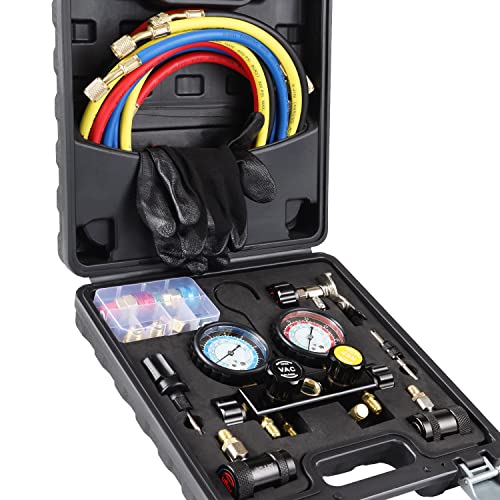
| Best for A/C Pros | Use case: Automotive AC refrigerant pressure monitoring/servicing (manifold gauge) | Measurement range: 0–550 PSI (low) / 0–800 PSI (high) | Display type: Dual analog manifold dials | VIEW LATEST PRICE | Read Our Analysis |
More Details on Our Top Picks
Universal 52mm Water Temperature Gauge with LED Backlight
In case you want a simple way to keep your engine safe, this universal 52mm water temperature gauge is a steady “watchdog” you can trust. You’ll see coolant temps from 100 to 250°F, so you can catch heat creep before it turns into real damage.
Because visibility matters, the 2-inch face shows clear numbers and a crisp needle, and the white LED backlight stays easy to read at night or in rain. Then you’ll like the build: ABS and stainless steel keep it light, tough, and fade-resistant. It runs on 12V DC and includes a sensitive sensor plus install parts for cars, trucks, bikes, and boats.
- Use case:Engine coolant temperature monitoring
- Measurement range:100–250°F
- Display type:Analog needle dial
- Power/source:12V DC
- Connection/mount type:Temp sensor (thread not specified)
- Included components:Gauge + temp sensor + install accessories
- Additional Feature:ABS & stainless build
- Additional Feature:White LED backlight
- Additional Feature:Clear numbers/hands
Universal 52mm Water Temperature Gauge with Alarm Sensor
Want a water temp gauge that’s easy to read at a glance during the moments you’re stuck in traffic, towing, or making a hard pull on a hot day? This universal 52mm gauge helps you stay calm and in control with a bright center LED that’s 87% larger, plus a sweeping blue needle you can catch in a split second.
Next, you get real protection. You can set your own warning threshold, and the alarm backs you up as temps climb. It reads 100 to 300°F, runs on 12V or 24V, and uses an NPT 1/8 sensor. Two face buttons let you program peak and recall too.
- Use case:Engine coolant temperature monitoring (with warning)
- Measurement range:100–300°F (38–150°C)
- Display type:Hybrid (center LED + sweeping needle)
- Power/source:12V or 24V DC
- Connection/mount type:NPT 1/8 sensor thread
- Included components:Gauge + alarm sensor + programmable controls
- Additional Feature:User-selectable warnings
- Additional Feature:Peak/recall functions
- Additional Feature:Ultra-slim 18.8mm
Dyno Racing 52mm Water Temperature Gauge 12V Yellow Light
Drivers who love a classic cockpit look but still need trustworthy cooling info will feel right at home with the Dyno Racing 52mm 12V water temperature gauge. You get a retro pointer dial that reads both °C and °F, so you won’t second-guess what you’re seeing. It tracks 40 to 130°C (110 to 265°F), and its high sensitivity helps you spot trouble before panic sets in. At night, the yellow LED backlight keeps the numbers calm and clear. Installation uses a 1/2-14 NPT sensor, 1.8 m cable, and 12V power. Pro install recommended.
- Use case:Engine coolant temperature monitoring
- Measurement range:110–265°F / 40–130°C
- Display type:Analog pointer dial (dual-scale)
- Power/source:12V DC
- Connection/mount type:1/2-14 NPT sensor thread
- Included components:Gauge + sensor + 1.8m cable
- Additional Feature:Dual-scale dial
- Additional Feature:Yellow LED backlight
- Additional Feature:Retro aesthetic design
2-in-1 Water Temp & Voltage Gauge Set (32mm)
A single, small gauge can calm a lot of worries, and this 2-in-1 Water Temp and Voltage Gauge Set (32mm) from BLLYOGU does exactly that. You get coolant temp from 14°F to 248°F and system voltage from DC 9V to 36V in one tidy display, so you don’t chase two dials. Whenever voltage jumps over 30V or dips under 10V, it flashes to warn you fast, like a quiet co-pilot.
Next, the blue LED backlight stays clear at night. Installation feels simple with the cable, bracket, 1/8 NPT sensor, and 32mm adapter.
- Use case:Water temp monitoring (plus voltage)
- Measurement range:14–248°F (plus 9–36V)
- Display type:Digital-style gauge w/ backlit display (2-in-1)
- Power/source:12–24V (vehicles), measures 9–36V
- Connection/mount type:NPT 1/8 sensor + 32mm inline adapter
- Included components:2-in-1 gauge + sensor + adapter + harness + bracket
- Additional Feature:Combined temp/voltage
- Additional Feature:Flashing alarm lights
- Additional Feature:Multiple adapter sizes
LICHAMP R1234YF/R134A 4-Valve Manifold Gauge Set
Working on your car’s AC can feel stressful, especially in the event that you’re managing two refrigerants and you don’t want to guess and get it wrong. With the LICHAMP R1234YF/R134A 4 valve manifold gauge set, you can charge, evacuate, diagnose, and support recovery work with more confidence. You get a 4 way gauge, four 5 ft hoses, and the right couplers for both systems, plus a can tap, tank adapters, and a valve core remover. Next, the color coded hoses keep you steady, while brass and aluminum parts handle shop life. Gauges read in Fahrenheit too.
- Use case:Automotive AC refrigerant pressure monitoring/servicing (manifold gauge)
- Measurement range:0–550 PSI (low) / 0–800 PSI (high)
- Display type:Dual analog manifold dials
- Power/source:Manual (no vehicle power)
- Connection/mount type:Quick couplers (R1234YF/R134A) + 5 ft hoses
- Included components:4-valve manifold + 4 hoses + couplers + can tap + adapters + valve core remover
- Additional Feature:Dual refrigerant compatible
- Additional Feature:4-way diagnostic manifold
- Additional Feature:Valve core remover included
Factors to Consider When Choosing Water Temperature Car Gauge Sets
At the time you pick a water temperature gauge set, you’re really choosing how safely and confidently you’ll read your engine’s heat every day. You’ll want the right measurement range and units, a sensor type and thread that fits your engine, power supply compatibility that won’t cause wiring headaches, and a display that stays clear at night with solid lighting. Also, you shouldn’t skip alarm and warning features, because they can catch a fast temp spike before it turns your normal drive into a stressful roadside stop.
Measurement Range And Units
Because engine heat can climb fast, you’ll feel a lot safer with a water temperature gauge that covers the full range your car could actually see and shows the numbers in units you understand at a glance. For most cars, you’ll want at least 100°F to 250°F, so normal warm ups and real overheating both stay visible. In case you drive hard, tow, or sit in traffic, a wider 100 to 300°F range adds a cushion, so scary spikes don’t hide off-scale.
Next, check the units. Dual-scale Fahrenheit and Celsius helps whenever you read manuals, shop parts, or share logs with a mechanic. Should you prefer one system, pick a gauge that lets you switch °F and °C quickly. Also, choose precise, steady readings so you can react before damage starts.
Sensor Type And Thread
Although two water temp gauges can look almost the same on your dash, the sensor type and its thread decide whether you get fast, trustworthy readings or a slow needle that makes you second-guess yourself. Choose a highly sensitive sender so it reacts quickly once coolant heat climbs, especially in traffic or on long pulls. That quick response can calm your nerves before trouble grows.
Next, check the thread size and style. In case your engine port is 1/8 NPT, a 1/2-14 NPT sender won’t seat right, and you might fight leaks. Also, look at the thread material. Brass and coated steel usually resist corrosion better in hot, wet bays. Finally, consider install fit. Odd threads might need an adapter or a pro.
Power Supply Compatibility
Why does a water temp gauge sometimes act weird, like it lags, flickers, or reads “hot” for no clear reason? Often it’s power mismatch, not your engine. Initially, check voltage. Most cars use 12V DC, but many trucks run 24V. In case you wire a 12V-only gauge to 24V, it can misread or fail fast. Next, look at current draw. Many sets pull about 0.3A, so in the event yours needs more, you might pop a fuse or strain a weak circuit. Then, choose a gauge that stays stable whenever your alternator ramps up. Finally, pick kits with matched sensors, wiring assemblies, and clean battery connections. Dual 12V and 24V inputs help on the off chance you share vehicles.
Display Readability And Lighting
How fast can you read your water temp gauge as traffic tightens up and the cabin lights feel dim? Whenever seconds matter, a clear gauge face with enlarged display areas helps you catch changes without squinting. Look for bold numbers and a dial size near 2 inches (52mm), so your eyes don’t have to hunt for tiny markings.
Next, pay attention to lighting, because night driving can turn good gauges into guesswork. LED backlighting in white, yellow, or blue keeps the face readable, but brightness and color should stay calm, not harsh. A center LED digital readout gives exact temperature, while a sweeping needle lets you spot trends at a glance. That combo feels reassuring as the road gets busy.
Alarm And Warning Features
During traffic tightens and your attention gets pulled in five directions, a strong alarm on your water temp gauge can step in like a calm co driver and warn you before heat turns into damage.
Look for real time alerts that trigger the moment coolant temperature crosses a safe line. Even better, choose user set thresholds, so you can match the warning point to your engine, your towing load, or your comfort level. Next, make sure the visual warning is loud in its own way, like flashing lights or a bright LED alarm you can’t miss at night. Then add an audible alarm if you prefer a backup whenever your eyes stay on the road. Some sets also pair temp alerts with voltage warnings, helping you catch bigger trouble early.
Gauge Size And Fitment
A good alarm can save your engine, but it won’t help much in case the gauge doesn’t physically fit where you need it. Most water temp gauges use the standard 52mm (2 inch) face, so you can usually drop it into common dash pods and keep the look factory clean.
If space is tight, you could consider a smaller 32mm (1.26 inch) gauge, often paired with extra readouts. Still, it can need special bezels or adapters, so measure initially. Next, check the gauge’s depth and case thickness, because shallow dash spots can block a bulky housing. Also match the sensor thread size, like 1/8 NPT or 1/2-14 NPT, so it seals securely. Finally, pick a mounting style that fits your dash scale, so you can read it fast.
Installation Complexity And Parts
Even should you’ve installed lights or a stereo before, a water temperature gauge can feel a little stressful because it ties into your cooling system and you don’t want leaks. Start off through checking the sensor thread type, since NPT 1/8 and 1/2-14 NPT are common, and a mismatch can stop the job cold. Next, look for a set that includes the sensor, wiring assembly, mounting bracket, and adapters, because hunting extra parts mid install is no fun. Gauge depth and size also matter, so a 52mm face with under 20mm depth usually slips into pods easier. Many kits add adapters for different water pipe diameters, which saves your sanity. Should you be managing a mechanical sensor or odd mounting, call a pro.
Build Materials And Durability
Because your gauge lives inches from heat, coolant, and constant shaking, the materials it’s made from can decide whether it stays accurate for years or starts acting weird after one rough season. Look for tough housings like ABS plastic that won’t warp, crack, or fade whenever the cabin bakes in summer. For rings, fittings, and sensor parts, stainless steel matters because it fights rust and coolant grime that can sneak inside and throw readings off.
Next, consider how it’s mounted. A lightweight but hard-wearing body puts less stress on brackets, so it won’t loosen as you hit bumps. Also, strong materials help the gauge handle vibration and heat cycles without the needle drifting. You’ll feel calmer whenever the number stays steady.
