


Knowing your car’s engine type and engine size is crucial for many reasons. This vital information helps you with proper maintenance, necessary repairs, and performance upgrades. It also significantly impacts your car’s resale value. This guide provides all the steps and resources you need. You will easily find out what engine does my car have. Identifying your engine is simpler than you might think with the right guidance.
Tip: Accurate engine details prevent costly mistakes and ensure you buy the correct parts!
Key Takeaways
Knowing your car’s engine type is important. It helps with maintenance, repairs, and upgrades.
You can find your engine type in many ways. Check your VIN, owner’s manual, or car registration.
Look under the hood for labels and markings. These show engine details and specifications.
Online tools like VIN decoders and manufacturer websites can help. They provide quick engine information.
Understanding engine codes and displacement helps you know your engine better. This includes its size and how it is built.
Why Knowing Your Engine Matters
Understanding your car’s engine is very important. This knowledge helps you in many practical ways. You can make better decisions about your vehicle.
Maintenance and Repairs
Knowing your engine type helps you greatly with maintenance and repairs. You can order the correct parts. Different engine types, like inline, V-type, or boxer, have unique repair needs. For example, replacing a timing belt in a V-type engine can be more expensive. This is because of its complex design. Engine specifications, such as V8, V6, or 4-cylinder, affect replacement costs. Larger, more powerful engines often have higher prices for parts and labor.
💡 Tip: Engines with advanced technologies cost more to maintain. Turbocharging, direct injection, or hybrid systems are complex. Replacing a turbocharger can cost between $2,200 and $2,900. This includes parts and labor. Hybrid battery packs can range from $2,000 to $8,000 to replace. Knowing your engine helps you prepare for these costs.
Performance Upgrades
You can plan performance upgrades better when you know your engine. You understand its power and limits. This knowledge guides your choices for modifications. Different engines respond differently to upgrades. You can choose parts that truly improve your car’s performance.
Resale Value and Accuracy
Accurate engine information is crucial for selling your car. Buyers often ask about the engine type and car engine sizes. You provide correct details for insurance or sale. This builds trust with potential buyers. It also ensures you get a fair price for your vehicle.
Quick Ways to Identify Your Engine
You can quickly find your car’s engine information. Several accessible methods help you identify your engine. These methods are often the simplest ways to learn about your vehicle.
Checking Your VIN
Your Vehicle Identification Number (VIN) is a unique code. It acts like your car’s fingerprint. You can find your VIN in several places. Look under the windshield on the driver’s side. This is the primary VIN for cars made after 1980. You can also find a secondary VIN inside the driver-side doorjamb or door-latch area. Sometimes, it is in the engine compartment. Hidden VINs, called Confidential (CON) VINs, exist in various spots. These include the radiator core support, the frame, or the trunk floor under the spare tire.
The VIN contains specific details about your car. Characters 4 through 8 of your VIN encode important engine information. These characters tell you your vehicle’s engine size. They also tell you your vehicle’s engine type. This makes the VIN a powerful tool to identify your engine.
Consulting Your Owner’s Manual
Your car’s owner’s manual is a treasure trove of information. Manufacturers include detailed specifications about your vehicle in this book. You will find comprehensive engine details here. The owner’s manual often lists the engine’s RPM or shaft speed. This shows how fast the crankshaft rotates. You will also see the number of cylinders your engine has. More cylinders usually mean more power. The manual specifies the engine’s displacement. This is the total volume of the engine cylinders. It indicates power and efficiency.
You can also learn about fuel consumption. This helps you understand your car’s fuel efficiency. The manual details energy efficiency, showing how well your engine converts fuel to power. It includes the compression ratio. This affects power and fuel octane needs. You will find the engine size, which is the same as displacement. The combustion chamber volume is also listed. This influences the compression ratio. The head gasket thickness is a critical specification. It seals the engine block. The block deck height is also there. This influences engine durability. Finally, you will see the engine’s horsepower. This measures power output. You will also find the torque. This shows rotational force, important for towing.
Reviewing Vehicle Registration
Your vehicle registration document also provides key details. This official paper often lists your car’s engine size or type. Look for a section labeled “engine” or “specifications.” The information might be less detailed than your owner’s manual or a VIN decoder. However, it offers a quick reference. This method is useful if you need a fast answer to “what engine does my car have” and do not have immediate access to your car or its manual.
Visual Engine Identification
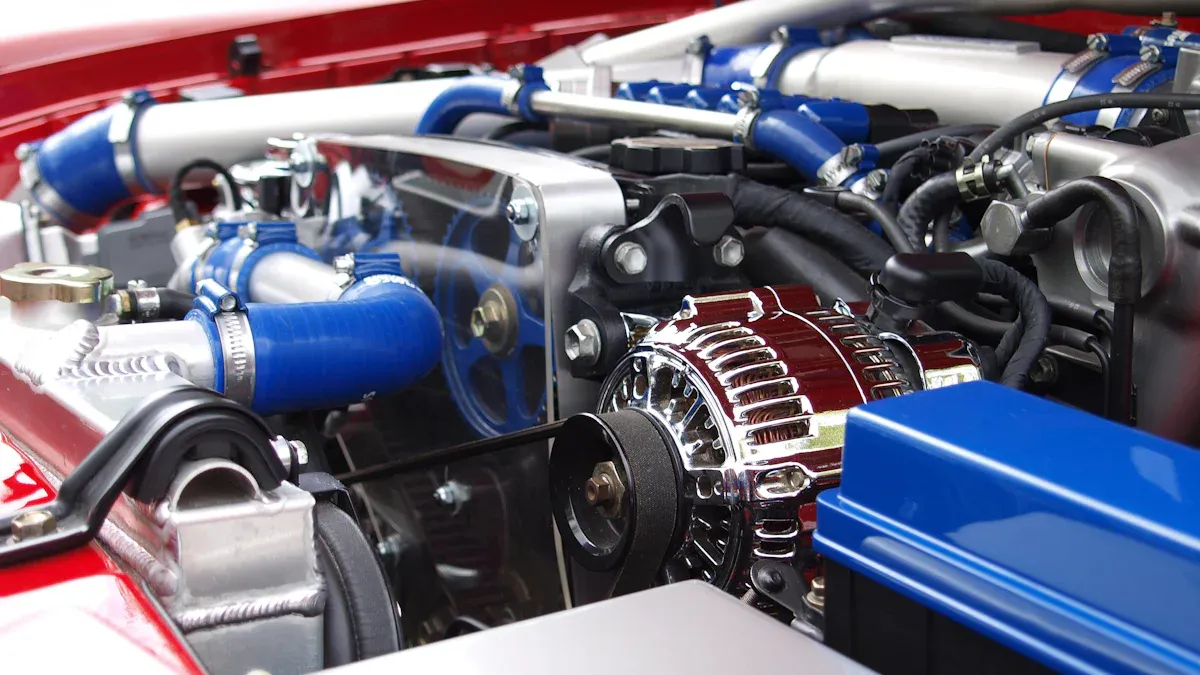
You can often find important engine details by simply looking at your car’s engine. This physical inspection provides direct clues about your engine type and specifications. You will find labels, stamps, and stickers that reveal crucial information.
Under the Hood Labels
Many labels under your car’s hood provide specific engine information. These labels are placed there by the manufacturer. They help you understand your engine’s characteristics.
A label following the SAE ‘J’ standard 639 is common. You will find it in the engine compartment. This label tells you:
The refrigerant type, such as HFC-134a.
The refrigerant capacity in ounces and grams, including any tolerance.
The type of compressor lubricant your car uses.
You can also find labels on the valve cover. Look on the air filter housing or directly on the engine block. These labels display engine displacement and other specifications. Manufacturers also stamp technical details onto metal components and plastic covers.
The EPA’s ‘Vehicle Emission Control Information’ label is another key source. You will find it under the hood or in the engine compartment. This label includes:
The manufacturer’s name and trademark.
A statement confirming compliance with EPA emission regulations.
Engine Block Markings
Your engine block itself often has markings. These are usually serial numbers or displacement figures. They are stamped or engraved directly onto the metal. The location of these markings can vary by engine type.
Engine block markings, especially serial numbers, appear in different places:
Domestic engines (Chevrolet, Ford, Dodge/Chrysler) often have stamps or engravings. You will usually find them at the front of the engine block. They can also be on the side near the alternator or on the engine head.
Japanese Engines (Toyota, Honda, Nissan) commonly place these markings on the valve cover. You might also find them on the front or side of the engine block. Sometimes, they are near the transmission.
German Engines (BMW, Mercedes) generally have markings in the engine bay. They are often near the firewall or on the side of the engine block. Your car’s manual can show you the exact spots.
Diesel Engines (Big Rigs) typically have serial numbers in clear, easy-to-reach spots. Look on the engine block near the fuel pump. They can also be around the valve cover or the fuel injection system.
Heavy Equipment Engines (tractors, bulldozers, cranes) have markings on the engine block. These are either at the front or near the exhaust manifold. Equipment manuals are also excellent references.
For specific Chrysler big-block engines, you can find unique markings. The 440ci RB-motor has “440” stamped on a machined pad. This pad is on the block in front of the lifter valley cover, in the center of the engine. B-motors show their engine displacement stamped on a machined pad. This pad is on the driver’s side of the distributor.
Decoding Engine Bay Stickers
Beyond the main labels and block markings, many smaller stickers in your engine bay offer clues. These stickers provide specific details about various engine components and functions. They help you identify your engine and its parts.
You might see stickers for:
Alternator engine decal.
Firing order engine decal.
Engine oil level decal.
Bosch Ignition Coil decal.
Shell air cleaner decal.
Other specialized stickers can also be present:
Detroit Diesel Engine Information ID Tag Sticker Decal.
Alfa Romeo 156 Restoration Warning Caution Underbonnet Engine Bay Stickers Label.
Audi oil timing belt replacement stickers decals.
Jeep Wrangler CJ7 Restoration Warning Caution Underbonnet Engine Bay Stickers Label.
These visual cues are very helpful. They give you direct information about your car’s engine.
Digital Tools for Engine Identification
You can use many online resources and applications to find your car’s engine details. These digital tools make engine identification easier. They provide quick access to important information.
Online VIN Decoders
Online VIN decoders are powerful tools. You enter your car’s VIN, and the decoder provides detailed information. This includes engine type and size. The National Highway Traffic Safety Administration (NHTSA) offers a reliable VIN decoder tool on its website, vPIC. This tool helps you identify specific information encoded in your vehicle’s VIN. It reveals details like the plant where your car was built. It also shows the country of manufacture. Using a VIN decoder is a fast way to learn what engine does my car have.
Manufacturer Websites
Your car’s manufacturer website is another excellent source. You can often find detailed engine specs there. Visit the official website for your car’s brand. Look for a section on vehicle specifications or owner resources. You can usually enter your car’s model year and trim level. The website will then display comprehensive information about your engine. This includes horsepower, torque, and displacement.
Automotive Apps and Databases
Many automotive apps and online databases exist. These tools compile vast amounts of vehicle data. They help with engine identification. Apps like Autotempest, for example, allow you to search for car specifications. You can find engine details, performance figures, and other important data. These databases often pull information from various sources. They give you a complete picture of your car’s engine. They are useful for quick lookups and comparing different models.
Decoding Engine Codes and Specs

You can learn a lot about your car’s engine by understanding its codes and specifications. These numbers and letters tell you important details about its design and performance.
Interpreting Engine Displacement
Engine displacement tells you the total volume of air and fuel your engine can push through its cylinders. This is a key part of understanding your engine size. You calculate displacement by multiplying three values: the stroke length, the circular area of the cylinder, and the total number of cylinders. The formula is: stroke length × π × (bore/2)^2 × number of cylinders. You typically express engine displacement in cubic centimeters (cc), liters (L), or cubic inches (CID). For example, a four-cylinder engine with an 8.25 cm bore and 9.28 cm stroke has about 1,984 cubic centimeters, or 2.0 liters.
Identifying Engine Configuration
Engine configuration describes how your cylinders are arranged. This helps you identify the specific engine type. Engines can have cylinders in a single row, called straight or inline engines. They can also have cylinders in multiple rows, like V engines or flat engines. Inline engines are generally longer and narrower. V-shape engines are shorter and wider. This makes V-engines easier to fit into different car designs. Inline engines often have simpler designs and are less expensive to make. V-engines can offer higher performance because they can pack more power into a compact design.
Understanding Engine Family Codes
Engine family codes help identify specific engine specs. The EPA uses these codes to group engines for certification. An engine family name is a 12-character code. It identifies all parts of a specific engine. Manufacturers must get new certificates for each family name they sell. For example, a Caterpillar engine might have an EPA Family Name like 5CPXH0928EBK. This code helps track engine details, including its model year and horsepower.
Common Challenges in Engine Identification
You might face some difficulties when trying to find your car’s engine details. However, you can overcome these challenges with the right approach.
Missing Documentation
Sometimes, you do not have your car’s owner’s manual or registration papers. This makes engine identification harder. If you bought a used car, the previous owner might not have given you all the documents. You can still find the information. Use online VIN decoders. These tools can give you many details about your car, including its engine type. You can also visit the manufacturer’s website. They often have digital versions of owner’s manuals.
Modified Engines
Some cars have engines that are not original. A previous owner might have swapped the engine. This makes it hard to trust standard identification methods. You need to look closely for signs of modification.
Examine the quality of stamped numbers. Factory stampings have consistent spacing and depth. Uneven spacing or overlapping digits suggest someone altered the numbers.
Check physical features against known specifications. For example, count the setscrews on a blanking plate. This number should match the engine’s expected series. A mismatch means the engine might not be original.
Cross-reference casting numbers with part numbers. Look at the casting number on the engine block. Compare it to documented part numbers for your car’s series. A difference can show an altered engine.
Look for engine numbers in other places. You might find them on the flywheel or crankshaft. If these match other documents, it increases confidence in the engine’s authenticity.
Be suspicious of numbers that do not look right. Unusual or inconsistent stampings need more investigation.
Ambiguous Information
Sometimes, the information you find is unclear. You might see conflicting details from different sources. For example, a VIN decoder might show one engine type, but a label under the hood shows another. When this happens, prioritize official sources. Your car’s manufacturer website or a certified dealership can provide the most accurate information. You can also consult a trusted mechanic. They often have specialized tools and knowledge to confirm your engine’s identity.
You now have many ways to find your car’s engine details. You can check your VIN, owner’s manual, or look under the hood. Digital tools also help you. Finding what engine does my car have is simple with this guide. You can use these reliable methods. Being well-informed helps you make smart choices for your vehicle. You can confidently manage your car’s needs. Enjoy being a knowledgeable car owner!
FAQ
How do I find my engine code?
You can find your engine code in several places. Check your VIN; characters 4 through 8 often tell you your engine type. Your owner’s manual also lists engine details. Look for labels under the hood or markings on the engine block.
Why is knowing my engine important for maintenance?
Knowing your engine helps you buy the correct parts. It ensures you follow the right service schedule. This prevents costly mistakes and keeps your car running well.
What does engine size mean?
Engine size refers to its displacement. This is the total volume of air and fuel your engine can process. It indicates your engine’s power and efficiency.
What if my car has a modified engine?
If your car has a modified engine, standard methods might not work. Look for physical signs of modification. Consult a trusted mechanic. They can help identify the engine accurately.



