

Mitsubishi is a Japanese conglomerate that is significant in understanding which country owns Mitsubishi, as this reveals the influence and control over its diverse entities. The Mitsubishi Group includes several key companies, such as Mitsubishi Corporation, Mitsubishi Heavy Industries, and Mitsubishi Motors, each playing a significant role in various sectors.
Key Takeaways
Mitsubishi is a group of independent companies, not just one. This allows each company to focus on its market while sharing common values.
Diverse ownership among Mitsubishi companies promotes stability and collaboration. Major stakeholders include Nissan and Mitsubishi Corporation.
Understanding Mitsubishi’s ownership helps reveal its global influence and the balance of interests among various investors.
Mitsubishi Group Overview
Mitsubishi is not just one company; it is a group of independent companies that operate under the Mitsubishi name. This structure allows each company to focus on its specific market while benefiting from shared values and principles. The Mitsubishi Group consists of about 30 companies, each contributing to various sectors.
Key Companies
Here are some key members of the Mitsubishi Group and their primary business activities:
Mitsubishi Corporation (Americas): This is a wholly-owned U.S. subsidiary of Mitsubishi Corporation.
Cutbank Ridge Partnership: This company focuses on the production and marketing of natural gas in Canada.
Diamond LNG Canada Ltd.: It manages the LNG Canada project.
Cameron LNG: This company operates an LNG plant in Louisiana.
Isuzu Motors de Mexico S. de R.L.: It handles the import, assembly, and sales of automobiles in Mexico.
Agrex, Inc.: This company specializes in the origination and marketing of grain.
The Mitsubishi Group operates in several sectors, including:
Sector | Scale of Operations |
|---|---|
Mineral Resources | 330,000 tons per year of equity production volume of copper, with plans to increase capacity. |
LNG | Current production capacity of 13 MTPA, aiming to grow to 18 MTPA by 2030. |
Automotive | Significant share of pickup trucks in Thailand; operations in ASEAN, Australia, Europe, India, Mexico. |
Food | One of the world’s largest producers of farmed salmon, catering to health-conscious consumers. |
Historical Context
The history of the Mitsubishi Group is rich and complex. Here are some key milestones in its evolution:
Early 1870s: Yataro Iwasaki founded Mitsubishi as a shipping company.
1954: Mitsubishi Corporation established itself as Japan’s largest general trading company.
1982: The company went public on the Tokyo Stock Exchange, marking a significant change in its ownership structure.
Post-WWII: The Allied occupation of Japan led to the dissolution of the zaibatsu, which impacted corporate identity but preserved management principles.
Originally, the Mitsubishi Group operated as a unified company known as the Mitsubishi zaibatsu from 1870 to 1946. After World War II, the zaibatsu was disbanded, resulting in the formation of independent companies. Although these companies share the Mitsubishi brand and logo, they operate independently without common control. They engage in business with each other and often own shares in one another, maintaining a cohesive system.
Mitsubishi Corporation’s recent management strategy, Corporate Strategy 2027, emphasizes leveraging integrated strengths for future growth. This strategy reflects the company’s commitment to adapting to geopolitical and economic changes while strengthening its earnings base.
Country Owns Mitsubishi Entities

Mitsubishi Corporation
Mitsubishi Corporation stands as Japan’s largest general trading company. You will find that its ownership structure is diverse, with various stakeholders holding significant shares. The table below illustrates the breakdown of ownership by shareholder type:
Shareholder Type | Percentage Ownership |
|---|---|
Foreign Institutional Investors | 37.0% |
Japanese Institutional Investors | 20.6% |
Individual Investors | 9.4% |
Mitsubishi Group Companies | 10.9% |
Treasury Stock | 5.5% |
Other Shareholders | 16.6% |
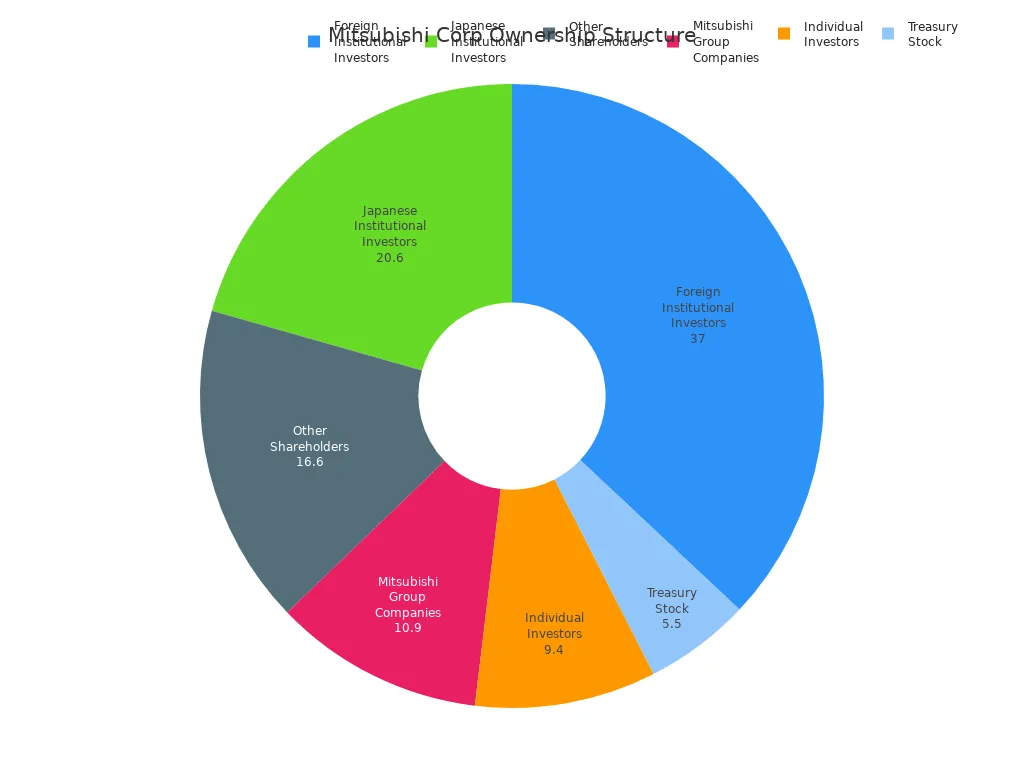
This diverse ownership reflects the global interest in Mitsubishi Corporation. You can see that foreign institutional investors hold a substantial portion, indicating international confidence in the company.
Mitsubishi Heavy Industries
Mitsubishi Heavy Industries (MHI) operates in various sectors, including aerospace, defense, and energy. Its ownership structure also shows a mix of domestic and foreign stakeholders. The table below highlights some of the major shareholders:
Name | % | Valuation |
|---|---|---|
Meiji Yasuda Life Insurance Co. | 2.372 % | 2,045 M ¥ |
Amova Asset Management Co., Ltd. | 1.927 % | 1,662 M ¥ |
Mitsubishi Heavy Industries Employee Stock Ownership Plan | 1.157 % | 998 M ¥ |
MUFG Bank Pension Fund | 1.136 % | 979 M ¥ |
Mitsubishi UFJ Asset Management Co., Ltd. | 0.9623 % | 830 M ¥ |
VESTAS WIND SYSTEMS A/S | 2.5% | 502,762,477 $ |
CENTRAL JAPAN RAILWAY COMPANY | 0.72% | 198,040,339 $ |
NIPPON YUSEN KABUSHIKI KAISHA | 0.71% | 111,763,256 $ |
JAPAN ENGINE CORPORATION | 14.8% | 91,685,271 $ |
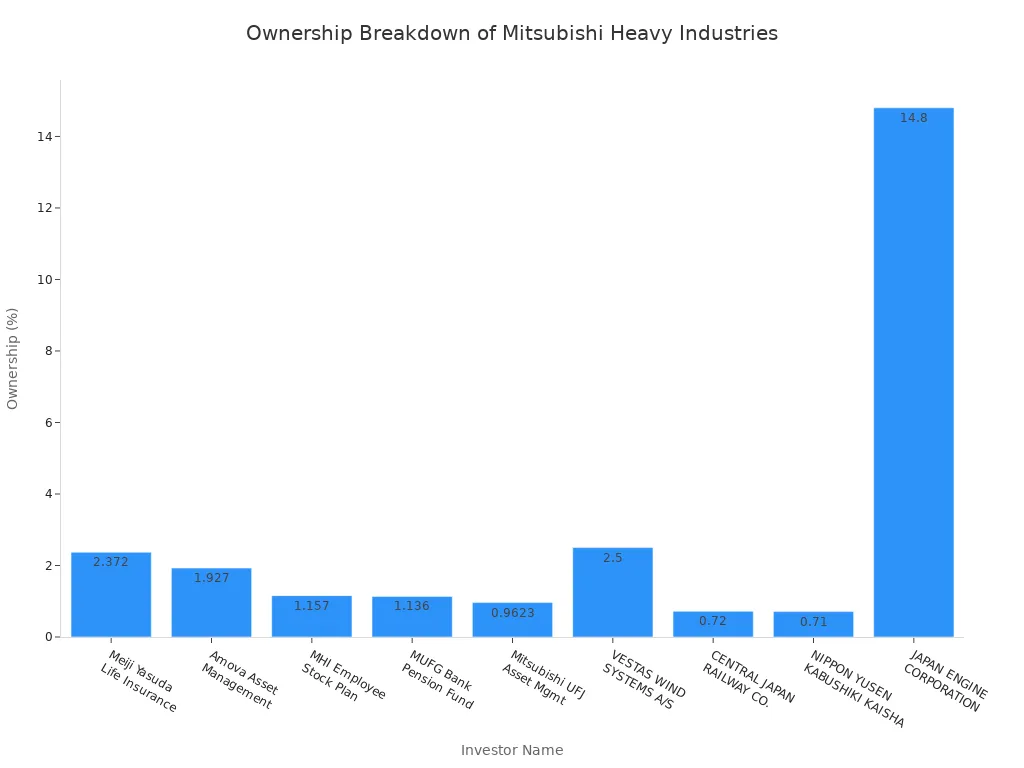
MHI’s ownership structure reflects the influence of both Japanese and foreign investors. The Japanese government and corporations play a significant role in guiding MHI’s management policies, ensuring that the company remains competitive and innovative.
Mitsubishi Motors
Mitsubishi Motors has a unique ownership structure, heavily influenced by its partnerships. The table below shows the major shareholders and their respective stakes:
Shareholder Name | Percentage of Shares |
|---|---|
NISSAN MOTOR CO., LTD. | 24.48 % |
MITSUBISHI CORPORATION | 20.41 % |
MITSUBISHI MOTORS CORPORATION | 8.216 % |
Arcus Investment Ltd. | 1.714 % |
MITSUBISHI HEAVY INDUSTRIES, LTD. | 1.477 % |
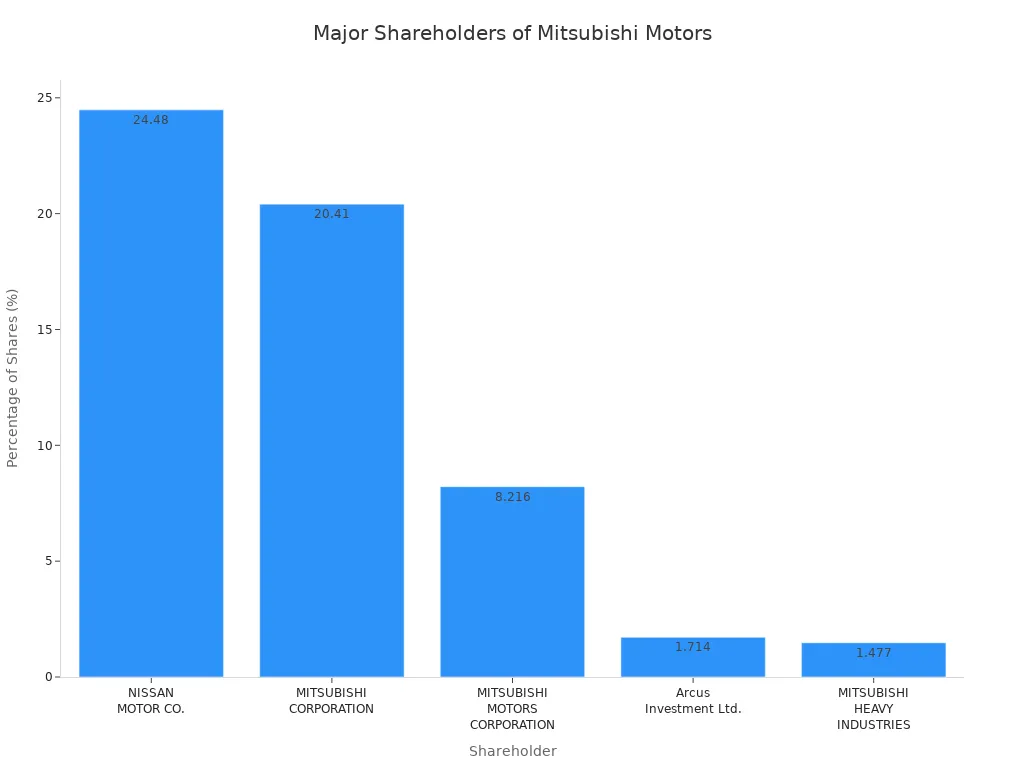
Nissan holds a significant stake in Mitsubishi Motors, making it the largest shareholder. This relationship allows both companies to collaborate on innovation and share resources effectively.
Mitsubishi UFJ Financial Group
Mitsubishi UFJ Financial Group (MUFG) is Japan’s largest financial group. Its ownership structure is also diverse, with significant stakes held by both domestic and international investors. The table below outlines the major stakeholders:
Stakeholder | Ownership Percentage | Country/Region |
|---|---|---|
Morgan Stanley | 23.38% | United States |
Bank of Ayudhya | 76.88% | Thailand |
Mitsubishi HC Capital Inc. | 19.57% | Japan |
Vietnam Commercial Bank for Industry | 19.73% | Vietnam |
PT Bank Danamon Indonesia Tbk | 92.47% | Indonesia |
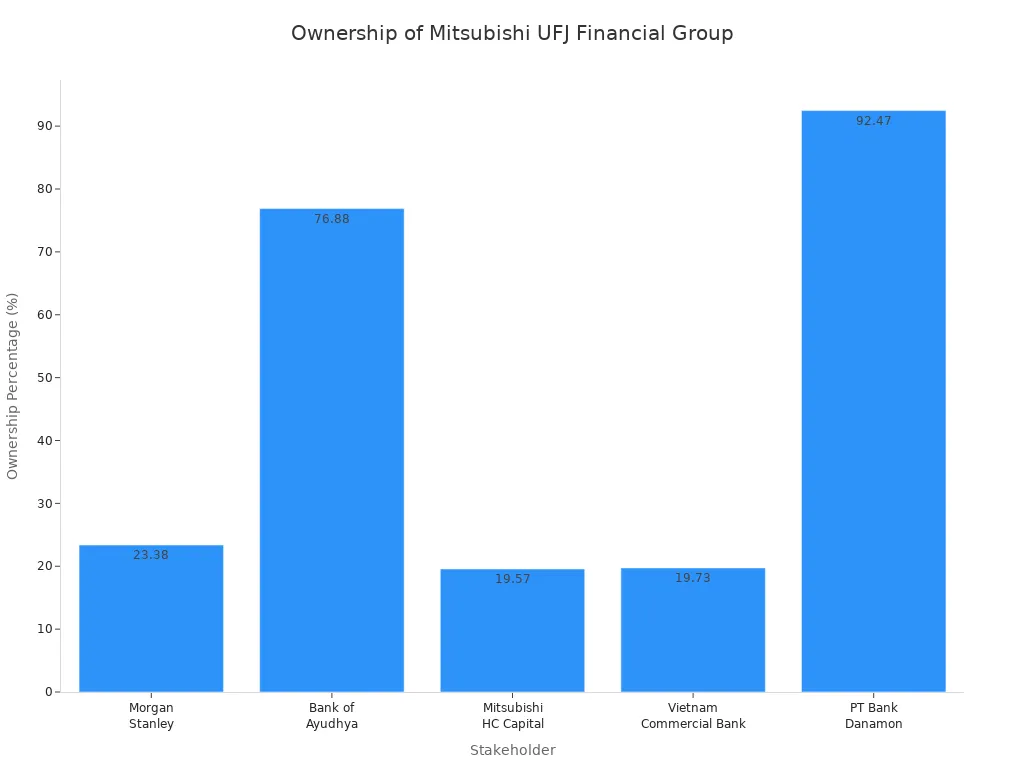
MUFG’s ownership reflects broader trends in Japanese banking and finance. Japanese financial institutions hold a significant portion of shares, indicating strong domestic support.
Mitsubishi’s ownership structure plays a vital role in its global influence. Key players like Nissan Motor Co. and Mitsubishi Corporation ensure stability and collaboration. This diverse ownership promotes innovation while balancing various stakeholder interests. Here are some key takeaways:
Key Player | Ownership Percentage | Role in Mitsubishi Group |
|---|---|---|
Nissan Motor Co., Ltd. | 26.67% | Biggest single shareholder of Mitsubishi Motors |
Mitsubishi Corporation | 22.23% | Core trading arm of the group |
Other Stakeholders | N/A | Includes various institutional investors |
Mitsubishi Family | 10% – 15% | Indirect holdings through family trusts |
Mitsubishi Heavy Industries | N/A | Small stake in Mitsubishi Motors |
Mitsubishi UFJ Financial Group | N/A | Financial support for group projects |
This structure promotes stability and collaboration among sectors.
It prevents hostile takeovers and sudden management changes.
It facilitates resource pooling for innovation and project support.
FAQ
What is the Mitsubishi Group?
The Mitsubishi Group consists of independent companies operating under the Mitsubishi name, covering various sectors like automotive, finance, and energy.
Who are the major shareholders of Mitsubishi Motors?
Nissan Motor Co. and Mitsubishi Corporation are the largest shareholders of Mitsubishi Motors, holding significant stakes in the company.
Is Mitsubishi Corporation publicly traded?
Yes, Mitsubishi Corporation is publicly traded on the Tokyo Stock Exchange, allowing various investors to buy shares and participate in its growth.



