

You want reliable, high-flow fuel-water separation that keeps your engine clean and running. Pick 10-micron units like the Kofil R12T, iFJF R12H, Seachoice Yamaha canister, S3213-compatible filter, or Attwood universal for proven removal of water and particulates. Make sure the separator’s flow exceeds engine demand, mount the bowl where you can drain and inspect it, and keep spare elements and O-rings aboard. Keep going to see specs, installation tips, and maintenance checks.
| Kofil R12T Marine Fuel Water Separator Assembly |

| Best Overall Performance | Micron Rating: 10 micron | Fuel Type Compatibility: Gasoline and diesel (outboard engines) | Water Separation Capability: Removes up to 99% of water and debris | VIEW LATEST PRICE | Read Our Analysis |
| S3213 Marine Fuel Water Separator Filter (Compatible) |

| Best for Compatibility | Micron Rating: 10 micron | Fuel Type Compatibility: Unleaded gasoline (marine outboards; universal applications) | Water Separation Capability: Separates water and allows visual inspection/drain | VIEW LATEST PRICE | Read Our Analysis |
| Seachoice Fuel Water Separator Filter Canister Yamaha 10 Micron |

| OEM Replacement Pick | Micron Rating: 10 micron | Fuel Type Compatibility: Gasoline (Yamaha outboards) | Water Separation Capability: Removes water from fuel system (meets OEM) | VIEW LATEST PRICE | Read Our Analysis |
| iFJF R12H Fuel Water Separator Marine Combo |
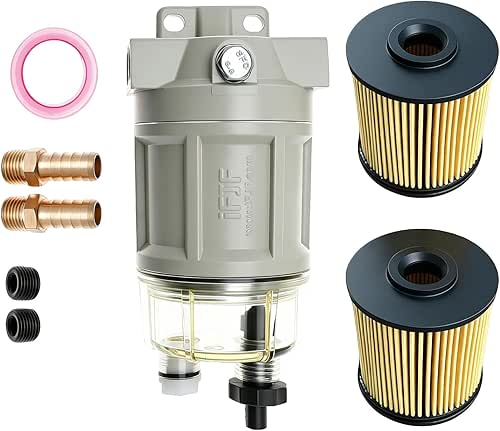
| Best for Upgrades | Micron Rating: 10 micron | Fuel Type Compatibility: Gasoline and diesel (marine use, spin-on) | Water Separation Capability: Removes water (transparent bowl with drain) | VIEW LATEST PRICE | Read Our Analysis |
| Attwood Universal 10-Micron Fuel/Water Separator Filter |
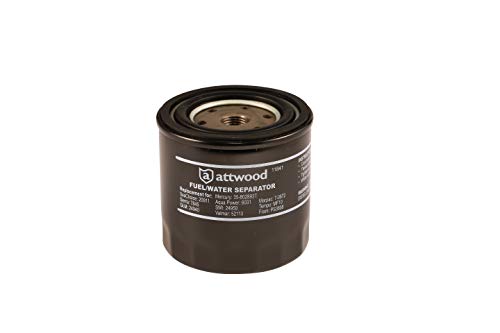
| Budget-Friendly Universal | Micron Rating: 10 micron | Fuel Type Compatibility: Marine and small-engine fuel (gasoline) | Water Separation Capability: Fuel/water separation capability | VIEW LATEST PRICE | Read Our Analysis |
More Details on Our Top Picks
Kofil R12T Marine Fuel Water Separator Assembly
In case you run an outboard motor and need reliable protection against water and debris, the Kofil R12T Marine Fuel Water Separator Assembly is a strong choice — it’s a 10-micron, high-performance unit designed to remove up to 99% of water and harmful particles from gasoline and diesel, protecting injectors and other sensitive components while supporting flow rates up to 15 GPH. You’ll appreciate the 3-layer element with deeper, denser pleats for extended life, rust-resistant coated body, and ready-to-install kit (sealant tape, plugs, fittings). Replace every 500 hours or 10,000 miles and verify compatibility before buying.
- Micron Rating:10 micron
- Fuel Type Compatibility:Gasoline and diesel (outboard engines)
- Water Separation Capability:Removes up to 99% of water and debris
- Connection / Fittings:3/8″ barb × 1/4″ NPT male fittings (included)
- Clear Collection Bowl / Visual Inspection:Not specified as clear bowl but includes drain/collection features and rust-resistant body
- Marine Use / Outboard Compatibility:Specifically for outboard motor marine engines
- Additional Feature:3-layer high-performance element
- Additional Feature:Rust-resistant coated body
- Additional Feature:Includes sealant tape
S3213 Marine Fuel Water Separator Filter (Compatible)
Should you run outboard engines from Yamaha, Mercury, Suzuki or use Racor/Sierra systems, the S3213-compatible marine fuel water separator is built to keep your fuel clean and flowing—its high-performance 10-micron element removes dirt and rust while the clear TPU bowl lets you spot water and debris at a glance. You’ll get direct replacements for many part numbers (S3213, 18-7922, 35-60494-1, MAR-24563-03-00, etc.), corrosion-resistant construction, and a rugged clear nylon/TPU collection bowl. The unit balances filtration and flow, includes a self-draining stopper, 3/8″ barb and 1/4″ NPT fittings, and Amazon support within 12 hours.
- Micron Rating:10 micron
- Fuel Type Compatibility:Unleaded gasoline (marine outboards; universal applications)
- Water Separation Capability:Separates water and allows visual inspection/drain
- Connection / Fittings:3/8″ barb and 1/4″ NPT fittings
- Clear Collection Bowl / Visual Inspection:Clear nylon/thermoplastic polyurethane bowl for visual inspection
- Marine Use / Outboard Compatibility:Compatible with Yamaha, Mercury, Suzuki and other outboards (marine)
- Additional Feature:Clear thermoplastic bowl
- Additional Feature:Self-spraying drain stopper
- Additional Feature:Wide OEM compatibility list
Seachoice Fuel Water Separator Filter Canister Yamaha 10 Micron
Boat owners running Yamaha outboards will appreciate the Seachoice 10-micron fuel water separator canister because it directly replaces Sierra 18-7866 and gives reliable protection against water and solid contaminants. You’ll get a high-efficiency 10-micron filter that meets OEM specifications and removes both water and particulate from your fuel system. That means smoother engine performance and reduced wear on injectors and fuel pumps. It’s built for marine conditions and backs performance with a one-year warranty, so you can trust replacement fit and function. Install it to protect your Yamaha outboard and maintain peak fuel system reliability.
- Micron Rating:10 micron
- Fuel Type Compatibility:Gasoline (Yamaha outboards)
- Water Separation Capability:Removes water from fuel system (meets OEM)
- Connection / Fittings:(Standard marine replacement — fits Yamaha/Sierra OEM connections)
- Clear Collection Bowl / Visual Inspection:Filter canister designed for marine use (OEM; implies serviceability) — compatible with transparent bowl designs
- Marine Use / Outboard Compatibility:Compatible with Yamaha outboards; marine application
- Additional Feature:OEM-spec replacement canister
- Additional Feature:1-year warranty backed
- Additional Feature:Yamaha-compatible design
iFJF R12H Fuel Water Separator Marine Combo
Should you want a durable, service-friendly separator that cuts operating costs, the iFJF R12H Fuel Water Separator Marine Combo is a strong choice — it lets you replace just the internal filter element (rather than the whole spin-on unit) and comes with two spare elements and extra O-rings so you’re ready for routine maintenance. You get a complete combo that replaces S3240/R12T/120AT/18-7987/RK10222, two fittings, two plugs, and a transparent nylon bowl with drain. The aluminum alloy housing resists seawater corrosion. It flows 15 GPH, filters to 10 microns, and uses large-capacity media. Expect reusable parts and reduced long-term costs.
- Micron Rating:10 micron
- Fuel Type Compatibility:Gasoline and diesel (marine use, spin-on)
- Water Separation Capability:Removes water (transparent bowl with drain)
- Connection / Fittings:Two connection fittings included (compatible with common marine ports)
- Clear Collection Bowl / Visual Inspection:Transparent nylon collection bowl with black drain valve
- Marine Use / Outboard Compatibility:Marine fuel water separator combo; replaces marine part numbers
- Additional Feature:Includes two extra elements
- Additional Feature:Aluminum alloy housing
- Additional Feature:Spin-on replaceable design
Attwood Universal 10-Micron Fuel/Water Separator Filter
Should you want reliable 10-micron filtration for marine or small-engine fuel systems, the Attwood 11841-4 is a solid universal choice—its double gasket/double seal design improves leak resistance and helps keep water out of your fuel. You’ll get true fuel/water separation with a 10-micron element that blocks fine particulates while shedding water. The universal 3/8″ ports fit common plumbing, and it replaces Mercury 35-60494-1, Aqua Power 6031, GLM 24940, Sierra 18-78250, SMI 15494, Valmar 52113, and Marpac 7-0872, simplifying maintenance. Install it as a drop-in upgrade whenever you need dependable, compact filtration for boats or small engines.
- Micron Rating:10 micron
- Fuel Type Compatibility:Marine and small-engine fuel (gasoline)
- Water Separation Capability:Fuel/water separation capability
- Connection / Fittings:Universal 3/8″ ports
- Clear Collection Bowl / Visual Inspection:(Implicit — universal separator design supports visual/inspection and drain features)
- Marine Use / Outboard Compatibility:Universal replacement for marine and small-engine fuel systems
- Additional Feature:Double gasket double seal
- Additional Feature:Universal 3/8″ ports
- Additional Feature:Broad OEM cross-reference list
Factors to Consider When Choosing Performance Fuel Water Separators
Upon picking a performance fuel water separator, check the filtration micron rating and flow rate capacity to make sure it matches your engine’s needs. You’ll also want high water separation efficiency and materials that resist corrosion for long-lasting protection. Finally, confirm the installation requirements and fittings fit your system to avoid leaks and pressure issues.
Filtration Micron Rating
Consider the micron rating the primary measure of how well a fuel/water separator will trap solid contaminants: it tells you the smallest particle size the media will catch (for example, a 10‑micron element stops particles roughly 10 micrometers and larger). You’ll pick lower micron numbers for finer filtration, but finer media usually raises flow restriction and can demand more frequent changes to prevent fuel starvation. Match the micron rating to protect sensitive parts—many injectors need ≤10 microns—while confirming your pump and engine tolerate the added pressure drop. Keep in mind micron rating addresses solid particle capture; water separation depends on media design and coalescing properties. For older or contaminated systems, finer filtration helps wear prevention, but always verify compatibility with your engine’s allowable pressure limits.
Flow Rate Capacity
Micron rating tells you what particles get stopped, but you also need a separator that can supply enough fuel under load. Make certain the separator’s maximum flow rate meets or exceeds your engine’s peak fuel demand (GPH) so you won’t starve the engine at full throttle. Should you run multiple engines, sum each engine’s wide-open-throttle consumption and choose a unit with a 10–20% safety margin. Check rated flow at the specified micron level rather than an unfiltered maximum, since finer filtration can reduce throughput. Confirm the rating is continuous for long runs; intermittent ratings won’t sustain high-load operation. Lastly, account for plumbing restrictions—hose diameter, fittings, and bends can create internal losses that lower actual flow below the nominal GPH.
Water Separation Efficiency
Although particle size matters, you also need a separator that actually removes free and droplet water from fuel with high efficiency, because water can quickly damage injectors and pumps. Aim for units rated to remove visible-phase water at 90–99% efficiency so free water doesn’t reach downstream components. Don’t assume micron ratings tell the whole story: a 10 µm particulate rating is common, but check separate water-separation specs. Prefer coalescing media that agglomerates fine droplets into larger ones for faster separation and less emulsification risk. Verify the collection bowl capacity and a reliable drain valve so accumulated water won’t force premature service. Finally, confirm the separator maintains high water-removal efficiency at your engine’s maximum fuel flow, not just at low test-flow conditions.
Material Corrosion Resistance
Because fuel systems live in harsh, often salty environments, pick separators built from corrosion-resistant metals (stainless or coated aluminum) or high-grade polymers so housings won’t pit or weaken over time. You should also choose bowls and sight-glasses made from UV-stable, impact-resistant plastics (nylon blends or TPU) to resist cracking and chemical attack from fuel and sunlight. Make sure seals, O-rings, and drain valves use fuel-resistant elastomers like Viton (FKM) or compatible nitrile to prevent swelling, hardening, and leaks. Look for anodizing, powder or epoxy coatings and sacrificial design features that reduce galvanic corrosion whenever different metals contact. Finally, verify lifespan ratings or ASTM B117 salt-spray test results where available—proven resistance predicts longer service life and fewer failures.
Installation And Fittings
After choosing corrosion-resistant materials and compatible seals, you’ll want to plan how the separator will connect and sit in your system so it actually works as intended. Verify inlet/outlet types and sizes—common are 3/8″ barb and 1/4″ NPT—and match them to your fuel line and fittings to prevent leaks or flow restriction. Choose fittings and hoses rated for fuel and marine use, like brass or corrosion-resistant stainless and ethanol-compatible hose, to preserve seal integrity. Make certain separator orientation and mounting place the bowl/drain accessible and, whenever required, below the fuel source for gravity feed and proper water drainage. Use proper thread sealant or PTFE tape on NPT fittings and torque to manufacturer specs. Confirm the separator’s max flow rate exceeds your engine’s demand.
Maintenance And Service Life
As you pick a performance fuel water separator, plan for its upkeep and service life up front so it reliably protects your engine; replace the element per the manufacturer’s interval (about every 500 hours or 10,000 miles), inspect the clear bowl and drain water after long trips or monthly, and watch for rising differential pressure or fuel-starvation symptoms that signal a clogged element needing immediate change. Keep spare elements, O-rings, and drain plugs on board and log installation dates so you can swap parts before they fail. During service, inspect seals, fittings, mounting hardware, and the bowl for corrosion or damage and replace compromised parts to prevent leaks. Monitor differential pressure or fuel flow continually; a rising pressure drop demands prompt element replacement to avoid downtime.
