Good brakes should bite cleanly the first time you squeeze the lever and stay consistent through mud, heat, and long rides.
This guide picks five 2026 rotors built from corrosion-resistant stainless, with smart cooling patterns and precision fit for less warp and longer pad life.
Options cover off-road grit, street performance, and heavy touring setups matched to common bikes and riding styles.
Read on for practical picks and what to look for next.
| 3-Pack Brake Rotor Discs for Arctic Cat Models |

| Best Fitment | Material: 420 stainless steel core | Application Type: Powersports/ATV brake rotor (front/rear) | Heat/warp resistance: Hardened surface treatment; warping tolerance 0.03 mm | VIEW LATEST PRICE | Read Our Analysis |
| 260mm Stainless Steel Front Disc Brake Rotor (6-Hole) |

| Lightweight Performance | Material: Stainless steel rotor with aluminum alloy carrier | Application Type: Motorcycle front disc rotor | Heat/warp resistance: Fast heat dissipation; reduces deformation at high temps | VIEW LATEST PRICE | Read Our Analysis |
| Dirt Bike Brake Disc Rotor 190mm (Fits Chinese Pit Bikes) |
| Small-Bike Friendly | Material: Stainless steel | Application Type: Pit/dirt bike front or rear rotor | Heat/warp resistance: Vented design to reduce deformation from overheating | VIEW LATEST PRICE | Read Our Analysis |
| 11.8″ Mirror-Polished Stainless Steel Front Brake Rotor for Harley Touring | Premium Touring | Material: 420 stainless steel (mirror-polished) | Application Type: Motorcycle (Harley Touring) front rotor | Heat/warp resistance: Full-sweep pattern and heat-treated for rapid cooling and reduced vibration | VIEW LATEST PRICE | Read Our Analysis | |
| M MATI Front Brake Disc Rotors for Polaris Vehicles |

| OEM Replacement | Material: High-strength stainless steel SUS 420 | Application Type: Powersports/ATV front brake rotor | Heat/warp resistance: Heat-treated to HRC 34–38; resists high-temperature warping | VIEW LATEST PRICE | Read Our Analysis |
More Details on Our Top Picks
3-Pack Brake Rotor Discs for Arctic Cat Models
Should you ride an Arctic Cat ATV and want a simple, dependable upgrade, these 3-pack brake rotor discs are a strong choice because they match factory specs and drop right into place with no modifications. You’ll get three rotors that directly replace OEM numbers 1436-164, 0402-009, 1402-225, and 0402-482. They fit many models from 250 through VLX 700, though some special editions aren’t included. You’ll notice laser-cut 420 stainless steel, cross-drilled ventilation slots for cooler braking, and a hardened finish with low warp tolerance. Installation is straightforward, and a 90-day limited warranty adds peace of mind.
- Material:420 stainless steel core
- Application Type:Powersports/ATV brake rotor (front/rear)
- Heat/warp resistance:Hardened surface treatment; warping tolerance 0.03 mm
- Installation compatibility / fitment focus:Direct OEM replacement; plug-and-play for listed Arctic Cat models
- Quantity packaged:3 rotors (3-pack)
- Corrosion / wear resistance:Hardened surface treatment for wear resistance
- Additional Feature:Cross-drilled ventilation slots
- Additional Feature:Laser-cut 420 core
- Additional Feature:90-day limited warranty
260mm Stainless Steel Front Disc Brake Rotor (6-Hole)
Should you ride small-displacement off-road bikes and want a rotor that balances light weight with long life, this 260 mm stainless steel front disc rotor with a 6-hole mount could be the right fit for you. You’ll like its 4 mm thickness and aluminum alloy carrier that cut weight while keeping strength. It fits many KTM, Husqvarna, Husaberg, GasGas, and Stark models, but you should confirm fit before buying. The stainless face resists wear and sheds heat fast, so braking stays steady under hard use. Installation is simple with the 6-hole pattern, and one rotor comes per package.
- Material:Stainless steel rotor with aluminum alloy carrier
- Application Type:Motorcycle front disc rotor
- Heat/warp resistance:Fast heat dissipation; reduces deformation at high temps
- Installation compatibility / fitment focus:6-hole bolt pattern; fits listed KTM/Husqvarna/GasGas/etc.
- Quantity packaged:1 front rotor
- Corrosion / wear resistance:Wear-resistant construction; lightweight carrier limits heat transfer
- Additional Feature:Aluminum alloy carrier
- Additional Feature:6-hole bolt pattern
- Additional Feature:Lightweight design
Dirt Bike Brake Disc Rotor 190mm (Fits Chinese Pit Bikes)
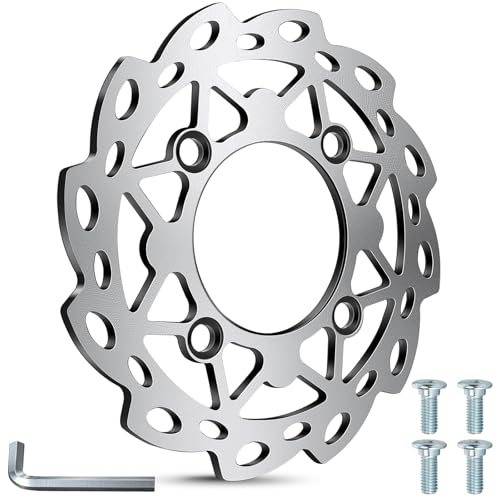
Should you ride Chinese pit bikes or work on them, this 190 mm stainless steel brake disc rotor is a smart choice that fits many popular 50cc to 150cc models and makes upgrades simple. You’ll like its 190 mm diameter and 1.8 mm thickness because they match front and rear brake setups on SSR, Tao Tao, Apollo, Coolster, Lifan, Stomp, SDG, Pitster Pro and more. The vented design helps prevent warping from heat, and the heavy duty stainless steel resists wear for confident stopping. You get four screws and a wrench for easy installation on 12 mm or 15 mm axles.
- Material:Stainless steel
- Application Type:Pit/dirt bike front or rear rotor
- Heat/warp resistance:Vented design to reduce deformation from overheating
- Installation compatibility / fitment focus:Fits many Chinese pit bike models; includes hardware for installation
- Quantity packaged:1 rotor
- Corrosion / wear resistance:Heavy-duty stainless construction for excellent wear resistance
- Additional Feature:Includes screws + wrench
- Additional Feature:Vented deformation-resistant design
- Additional Feature:Front/rear dual compatibility
11.8″ Mirror-Polished Stainless Steel Front Brake Rotor for Harley Touring
Premium Touring
View Latest PriceShould you ride a Harley Touring model and want a rotor that blends strong stopping power with a polished show finish, this 8-inch mirror-polished stainless steel front brake rotor is a standout choice. You’ll get 11.8 inches of cutting power made from 420 stainless steel that resists corrosion and looks sharp. The hollow design trims weight, and full-sweep cooling helps keep temperatures down so braking stays consistent in wet or dry conditions. Heat treatment and extra chrome enhance wear life, and precision grinding prevents vibration. It includes an adapter ring for bore fitment, so double-check compatibility before you buy.
- Material:420 stainless steel (mirror-polished)
- Application Type:Motorcycle (Harley Touring) front rotor
- Heat/warp resistance:Full-sweep pattern and heat-treated for rapid cooling and reduced vibration
- Installation compatibility / fitment focus:Includes adapter ring for rotor bore; specified Harley models
- Quantity packaged:1 rotor (front)
- Corrosion / wear resistance:Heat-hardened and chrome content for improved wear resistance
- Additional Feature:Mirror-polished finish
- Additional Feature:Adapter ring included
- Additional Feature:Hollow weight-saving design
M MATI Front Brake Disc Rotors for Polaris Vehicles
Should you ride a Polaris ATV and want brake rotors that match OEM fit and feel, the M MATI 2 PCS Front Brake Disc Rotor set is a smart pick you can trust. You’ll get two rotors packed simply in a bag with part number 5242935. They suit many Polaris models like Magnum, Ranger, Sportsman, Xplorer, Xpedition, Worker, and Diesel 455. They’re made from SUS 420 stainless steel, heat treated to HRC 34–38, so they resist high heat warping and last longer. You can expect OEM specifications and one year of seller support in case you need help.
- Material:High-strength stainless steel SUS 420
- Application Type:Powersports/ATV front brake rotor
- Heat/warp resistance:Heat-treated to HRC 34–38; resists high-temperature warping
- Installation compatibility / fitment focus:OEM-spec fitment for listed Polaris models (part #5242935)
- Quantity packaged:2 rotors (2 PCS front)
- Corrosion / wear resistance:Heat-treated SUS 420 with improved service life and warp resistance
- Additional Feature:OEM specification build
- Additional Feature:Heat-treated HRC 34–38
- Additional Feature:1-year product support
Factors to Consider When Choosing Powersports Brake Rotors
As you select brake rotors, consider about the material and construction initially because that affects strength and how long they last. Also pay attention to heat dissipation design, thickness and wear limits, and fitment and compatibility so the rotor will stop reliably and bolt on without trouble. Finally, consider installation and maintenance needs since an easy install and clear service limits will keep you safer and make life simpler.
Material And Construction
Because your brake rotor is where stopping power meets heat, picking the right material and construction matters a lot for safety and feel. You’ll find stainless steel faces, often 400-series like 420, give strong corrosion resistance and long wear. They machine flat and stay true, which helps pedal feel. Two-piece rotors pair a stainless ring with an aluminum carrier to cut unsprung weight and isolate heat from the hub, so your suspension and bearings thank you. Heat treatment and surface hardening increase wear resistance and lower warping risk during hard use. Designs like cross-drilled, vented, or slotted help clear gas and debris but change fatigue and slightly reduce mass. Thicker rings and stout carriers raise stiffness and resist deformation while adding rotational weight.
Heat Dissipation Design
Should you want brakes that stay strong on a long run, the rotor’s heat dissipation design matters as much as the pad compound and caliper setup. You’ll look for venting like cross-drilled holes, slots, or full-sweep patterns because they add surface area and enhance airflow, which cools rotors faster during repeated heavy stops. Pay attention to material and construction next since stainless thickness, aluminum carriers, or hollow cores change thermal mass and conductivity. That affects how heat soaks into hubs and calipers. Also consider size and thickness tradeoffs because larger rotors hold more heat yet can warp provided not balanced. Designs with dissimilar materials or floating faces let parts expand differently, cutting warpage risk. Finally, precision grinding and surface treatment improve flatness and cooling given reduced hot spots.
Fitment And Compatibility
Should you want replacement rotors that fit right and stop you safely, start checking the exact measurements and mounting pattern for your bike or ATV. You’ll verify rotor diameter, thickness, and bolt hole count against factory specs so the rotor clears the caliper and wheel. Next, confirm the model year and variant since small changes can mean different sizes or patterns. Also match the hub bore and any adapter or spacer needs to avoid gaps or machining. Check whether the rotor is for front or rear use and that axle diameter and caliper spacing match. Whenever you replace multiple rotors, make sure they work with your existing calipers, pads, and brake lines to keep braking geometry and feel predictable.
Thickness And Wear Limits
Now that you’ve checked fit and mounting, pay close attention to rotor thickness and wear limits because they directly affect how your bike or ATV will stop. You need to know the new thickness and the minimum safe thickness the manufacturer lists. Measure with a micrometer at several points. Should readings vary too much, usually around 0.03 to 0.10 mm, the rotor is uneven and should be replaced. Thin rotors lose heat capacity, overheat faster, and can warp, so replace before they hit the minimum. Turning the rotor can fix flatness but it removes material, so never machine below the published limit. Also check local variation specs in your service manual and replace paired rotors together to keep braking balanced and predictable.
Installation And Maintenance
Whenever you fit new rotors, take your time and do each step right so your brakes feel predictable and safe from day one. Clean new rotors with brake cleaner or isopropyl alcohol and avoid touching the braking surface with oily hands. Fit rotors with clean mounting surfaces and bolt holes, and apply thread locker or anti seize per OEM guidance so parts clamp consistently and resist corrosion. Torque rotor bolts to the manufacturer specified value using a calibrated torque wrench to prevent warping or loosening. After installation, perform a bedding procedure of 8 to 12 progressive stops from moderate speed to transfer pad material and stabilize friction. At each service, check runout with a dial indicator, inspect scoring, measure thickness, and check pad and caliper slide function.