

You can keep your Toyota feeling clean and calm with five smart filter picks. Puroma CP157 or CF12157 2-pack traps pollen and dust fast, while Puroma CP285 adds activated carbon and soda weave to cut fumes and food smells. For the engine, EPAuto GP171 (Camry 2007 to 2017) and EPAuto GP190 (Corolla family) seal tight for steady airflow and better efficiency. Match your year and OEM number, then swap every 12,000 miles to stay fresh, and there’s more ahead.
| Puroma Cabin Air Filter 2-Pack (CP157 CF12157) |

| Best Cabin Value Pack | Filter type: Cabin air filter (2-pack) | Primary fitment: Toyota/Lexus + Mazda/Subaru (newer models) | Filtration media: Non-woven + activated carbon (soda-woven) | VIEW LATEST PRICE | Read Our Analysis |
| EPAuto GP171 Engine Air Filter (CA10171) |
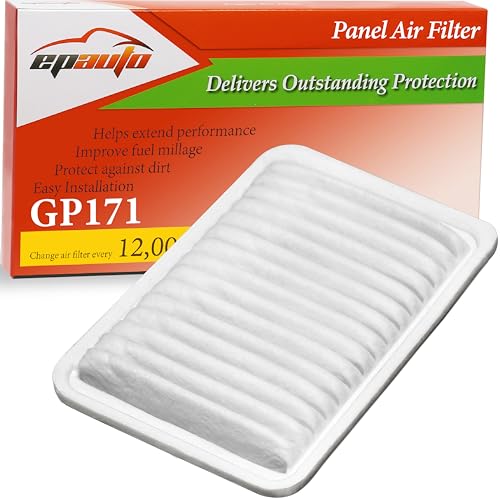
| Best for Camry | Filter type: Engine air filter (panel) | Primary fitment: Toyota Camry/Venza L4 (2007–2017 / 2009–2016) | Filtration media: High-efficiency pleated paper (panel) | VIEW LATEST PRICE | Read Our Analysis |
| Puroma Activated Carbon Cabin Air Filter (CP285) |

| Best Odor Control | Filter type: Cabin air filter | Primary fitment: Toyota + Lexus/Subaru/LR/Jag/Scion/Pontiac (mostly 2006–2024) | Filtration media: Non-woven + activated carbon (soda-woven) | VIEW LATEST PRICE | Read Our Analysis |
| EPAuto GP190 Engine Air Filter (CA10190) Replacement |

| Best for Corolla | Filter type: Engine air filter (panel) | Primary fitment: Toyota Corolla/Matrix/Yaris + Scion/Pontiac (mostly 2008–2019) | Filtration media: High-efficiency pleated paper (panel) | VIEW LATEST PRICE | Read Our Analysis |
| EPAuto CP157 Cabin Air Filter (Fits 2016-2025) |

| Best Broad Fit | Filter type: Cabin air filter | Primary fitment: Toyota/Lexus + Subaru/Mazda (2016–2026 range) | Filtration media: Soda + carbon (cabin filter media) | VIEW LATEST PRICE | Read Our Analysis |
More Details on Our Top Picks
Puroma Cabin Air Filter 2-Pack (CP157 CF12157)
Should your Toyota’s cabin air start smelling musty, or your vents blow dust that makes you sneeze, the Puroma Cabin Air Filter 2-Pack (CP157, CF12157) fits you especially well because it tackles both particles and odors at the same time. You get a tight non woven layer that traps grit, pollen, and road dust, so your HVAC breathes easier and your system avoids extra wear. Next, the soda woven and activated carbon media grabs stink causing contaminants. You can swap it in about 10 minutes using the airflow arrow. Replace yearly or 12,000 miles.
- Filter type:Cabin air filter (2-pack)
- Primary fitment:Toyota/Lexus + Mazda/Subaru (newer models)
- Filtration media:Non-woven + activated carbon (soda-woven)
- Odor control:Yes (activated carbon)
- Replacement interval:12,000 miles/1 year (5,000 in heavy conditions)
- Install style:Direct-fit; airflow arrow; ~10 min
- Additional Feature:Two-pack value set
- Additional Feature:High-flow air capacity
- Additional Feature:Airflow direction arrow
EPAuto GP171 Engine Air Filter (CA10171)
In case you drive a Toyota Camry (2007 to 2017) or a Toyota Venza (2009 to 2016) with a 4 cylinder gas engine, the EPAuto GP171 (CA10171) engine air filter can feel like the right kind of “quiet protection” under the hood.
It’s a rigid panel filter built for 2.4L and 2.5L engines, and it matches Toyota part numbers 17801-0H050 and 17801-28030. Because it’s precision-made, you get an OEM-style fit that seals well. That matters, since high-efficiency media catches dust and grit before it hits key parts. Next, you’ll like the airflow balance, since it can support fuel mileage. Plan to swap it every 12,000 miles, and pair it with CP285 (CF10285).
- Filter type:Engine air filter (panel)
- Primary fitment:Toyota Camry/Venza L4 (2007–2017 / 2009–2016)
- Filtration media:High-efficiency pleated paper (panel)
- Odor control:No (engine air; not for odors)
- Replacement interval:12,000 miles
- Install style:OEM-style direct-fit panel
- Additional Feature:Rigid panel design
- Additional Feature:OEM part cross-ref
- Additional Feature:Helps fuel mileage
Puroma Activated Carbon Cabin Air Filter (CP285)
Puroma’s Activated Carbon Cabin Air Filter (CP285) fits you best in case you want your Toyota’s cabin to smell clean again, even whenever traffic fumes, fast food odors, or dusty roads try to take over. It uses soda woven material plus activated carbon, so odors and grime get trapped before you breathe them in. A close meshed, non woven layer blocks fine particles and helps your HVAC stay strong with steady airflow. Next, installation feels easy: you’ll follow the airflow arrow and complete in about 10 minutes. Replace it every 12,000 miles, or earlier in heavy dust.
- Filter type:Cabin air filter
- Primary fitment:Toyota + Lexus/Subaru/LR/Jag/Scion/Pontiac (mostly 2006–2024)
- Filtration media:Non-woven + activated carbon (soda-woven)
- Odor control:Yes (activated carbon)
- Replacement interval:12,000 miles/1 year (5,000 in heavy conditions)
- Install style:Direct-fit; airflow arrow; ~10 min
- Additional Feature:Soda-woven + carbon
- Additional Feature:Protects system from wear
- Additional Feature:10-minute install
EPAuto GP190 Engine Air Filter (CA10190) Replacement
Should you drive a Toyota Corolla, Matrix, Yaris, or even a Scion iM or xD, the EPAuto GP190 (CA10190) engine air filter can feel like the easy win you’ve been hoping for, because it’s made to fit those exact air boxes without the “will this even line up?” stress. It also fits Pontiac Vibe 1.8L.
Once it’s in, you help your engine breathe cleaner air, block grit, and support steady mpg. Its rectangular 9.57 x 6.93 x 1.93 inch build matches OEM numbers like 17801-YZZ05. Swap it about every 12,000 miles, and pair CP285 cabin filter too.
- Filter type:Engine air filter (panel)
- Primary fitment:Toyota Corolla/Matrix/Yaris + Scion/Pontiac (mostly 2008–2019)
- Filtration media:High-efficiency pleated paper (panel)
- Odor control:No (engine air; not for odors)
- Replacement interval:12,000 miles
- Install style:OEM-style direct-fit panel
- Additional Feature:FRAM CA10190 replacement
- Additional Feature:Rectangular compact size
- Additional Feature:Lightweight (5.3 oz)
EPAuto CP157 Cabin Air Filter (Fits 2016-2025)
EPAuto CP157 is a smart pick in case you drive a newer Toyota and you want the air inside your car to feel clean, calm, and easy to breathe. It fits many models like Camry, Corolla, RAV4, Prius, Highlander, Sienna, and Venza from 2016 to 2025, so you’re likely covered.
What makes it soothing is the soda and carbon blend, which helps cut stale smells and supports your HVAC system so airflow stays steady. It also replaces common parts like FRAM CF12157 and Toyota numbers like 87139-YZZ37. For best comfort, swap it every 12 months or 12,000 miles.
- Filter type:Cabin air filter
- Primary fitment:Toyota/Lexus + Subaru/Mazda (2016–2026 range)
- Filtration media:Soda + carbon (cabin filter media)
- Odor control:Yes (carbon/soda)
- Replacement interval:12,000 miles/12 months
- Install style:Direct-fit replacement (vehicle-specific)
- Additional Feature:Cross-references FRAM models
- Additional Feature:Multi-brand OEM replacement
- Additional Feature:Soda + carbon blend
Factors to Consider When Choosing Car Air Filters for Toyota**
Now that you’ve seen a solid filter option, you’ll want to choose the right Toyota air filter through checking vehicle fit and compatibility initially, so it seals tight and works the way it should. Next, you can compare filter type and media, filtration efficiency level, and odor and allergen control, because those details decide how clean your air feels on every drive. Finally, you should balance airflow and HVAC load, so you don’t choke your system and end up with weak vents at the moment you need them most.
Vehicle Fit And Compatibility
How do you make sure an air filter will actually fit your Toyota and not turn a quick swap into a frustrating wrestle? Start with your exact model and year, then match the OEM part number on your current filter or in your manual. That number keeps the size, seal, and tabs lined up, so it snaps in without forcing.
Next, check your engine and trim details. A 4 cylinder, V6, or hybrid setup can use different housings, even within the same nameplate. Also confirm whether you’re buying an engine air filter or a cabin HVAC filter, because the shapes differ.
Some filters claim broad Toyota coverage, so verify the exact year range and variant. Should it be wrong, you might fight the lid, lose airflow, and risk damage.
Filter Type And Media
Once you’ve confirmed the filter will fit your Toyota’s air box or cabin slot, the next thing to watch is what it’s made of, because the media controls what gets trapped and how easily air can still flow. Most filters use tight, non woven fabric layers that catch dust, dirt, and road grit before it reaches your engine or your lungs.
Next, match the media to the job. For the cabin, choose activated carbon or soda woven layers in case smells, fumes, or city exhaust bug you. They help keep the inside air calmer and cleaner. For the engine, look for a rigid panel or rectangular build that holds its shape, seals well, and keeps airflow steady. Whenever the media stays clean and open, your HVAC works easier, and your fuel mileage doesn’t take a hit.
Filtration Efficiency Level
Why does filtration efficiency matter so much as you’re picking an air filter for your Toyota? Because you breathe what your cabin filter catches. A high efficiency filter stops fine dust, pollen, and tiny airborne grime before it drifts inside, so your drive feels calmer and cleaner.
Next, look at the media. Close meshed, non woven layers trap more particles while still letting air pass through. That balance matters, since strong airflow keeps your HVAC working right and helps you get steady heat in winter and cool air in summer. It also helps reduce strain and wear from dust and debris.
Finally, match efficiency to your routine. Higher efficiency usually means you should swap it yearly or around 12,000 miles to keep performance steady.
Odor And Allergen Control
Although your Toyota’s cabin air filter looks like a small, simple part, it plays a big role in keeping the air you breathe free from bad smells and allergy triggers. In case your cabin starts to smell musty or like exhaust, choose a filter with activated carbon or soda woven material. These layers grab odor causing fumes and leave the air feeling clean again.
Next, consider what makes you sneeze. Close meshed, non woven layers can trap dust and pollen before they reach your nose. That means fewer watery eyes on spring drives and less coughing in traffic. For the best results, replace the filter about every 12,000 miles or once a year. Should you be sensitive, pick advanced filters that block more airborne pollutants and keep rides calm.
Airflow And HVAC Load
Fresh, clean-smelling air is great, but your Toyota also needs that air to move freely through the vents so you don’t end up with weak airflow on a hot day. If airflow drops, your HVAC system has to work harder, and you’ll feel it in slower cooling and uneven heat. That extra effort can strain the blower motor and other parts, which nobody wants while you’re just trying to stay comfortable.
Replacement Interval And Cost
At the moment you know at what point to replace your Toyota’s air filter and what it should cost, you can avoid that sudden moment when the vents barely breathe and the cabin starts to feel stuffy. Most filters need changing every 12,000 miles or once a year, so you can plan it like an oil change.
Next, consider where you drive. In case you face heavy smog, dusty lots, or dirt roads, you might need a new filter around 5,000 miles before it clogs and makes your HVAC work harder. Waiting too long can cut airflow and even raise engine wear.
Cost depends on the filter price and whether you pay labor. A pricier filter can last longer or trap more grit, so you might replace it less often.
