

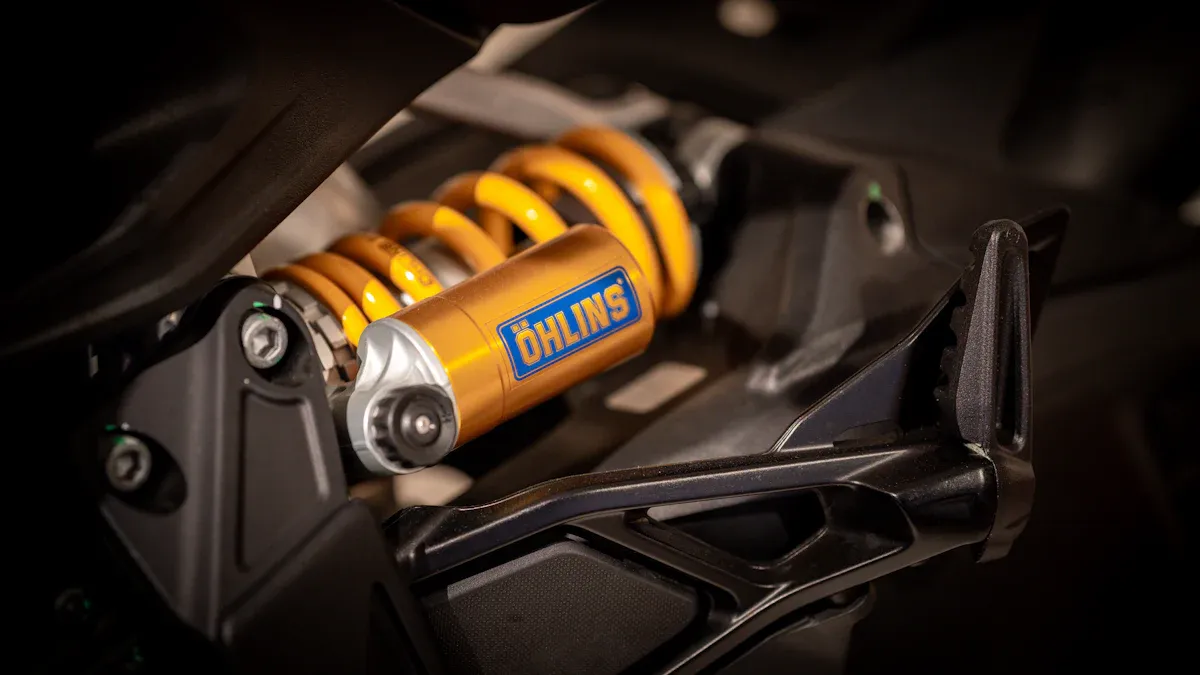
Shocks primarily dampen, struts dampen and provide structural support, and coilovers combine these with adjustability. While all three are crucial for your vehicle’s suspension, their design and purpose vary greatly. This impacts vehicle performance, ride quality, and cost. Understanding these differences helps you choose the right suspension system. We will explore each component and compare shocks vs struts vs coilovers directly. This helps you understand which is right for your needs.
Key Takeaways
Shocks control spring movement. They make your ride smooth. Shocks do not hold up your car.
Struts combine a shock and a spring. They hold up your car. Struts also make your ride smooth.
Coilovers are like struts but you can change them. You can make your car higher or lower. You can also change how stiff the ride is.
Shocks are usually cheaper to replace. Struts cost more. Coilovers are the most expensive.
Choose shocks, struts, or coilovers based on your driving. Think about daily driving, off-roading, or racing.
Shocks: Primary Dampeners
Shock Absorber: Definition and Role
You find shocks in your vehicle’s suspension system. A shock absorber is a separate component. It primarily dampens spring oscillations. This means it controls the movement of your springs. Shocks ensure a smooth ride. They absorb excess energy from the springs. They use valving of oil and gasses for this. This reduces the effect of traveling over rough ground. It improves your ride quality and vehicle handling. Shocks, also known as dampers, support the coil spring. They further reduce the impact of bumps or potholes.
How Shocks Work: Internal Mechanisms
A shock absorber converts kinetic energy into heat. It does this using a cylinder body filled with oil. A piston with a plunger moves inside this cylinder. The plunger has holes. These holes control oil flow between two chambers. This fluid movement creates resistance. This resistance generates heat. The heat then dissipates into the atmosphere. This process brings spring oscillations under control. Key internal parts of a hydraulic shock include:
Body (Tube): This tube holds hydraulic fluid.
Piston: It moves inside the body. Its movement through the fluid provides damping.
Hydraulic Fluid (Oil): This non-compressible fluid flows through the piston. Its viscosity affects flow rate and damping.
Shims: These small metal discs fine-tune compression and rebound. They control fluid flow through the piston’s holes.
Valves: These control fluid paths. They allow different damping characteristics.
Key Components of Shocks
A common type is the twin-tube shock absorber. It has two cylinders. One cylinder sits within the shell case. The second, inner cylinder, houses the piston valve. This valve moves vertically. Twin-tube shocks feature an inner and outer tube. These tubes separate the oil and gas. The smaller inner tube contains the piston shaft assembly, base valve, and oil. The outer tube holds both nitrogen gas and hydraulic shock oil. Essential components include:
Piston rod
Piston
Inner Cylinder
Reservoir tube
Foot valve
Common Vehicle Applications
Many vehicles use shocks. You find them in regular cars. These are optimized for comfort. Race cars also use shocks. They design these for handling and speed. Off-road cars use shocks too. These withstand extreme conditions and rough terrain. Trucks, vans, or vehicles used for hauling often use monotube shocks. Cars and smaller SUVs typically use twin-tube shocks. Some vehicles, like GM’s full-size SUVs, Cadillac Escalade, Chevy Suburban, and GMC Yukon, use electronic shocks. Volvos and Dodge Chargers might use self-leveling Nivomat shock absorbers.
Struts: Structural and Dampening Role
Strut Assembly: Definition and Function
You find struts in your vehicle. Struts are integrated components. They combine a shock absorber and a coil spring into one unit. Struts provide both dampening and structural support to the vehicle’s suspension. They are an integral part of the suspension, unlike separate shocks. Struts provide structural support for the vehicle. They support the spring and maintain tire alignment. Struts bear a significant portion of the side load on the vehicle. They influence riding comfort, handling, vehicle control, braking, steering, wheel alignment, and wear on other suspension components. Typically, a strut consists of a coil spring, a strut housing, and a damping unit.
How Struts Work: Integrated System
Struts work as an integrated system. A common type is the MacPherson strut. It combines a shock absorber and a coil spring into a single, compact assembly. The coil spring supports vehicle weight. It absorbs large road impacts, providing structural support. The shock absorber controls spring movement. It smooths out vibrations, providing dampening. The strut housing provides structural integrity. It connects components to the vehicle. This design eliminates the need for an upper suspension arm. Struts must have a rugged design. They need mounting points for attaching loads.
Key Components of Struts
A typical strut assembly has several key components. These include the strut body or strut insert. You also find a bumpstop and boot. The strut upper mount is another part. A coil spring is essential. The spring seat holds the spring. Some assemblies may also feature a spring isolator or mount bearings.
Common Vehicle Applications
Many vehicles use struts. MacPherson struts are widely used in modern automobiles. You often find them in front-wheel-drive vehicles. Double wishbone struts are common in luxury and performance vehicles. Coilover struts are versatile. They suit track racing and everyday use.
Coilovers: Performance and Adjustability
Coilover System: Definition and Design
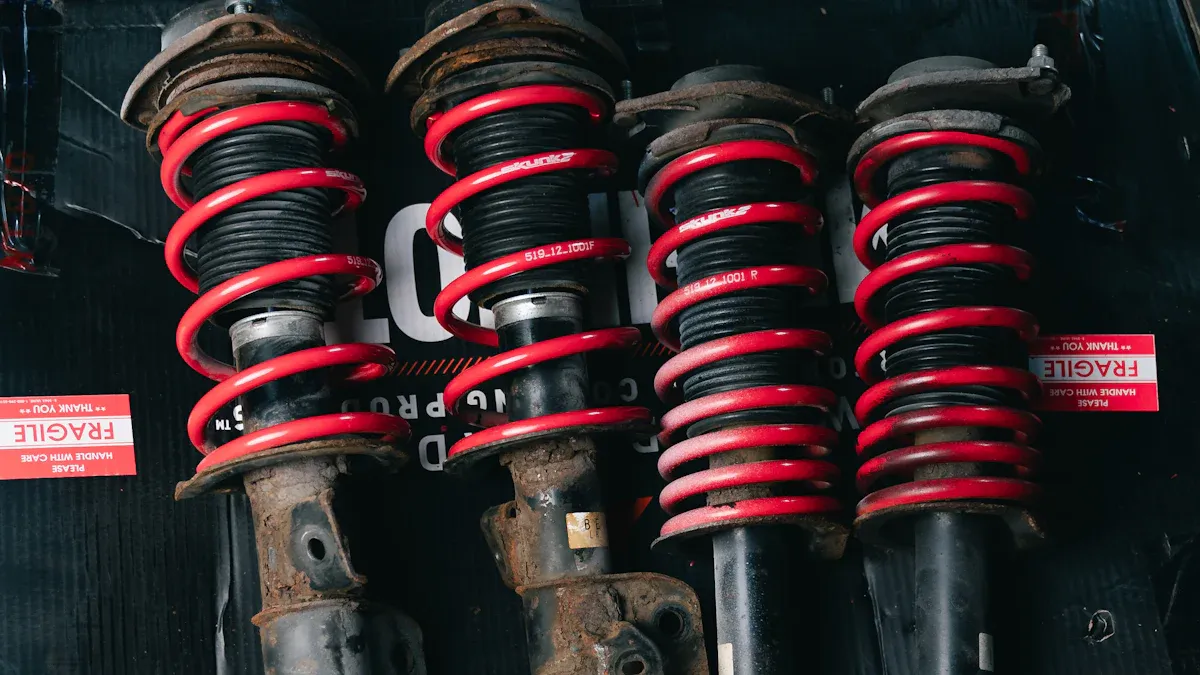
A coilover is an automotive suspension component. Its name is an abbreviation of “coil over shock absorber.” It consists of a damper encircled by a coil spring. You assemble it as a single unit for installation and replacement. Coilovers are part of a passive coilover suspension system. They maintain ideal ride height and provide damping for a smoother, more comfortable ride. They use a sturdy strut to support vehicle weight. A metal coil spring provides resistance and controlled give. These springs are much stronger and more precise than mattress springs. Coilovers absorb impacts from road changes. They also handle forces from driving actions like turning and stopping. The coils are ‘tuned’ or calibrated. This provides optimal resistance for your specific vehicle. It balances between a spongy, inefficient ride and a bumpy, stiff one. Proper tuning allows coilovers to deliver a smooth ride and balanced handling. This makes them suitable for general use and high-performance applications like off-roading and racing.
How Coilovers Work: Integrated and Adjustable
Coilovers integrate a coil spring and a shock into one compact unit. The shock absorber dampens, controlling compression and rebound. This maintains tire contact with the road. You achieve adjustable ride height by manipulating a threaded shock body. This lets you raise or lower your vehicle. You can fine-tune suspension settings for aesthetics or performance. Some coilover shocks also offer adjustable damping levels. You might find options like 32 levels of adjustment. You can easily modify these at the top of the coilover unit.
Key Components of Coilovers
Key components of coilovers include springs, dampers, and bump stops. Springs manage your vehicle’s chassis and tire contact. Without dampers, springs lead to a bouncy ride. Dampers control spring oscillations. They allow for controlled compression and rebound motions through finely tuned valving. They work with springs to manage energy release. Bump stops are rubber components. They limit damper compression. This prevents damage to parts. It ensures predictable handling by setting a limit to suspension travel. Coilover springs are helically wound from high tensile steel alloy. They provide consistent characteristics like free length and spring rate. This helps with effective weight transfer during cornering. An adjustable spring perch allows for height adjustment. You can use it to shift weight on each wheel for corner balancing. This leads to more consistent handling. Coilover dampers control the release of energy from the spring. They are crucial for suspension tuning. They offer various levels of adjustability (single-way, two-way, four-way). This optimizes setup for different conditions. Many aftermarket coilover kits include these advanced features.
Common Performance Applications
You find coilovers in many performance applications. Drift cars use them. Track machines for time attack also use them. Autocross and show cars commonly feature coilovers.
Shocks vs Struts vs Coilovers: A Direct Comparison
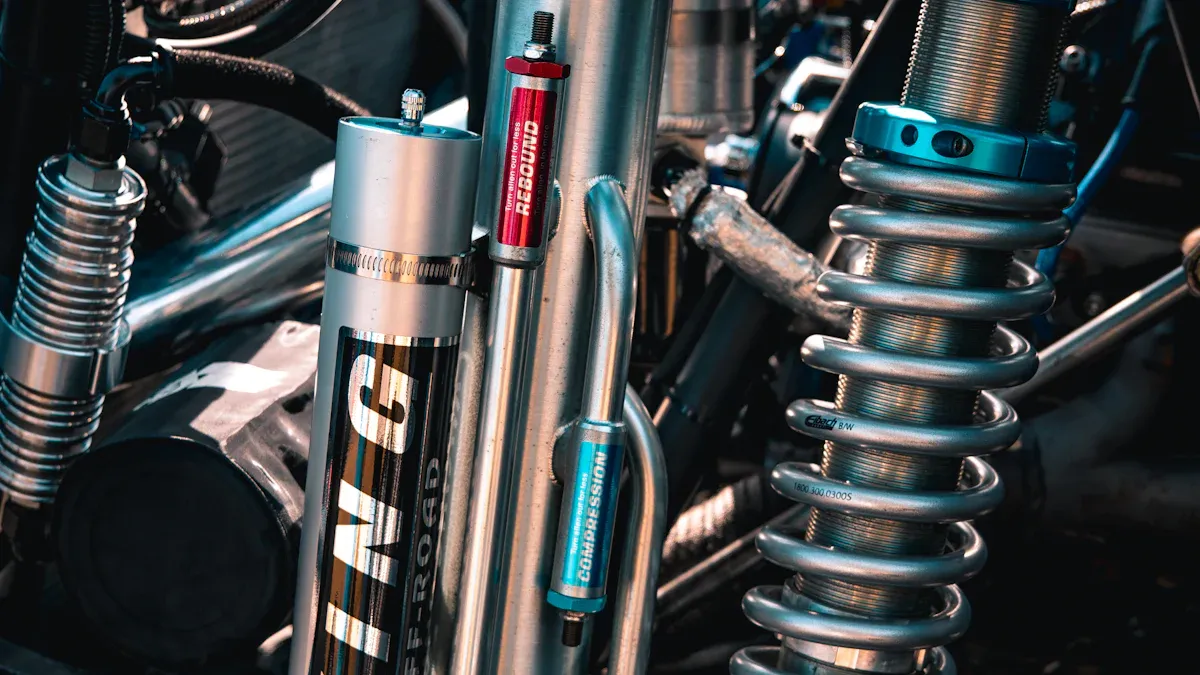
You now understand the basics of shocks, struts, and coilovers. Let’s directly compare them. This helps you see how each one fits into your vehicle’s suspension. You will learn about their design, function, and impact on your driving experience.
Design and Construction: Shocks vs Struts
You find clear differences in how shocks and struts are built. Shocks are standalone parts. They usually sit behind your tires. They work with a separate spring. Their main job is to absorb road impact. However, they cannot support your vehicle’s weight. They also do not affect alignment.
Struts are different. They combine a shock and a spring into one unit. They are a key part of your suspension’s structure. Struts absorb road impact. They also support your vehicle’s weight. This means they affect your car’s alignment.
Here is a quick look at their design:
Feature | Shocks | Struts |
|---|---|---|
Design | Standalone components, usually located behind the tires, work alongside a separately mounted spring. | Combine shocks and spring into one unit, part of the suspension’s system structure. |
Functionality | Absorb road impact, but cannot support vehicle weight or affect alignment. | Absorb road impact, support the vehicle’s weight, and affect its alignment. |
You can see that a shock absorber is an individual component. It does not support vehicle weight. Its main purpose is to control spring and suspension movement. A strut, however, is a major structural part. It takes the place of the upper control arm and upper ball joint. It provides structural support for your vehicle’s suspension. It also supports the spring and holds the tire in an aligned position. This means it bears much of the side load.
Functional Differences: Struts vs Shocks
The way struts vs shocks work in your car also differs greatly. Shocks primarily dampen spring oscillations. They control suspension movement. They ensure your tires stay in contact with the road. They are not structural. You can remove a shock without your vehicle collapsing.
Struts have a dual role. They provide structural support for your vehicle’s suspension. They also dampen spring oscillations. Often, they house the coil spring. A strut is a structural component. It integrates the shock absorber, coil spring, and sometimes the steering knuckle or wheel hub.
Consider these functional distinctions:
Feature | Shocks | Struts |
|---|---|---|
Structural Role | Not a structural component; can be removed without the vehicle collapsing. | A structural component; integrates the shock absorber, coil spring, and often the steering knuckle/wheel hub. |
Impact on Alignment | Generally does not affect wheel alignment when replaced. | Replacement often requires a wheel alignment afterward due to its structural role in suspension geometry. |
Load Bearing | Does not bear vehicle weight. | Bears a significant portion of the vehicle’s weight. |
When you replace shocks, you usually do not need a wheel alignment. When you replace struts, you often need an alignment. This is because struts directly influence your vehicle’s suspension geometry.
Adjustability: Coilovers vs Shocks
You will find a big difference in adjustability when comparing coilovers vs shocks. Standard shocks offer little to no adjustability. You generally cannot change their settings easily.
Coilovers are much more customizable and adjustable. You need to invest time and energy to optimize their settings. This helps you get the full benefit from them.
The factors that make coilovers specifically more work to deal with are unavoidable byproducts of their upsides. Namely, coilovers are more customizable and adjustable. You need to invest time and energy into optimizing those settings to fully benefit from having them.
Coilovers are more customizable and adjustable. They require time and energy to optimize settings for full benefit.
Standard shocks are generally less customizable and adjustable. They often require more steps to change settings.
Coilovers let you adjust ride height. You can also change damping rates. This allows you to fine-tune your vehicle’s handling. This level of control is not possible with standard shocks.
Ride Quality and Performance Impact
Each suspension component affects your ride quality and performance. When you compare shocks vs struts vs coilovers, you see varied impacts.
Enhanced Ride Comfort and Reduced Road Noise: Improved components absorb road imperfections more effectively. This leads to a smoother drive and less vibration. Long journeys become more pleasant.
Boosted Vehicle Stability and Cornering Capabilities: This minimizes body roll during turns. It allows for more confident maneuvers. This is crucial for safety in emergency situations. It enhances your feeling of control.
Improved Traction and Tire Wear: It ensures even tire contact with the road. This provides superior grip in various driving conditions. It not only improves performance but also extends tire lifespan. It maintains control on wet or uneven surfaces.
Here is a summary of their impact:
Component | Ride Quality | Performance |
|---|---|---|
Shocks | Often provides a smoother ride | Suitable for everyday driving, less customization |
Struts | Significant impact on ride quality and handling due to alignment and structural integrity | Often used in stock/factory setups |
Coilovers | Balance between ride quality and performance, adjustable for various conditions | Favored by performance enthusiasts for fine-tuning handling |
Coilovers offer the most control over performance. They allow you to dial in your suspension for specific driving needs. This is why many performance enthusiasts choose coilovers vs struts or shocks.
Cost and Replacement Considerations
Cost is a major factor. Shocks are generally less expensive to replace individually. Their simpler design makes them easier to swap out. Struts are often more complex. They can be costlier to replace. This is especially true if you replace the entire quick-strut assembly. This assembly includes the spring and mount.
Coilovers are typically the most expensive option. Their advanced design and adjustability come at a higher price. You also pay for the ability to fine-tune your suspension. When you consider coilovers vs struts, the initial investment for coilovers is usually higher.
Maintenance and Longevity
All suspension components need maintenance. You should regularly check shocks for leaks. You also need to check their damping effectiveness. Struts require checks for leaks, spring integrity, and bearing wear. You also need to inspect the overall assembly condition. Coilovers, with their adjustability, might require more frequent checks. You need to ensure all settings are correct and secure. Proper maintenance helps extend the life of your shocks, struts, or coilovers.
Choosing Your Suspension: Shocks, Struts, or Coilovers?
You have learned about shocks, struts, and coilovers. Now, you need to decide which is right for your vehicle. This choice depends on your driving style, budget, and performance goals. Let’s explore the factors you should consider.
Daily Driving vs. Performance Needs
Your daily commute differs greatly from a track day. This means your suspension needs will also differ. For daily driving, you often prioritize comfort and reliability. Quality coilovers, like ST and KW v1, are superb for daily driving. They offer a good balance. Good coilovers ensure the shock perfectly matches the spring rate. This is better than mixing lowering springs with aftermarket shocks.
However, coilovers can make your car feel stiffer. This happens even on their softest settings. You must accept a more aggressive ride. Coilovers also require you to test, tweak, and adjust settings after installation. This optimizes performance and comfort. On rough roads, coilovers can make your car unsettled. This is due to limited suspension travel. You will feel more acute vibrations. Regular shocks and struts often offer a more comfortable ride on imperfect roads.
Before switching to coilovers, consider your vehicle’s entire setup. Stiffer suspension can highlight weak points. These include aged sway bar bushings, tie rods, and motor mounts. You might need additional modifications. A rear camber kit or adjustable sway bar endlinks can prevent issues like knocking. They also ensure proper alignment. This adds complexity and potential cost to your suspension upgrades.
Off-Roading and Heavy-Duty Use
If you regularly tackle trails or carry heavy gear, coilovers are highly recommended for off-roading. They offer full adjustability. You can change ride height, spring preload, and damping. This gives you superior control and flexibility. Their design combines a coil spring and shock absorber. This saves space and enhances performance. Coilovers often allow for more travel and better articulation. These features are crucial for off-road conditions.
For heavy off-roading, your suspension’s ability to handle high articulation is critical. This means each wheel can move independently. It helps maintain ground contact on uneven terrain. Dependent suspension systems, with a solid axle and control arms, are the “unquestioned king” in tough off-road conditions. They prioritize adaptability over comfort.
Coilovers are also well-suited for heavy-duty vehicle use. You find them in light-duty trucks and off-road race vehicles. They lift these vehicles. This allows them to accommodate larger tires or heavier equipment. This shows their suitability for demanding applications. They provide increased clearance or load-bearing capacity.
Budget and Value Proposition
Cost is always a factor when choosing your vehicle’s suspension. Shocks are generally the least expensive to replace. Struts and coilovers cost more. Here is a general idea of costs:
Component Type | Part Cost (per corner) | Labor Time (per corner) | Total Cost (typical) |
|---|---|---|---|
Shocks | $30 – $150 | 30 – 60 minutes | $1000 (entry/mid-level vehicle) |
Struts & Coilovers | $50 – $300 | 1 hour (coilovers), 2-3 hours (front struts) | Upwards of $2500 – $3000 (luxury vehicle with air/electronic suspension) |
Note: Typical shop labor is $100-$150/hr. Disassembling original units and assembling onto new units can add 30-90 minutes to labor time for struts/coilovers.
Coilovers are popular among car enthusiasts. They offer a high level of adjustability and performance. This allows you to fine-tune your vehicle’s suspension system to your specific needs. Adjustable coilovers let you alter your car’s ride height on demand. You can also adjust the dampening rate. This fine-tunes the suspension. You can easily reverse adjustments made to coilovers. This allows for fine-tuning not easily done with other suspension types. Coilovers provide a greater level of performance compared to coil springs. A coilover integrates a shock and coil spring into a single assembly. This design supports the vehicle’s weight with the integral spring. The shock dampens spring oscillations. It is both lightweight and simple. Unlike conventional shocks and springs, it provides for manual height adjustment.
Installation and Replacement Complexity
The complexity of installation varies significantly. Coilover installation is more complex. It typically requires professional expertise. Adjustable coilovers need precise tuning and alignment. This optimizes their performance.
Replacing the entire strut assembly, as with coilovers, is generally more involved than just swapping springs. Lowering springs have a simpler installation. Coilovers have a more complex installation. They frequently require professional installation. You might also need additional components like camber kits.
Here is a look at average labor times:
Component | Quantity | Average Labor Time |
|---|---|---|
Shocks | Single (per corner) | Up to 30 minutes |
Shocks | Four (truck) | 1 hour |
Shocks | Four (general) | 2 hours |
Struts/Coilovers | Two (front corners) | 2-3 hours |
Struts/Coilovers | Single (per corner) | 1 hour |
Struts/Coilovers | Single (ready for installation) | 30 minutes |
Struts/Coilovers | Single (disassembling/assembling) | 30-90 minutes |
Struts/Coilovers | Single (with coil spring compressor) | Double normal labor time |
Impact on Vehicle Handling
Each suspension component plays a vital role in how your vehicle handles. Shocks primarily dampen spring oscillations. They prevent excessive bouncing. They play a crucial role in overall vehicle handling control.
Struts significantly impact ride quality and handling. This is due to their structural role. They support vehicle weight. They maintain alignment. They influence steering dynamics. Struts provide superior handling and cornering stability. They also offer damping. They are more complex and influence steering dynamics.
Coilovers offer extensive adjustability. You can change ride height, damping rates, and front-to-rear balance. This allows for precise tuning of performance and handling characteristics. Enthusiasts favor them for customization. They give you the most control over your vehicle’s handling.
You now understand the distinct roles of shocks, struts, and coilovers. Shocks primarily dampen. Struts provide structural support and dampening. Coilovers offer integrated, adjustable performance. Your best choice depends on your driving needs, budget, and desired vehicle characteristics. Consider your specific requirements before deciding. Selecting the appropriate component for your vehicle’s suspension ensures optimum performance and safety.
FAQ
Can I replace shocks with struts on my car?
No, you cannot directly swap shocks for struts. Shocks only dampen. Struts provide structural support and dampen. Your vehicle’s design dictates which component it uses. You must use the correct type for your car’s suspension system.
Do coilovers always make my car’s ride stiff?
Coilovers can make your ride stiffer. This happens even on soft settings. You can adjust them for comfort or performance. Many modern coilovers offer a good balance. You choose the ride quality you prefer.
How often should I replace my shocks or struts?
You should inspect shocks and struts every 50,000 miles. Replace them if you notice leaks, excessive bouncing, or poor handling. Your driving conditions affect their lifespan. Heavy use means more frequent checks.
Will upgrading to coilovers increase my car’s resale value?
Upgrading to coilovers might not significantly increase resale value. Some buyers prefer stock suspension. Performance enthusiasts might appreciate the upgrade. You should consider your personal driving enjoyment as the main benefit.



