

Should you want your Chevy to stop tossing O2 codes and start running smooth again, pick sensors that match your year, engine, and position. Top 2026 choices include the Chevy GMC 4Pcs set for 2014-2018 4.3L/5.3L/6.2L trucks, the 3.6L Buick/Chevy/GMC 4Pcs set, the BOSCH 15284 OE-fit sensor for 2003-2006 models, the 4Pcs 5.3L set for 2003-2005, and the 234-4242/234-4251 Equinox Terrain 2.4L option, and you’ll spot key fit checks next.
| Chevy GMC O2 Sensors 4Pcs 2014-2018 |

| Best Full-Size Truck Fit | Vehicle fitment: Chevy/GMC full-size trucks & SUVs (2014–2018; 4.3L/5.3L/6.2L) | Sensor quantity: 4 pcs | Sensor position: Upstream & downstream (set) | VIEW LATEST PRICE | Read Our Analysis |
| Oxygen O2 Sensor Set for Buick/Chevy/GMC (4pcs) |
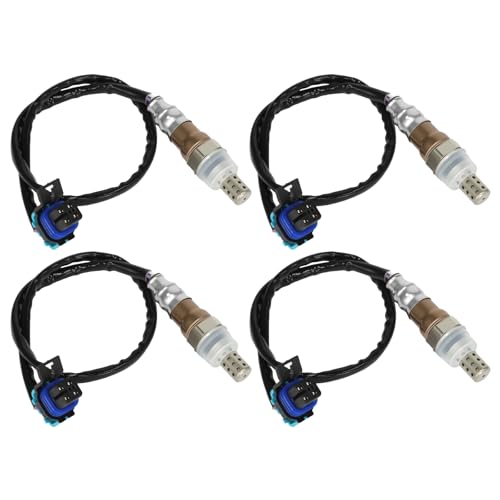
| Best for 3.6L V6 | Vehicle fitment: GM crossovers/sedans/midsize trucks (2012–2018; 3.6L) | Sensor quantity: 4 pcs | Sensor position: Upstream & downstream (set) | VIEW LATEST PRICE | Read Our Analysis |
| BOSCH 15284 Premium OE Fitment Oxygen Sensor |

| Premium OE Upgrade | Vehicle fitment: GM full-size trucks & SUVs (2003–2006; various) | Sensor quantity: 1 pc | Sensor position: Position varies by application (verify) | VIEW LATEST PRICE | Read Our Analysis |
| 4pcs O2 Sensors for 2003-2005 Silverado Tahoe Yukon 5.3L |

| Best for 5.3L V8 | Vehicle fitment: GM full-size trucks & SUVs (2003–2005; 5.3L) | Sensor quantity: 4 pcs | Sensor position: Upstream & downstream (set) | VIEW LATEST PRICE | Read Our Analysis |
| Oxygen O2 Sensor 234-4242/234-4251 for Equinox Terrain 2.4L |

| Best for 2.4L Engines | Vehicle fitment: GM 2.4L cars/crossovers (2007–2014; e.g., Equinox/Terrain/Malibu) | Sensor quantity: 1 pc | Sensor position: Upstream or downstream (by part#/fit) | VIEW LATEST PRICE | Read Our Analysis |
More Details on Our Top Picks
Chevy GMC O2 Sensors 4Pcs 2014-2018
In case you drive a 2014 to 2018 Chevy or GMC full-size truck or SUV and you want your engine to feel smooth again, this 4-piece O2 sensor set can be the right fit for you. You get coverage for Silverado and Sierra 1500, Tahoe, Suburban, Yukon and Yukon XL, and Escalade, with 4.3L, 5.3L, or 6.2L engines. Next, you’ll like the fast response that reads the air-fuel mix accurately, so mpg can climb and fuel waste can drop. Stainless steel and high-heat parts resist burnout, while tight sealing helps. Plug-and-play connectors match OEM numbers like 234-4940. Support’s ready.
- Vehicle fitment:Chevy/GMC full-size trucks & SUVs (2014–2018; 4.3L/5.3L/6.2L)
- Sensor quantity:4 pcs
- Sensor position:Upstream & downstream (set)
- OEM fit:OEM-spec plug-and-play
- Material/build:Stainless steel + high-temp materials
- Efficiency/emissions benefits:Improves MPG; reduces fuel use
- Additional Feature:Fast response sensing
- Additional Feature:Plug-and-play install
- Additional Feature:Double sealing protection
Oxygen O2 Sensor Set for Buick/Chevy/GMC (4pcs)
Should your 3.6L Buick, Chevy, GMC, or even Cadillac has started feeling a little off, this 4 piece Oxygen O2 Sensor Set can be the steady, confidence-boosting fix you’ve been hoping for. You get both upstream and downstream sensors, so your engine can read exhaust data correctly again. That means stronger power, better mileage, fewer misfires, and smoother takeoffs at stoplights.
Prior to purchasing, match your vehicle and your old part number to options like 234-4565 or 234-4566. Since it’s OEM-fit, you’ll usually install it without mods, even in case you’re a careful DIYer.
- Vehicle fitment:GM crossovers/sedans/midsize trucks (2012–2018; 3.6L)
- Sensor quantity:4 pcs
- Sensor position:Upstream & downstream (set)
- OEM fit:OEM-fit direct replacement
- Material/build:High-temp resistant materials
- Efficiency/emissions benefits:Improves fuel efficiency; reduces misfires
- Additional Feature:Reduces engine misfires
- Additional Feature:Smoother acceleration feel
- Additional Feature:No modifications required
BOSCH 15284 Premium OE Fitment Oxygen Sensor
Drivers who want a worry-free fix for a check engine light will often do best with the BOSCH 15284 Premium OE Fitment Oxygen Sensor, especially in case you drive a 2003 to 2006 Chevrolet truck or SUV like a Tahoe, Suburban 1500, Silverado 1500, or Avalanche 1500. You get Bosch know-how from the company that invented the oxygen sensor, so you’re not guessing.
Next, you’ll feel the quick response from its fast heater, which reaches operating temp in seconds. You’ll also trust the factory testing and the sealed, double laser-welded stainless body that resists exhaust damage. Installation stays calm with true OE connectors and anti-seize threads. Double-check engine and sensor position with a fit checker.
- Vehicle fitment:GM full-size trucks & SUVs (2003–2006; various)
- Sensor quantity:1 pc
- Sensor position:Position varies by application (verify)
- OEM fit:Direct-fit OE connectors/harness
- Material/build:Stainless steel body (double laser-welded)
- Efficiency/emissions benefits:Fast heat-up for optimal sensor performance
- Additional Feature:Fast-acting heater
- Additional Feature:Pre-coated anti-seize
- Additional Feature:Factory tested quality
4pcs O2 Sensors for 2003-2005 Silverado Tahoe Yukon 5.3L
Fresh, accurate feedback is what your 5.3L V8 needs to run clean and strong, and this 4pcs O2 sensor set fits that job perfectly for 2003-2005 Silverado 1500, Tahoe, Yukon, Suburban 1500, Avalanche 1500, Sierra 1500, Yukon XL, and Escalade models. You get factory-style fit, so install feels straightforward and secure. Next, the smart sensing keeps fueling tight, which can mean better MPG, quicker throttle, and a smoother cruise. Premium platinum and ceramic parts handle heat and pressure without drama. It also supports cleaner emissions. Match OE numbers like 234-4668 and confirm your year.
- Vehicle fitment:GM full-size trucks & SUVs (2003–2005; 5.3L)
- Sensor quantity:4 pcs
- Sensor position:Upstream & downstream (set)
- OEM fit:Factory-style fit (direct replacement)
- Material/build:Platinum + ceramic components
- Efficiency/emissions benefits:Optimizes MPG; cleaner emissions
- Additional Feature:Premium platinum components
- Additional Feature:Ceramic sensing element
- Additional Feature:Real-time engine data
Oxygen O2 Sensor 234-4242/234-4251 for Equinox Terrain 2.4L
A proper match, like the Oxygen O2 Sensor 234-4242/234-4251, gives your 2.4L Chevy Equinox or GMC Terrain the kind of steady feedback your engine needs to run smooth and breathe clean. You get a high-heat Liangchi build, plus a built-in heater that helps it wake up fast, so fuel control sharpens and emissions drop.
Prior to buying, check your sensor plug and the part numbers, since it won’t fit some Malibu trims like LTZ. At the time you install it, remove the old one with a socket, compare shapes, clean the threads, then snug it gently to protect wires and seal.
- Vehicle fitment:GM 2.4L cars/crossovers (2007–2014; e.g., Equinox/Terrain/Malibu)
- Sensor quantity:1 pc
- Sensor position:Upstream or downstream (by part#/fit)
- OEM fit:Direct replacement (match plug/part #)
- Material/build:High-temp resistant materials (anti-vibration/corrosion design)
- Efficiency/emissions benefits:Improves fuel efficiency; lowers harmful emissions
- Additional Feature:Built-in heater element
- Additional Feature:Vibration-resistant design
- Additional Feature:Wire corrosion prevention
Factors to Consider When Choosing Oxygen Sensors for Chevrolet**
At the time you’re choosing an oxygen sensor for your Chevrolet, you want it to fit your exact model and engine size, because a “close enough” match can turn into a check engine light fast. Next, you’ll match the sensor’s position and connector style to what your Chevy uses, so it plugs in cleanly and reads correctly without splicing wires. Finally, you’ll pay attention to heater circuit response, since a quick, steady warm up helps your engine run smoother and keeps you from chasing rough idle problems later.
Vehicle Fitment Accuracy
How do you make sure the oxygen sensor you buy for your Chevrolet actually fits and works the initial time? Start with your exact basics: make, model, and model year. Then match the engine, because a 4.3L V6, 5.3L V8, and 3.6L don’t share the same needs. In case you guess, you can end up with a sensor that won’t talk to your truck’s computer, and that’s a fast path to stress. Next, check the original sensor’s part number, or at least the plug style, so the connector clicks in cleanly. Also look out for trim and option changes, since two Chevys from the same year can differ. Lastly, choose OEM or OEM-spec fitment for factory-level confidence.
Sensor Position Matching
Why does sensor position matter so much on your Chevrolet, even though the new oxygen sensor “looks the same” in your hand? Because “upstream” and “downstream” jobs aren’t interchangeable. Upstream sensors sit before the catalytic converter, so they watch the air fuel mix and help your engine computer adjust fueling fast. Downstream sensors sit after the converter, so they judge how well the converter cleans exhaust.
OEM Connector Compatibility
Connectors are the handshake between your new oxygen sensor and your Chevrolet’s wiring assembly, and that handshake has to match perfectly. Once the connector is OEM compatible, you plug it straight into the factory harness, no adapters, no splicing, no guesswork. That saves time and keeps your wiring safe.
Next, check the connector like you’d match a key to a lock. You want the same shape and size, and you also need the same pin layout. In case even one pin sits wrong, you can get bad readings, rough running, or surprise warning lights. With the exact OEM connector, you keep a tight electrical contact, so the sensor sends clean signals. You’ll avoid bent terminals, stressed wires, and premature sensor failure.
Engine Size Requirements
During the period you’re staring at parts listings, engine size is the detail that keeps you from buying the wrong oxygen sensor and chasing a stubborn check engine light later. Start starting with matching your exact displacement, like 2.4L, 3.6L, 4.3L V6, 5.3L V8, or 6.2L V8, because the sensor’s calibration must fit your engine’s airflow and fuel needs. Next, keep in mind that engine size also drives sensor count and placement. Bigger V8s often use more sensors, with units before and after the catalytic converter for tight upstream and downstream monitoring. Because heat and combustion loads change with displacement, the right match lasts longer. When you confirm fit based on engine size, you protect power, emissions control, and avoid misfires.
Heater Circuit Response
Because your Chevy’s oxygen sensor has to wake up fast, the heater circuit response matters more than most people expect. The heater quickly brings the sensor up to working heat, so it can read the air fuel mix right away. That means your engine spends less time in open loop, burns less gas, and sends out fewer dirty fumes.
Next, consider what that speed does for drivability. Whenever the heater responds fast, your ECU gets oxygen data sooner, so it can correct fueling before you feel rough idle, lag, or a stumble. You’ll also want solid connectors and clean wiring. In case plugs corrode or wires loosen, the heater can’t get steady power, and the sensor acts late. Check for secure fit, sealed terminals, and proper voltage support.
Material And Durability
While your Chevy’s oxygen sensor works in a harsh exhaust stream, the materials it’s made from decide whether it stays accurate for years or quits at the moment you need it most. Look for stainless steel housings and ceramic cores because they handle extreme heat and pressure without warping. Next, pay attention to build quality. A laser welded or precision built stainless body takes hits from road vibration and resists damage from exhaust blasts.
Then focus on protection. Double sealing and tough coatings block rust, moisture, and grime that can poison readings. High temperature parts also matter because they keep signals steady during hard pulls and long idles. Finally, choose sensors with integrated heaters so they reach working heat fast. With premium materials, you’ll keep fuel economy and emissions in line longer.
Installation Ease Factors
How fast can you swap an oxygen sensor on your Chevrolet without turning a simple job into an all-day headache? You’ll feel the difference once you choose a plug-and-play, direct-fit sensor with an OEM-style connector. It clicks into your factory wiring assembly, so you don’t splice wires or guess colors.
Next, pay attention to true OE-fitment. Whenever the sensor matches the port depth and wire length, you won’t fight tight bends or stretched leads. Also, look for threads pre-coated with anti-seize. You can start it smoothly, and you’re less likely to cross-thread and ruin your day.
After it’s installed, an integrated quick-heating element helps it wake up fast. Finally, clear instructions and real customer support keep you calm in case you hit a snag.
Emissions Standards Compliance
Even though your Chevrolet seems to run fine, the wrong oxygen sensor can quietly push it out of emissions compliance and light up your dash at the worst time. You need a sensor that meets emissions rules, because it steers the air fuel mix and keeps your exhaust cleaner.
Next, consider how it talks to your OBD II system. A compliant sensor sends fast, precise signals, so the computer can cut carbon monoxide, hydrocarbons, and nitrogen oxides before they spike and set codes.
Then, recall the harsh life it lives. The exhaust runs hot, under pressure, and it never really rests, so durability matters.
Finally, stick close to OEM specs. That match helps you meet federal and state checks, and it saves you stress later.
