A car that experiences a car idle rough and high RPMs, often accompanied by fluctuating engine speeds, creates a frustrating experience. These symptoms clearly indicate underlying issues within your engine’s air, fuel, or ignition systems, or perhaps a vacuum leak.
A common cause for a lean condition and a high idle in many vehicles is a vacuum leak, specifically in the air intake, intake manifold, or vacuum lines. This always points to an imbalance in the air-fuel mixture. This post explores 11 common culprits behind these “revving issues.” Understanding these causes is your first step toward accurate diagnosis and repair, preventing more costly repairs later.
Key Takeaways
A rough idle and high RPM mean your car has a problem. This often points to an issue with the air, fuel, or ignition systems.
Vacuum leaks are a common cause. They let extra air into the engine. This makes the engine run unevenly.
Many parts can cause these issues. These include the IAC valve, MAF sensor, O2 sensors, spark plugs, and fuel injectors.
Do not ignore these car problems. Fixing them early saves money. It also keeps your car safe and running well.
Vacuum Leaks Causing Car Idle Rough

Unmetered Air Entry
A vacuum leak allows extra air to enter your engine without passing through the mass air flow sensor. This unmeasured air directly disrupts the air-fuel mixture. When unmetered air enters the engine, it causes the engine to run ‘lean.’ This means you have too much air and not enough fuel.
The mass air flow sensor receives false readings about the incoming air volume because the system is unsealed. As a result, your engine’s computer makes incorrect fuel mixture calculations. This imbalance leads to suboptimal combustion, which can cause reduced power, a rough idle, and increased emissions. Your engine tries to compensate for this lean condition by increasing the RPM, making your car idle rough.
Key Symptoms and Sounds
You will often notice specific signs if your car has a vacuum leak. Your car might experience a Car Idle Rough, meaning it shakes or runs unevenly when you are stopped. The RPMs can also stay consistently high or fluctuate erratically. Beyond these performance issues, you might hear distinct sounds.
Many drivers report an audible hissing noise under the hood. You might also hear a sucking noise coming from the engine. Sometimes, these sounds remind people of a shop vac hose or even a squealing noise. These sounds are often your engine pulling in air through a small crack or opening.
Common Leak Points
Vacuum leaks can occur in several places within your engine. You should check various components for damage.
Deteriorated Vacuum Hoses: These rubber or plastic hoses become brittle and crack over time due to engine heat.
Faulty Intake Manifold Gasket: This gasket seals the connection for air-fuel mixture distribution; failure allows excess air in.
Malfunctioning PCV Valve: This valve manages engine pressure; a malfunction can create a vacuum leak.
Intake manifold itself: Leaks can come from joints or bolts.
Brake booster system: This system can also develop leaks.
Throttle body/vacuum ports: Gasket wear or loose fittings here can cause issues.
Fixing these leaks is important for your car’s health. Repair costs can vary depending on the severity and location of the leak. In Cleveland, for example, auto repair shops typically charge between $80 and $120 per hour for labor. The shop’s reputation and location can affect these rates.
Type of Repair | Cost Range |
|---|---|
Minor vacuum leak | $150 – $350 |
HVAC cabinet gasket replacement | $250 – $600 |
Flex-duct replacement with re-insulation | $600 – $1,500 |
Plumbing vent repair | $750 – $1,800 |
Duct chase repair with drywall restoration | $1,200 – $2,800 |
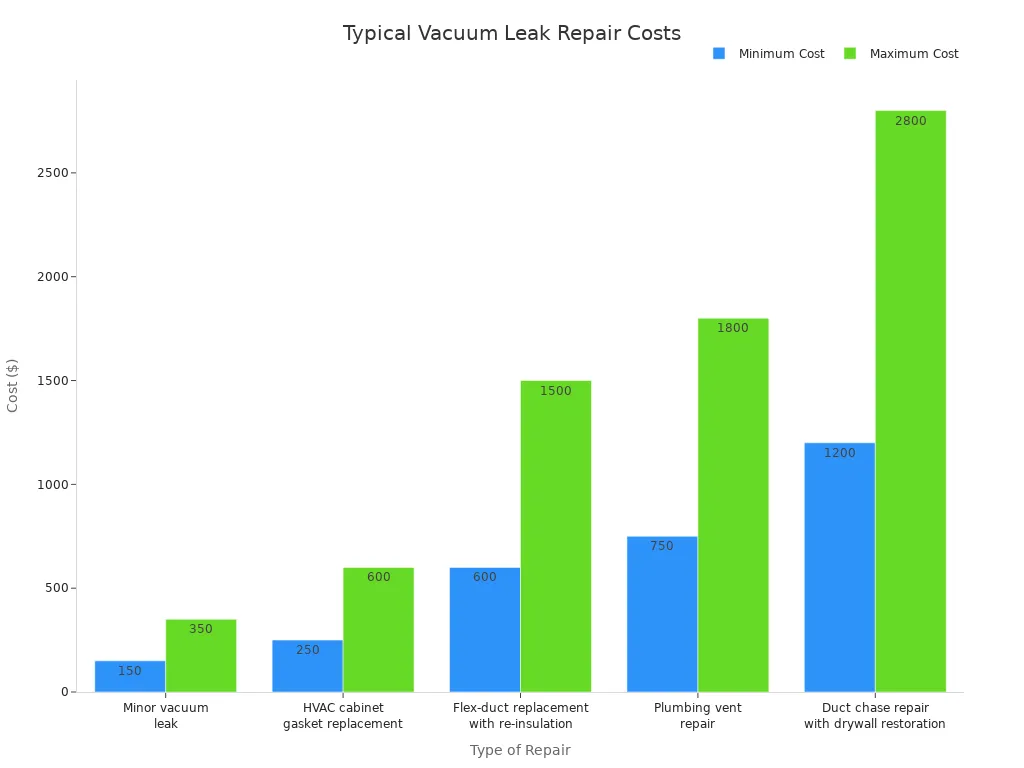
Addressing these issues promptly can prevent more significant problems down the road.
Faulty Idle Air Control Valve
IAC Valve Function
Your car’s Idle Air Control (IAC) valve plays a crucial role in maintaining a steady engine speed when your foot is off the gas pedal. This valve regulates the amount of air that bypasses the closed throttle plate and enters the intake manifold. This airflow regulation is essential for your engine to run smoothly at idle. The engine control unit (ECU) electronically manages the IAC valve’s position. It uses various inputs like engine temperature, electrical load, and throttle position.
For example, during cold starts, the valve opens wider. This increases airflow and raises the idle speed. It helps prevent the engine from stalling. The ECU constantly monitors data from different sensors. It then sends signals to the IAC valve. This tells the valve to open or close. This real-time adjustment of air volume allows precise control over your engine’s idle speed. It reacts quickly to changing conditions. There are two main types of IAC valves. The stepper motor type moves the valve in small, precise steps to regulate airflow. The Pulse-Width Modulated (PWM) type uses varying electrical pulses to control the valve’s position continuously.
Erratic Idle and Stalling
A faulty IAC valve often causes noticeable problems. You might experience an erratic idle. This means your engine speed goes up and down unpredictably when you are stopped. Sometimes, your car will have a consistently high idle.
It might also frequently stall, especially when you come to a stop. These issues happen because the valve cannot properly control the air entering the engine at idle. This leads to an incorrect air-fuel mixture. You might also notice a Car Idle Rough feeling. This indicates the engine is struggling to maintain a smooth operation.
Dirty or Faulty Throttle Body
Carbon Buildup Impact
Your car’s throttle body is a crucial component. It controls the amount of air entering your engine. Over time, carbon deposits can build up on the throttle plate and inside the throttle body. These deposits restrict airflow. This limitation in airflow disrupts the air-to-fuel ratio. You will notice a decrease in fuel efficiency.
You will also experience a reduction in engine power. Cleaning these carbon deposits ensures smoother airflow. It also provides better throttle response. Sometimes, the throttle position sensor itself can malfunction. This sensor tells your engine’s computer how open the throttle is. A faulty sensor sends incorrect signals. This confuses your engine and affects how it manages air intake.
Sticking Throttle and High Idle
When carbon buildup or a faulty sensor affects your throttle body, you will notice specific problems. Your throttle plate might stick. This means it cannot close completely. This causes a consistently high idle speed.
You might also feel the throttle sticking when you press the accelerator pedal. This makes it difficult to accelerate smoothly. Your car might also experience a Car Idle Rough. This happens because the engine struggles to maintain a steady speed. These issues indicate your engine is not getting the correct amount of air. This leads to an imbalanced air-fuel mixture.
Malfunctioning Mass Air Flow Sensor
MAF Sensor’s Role
Your car’s Mass Air Flow (MAF) sensor is a vital component. It measures the amount of air entering your engine. This measurement is crucial for the Engine Control Unit (ECU) to calculate the correct amount of fuel to inject.
An accurate air-fuel ratio ensures efficient combustion. MAF sensors often use hot-wire technology. A wire inside the sensor heats up. As air flows past this heated wire, it cools down. This cooling effect changes the wire’s electrical resistance. The ECU measures this change in resistance. It then uses this information to precisely adjust fuel delivery. This ensures an optimal air-fuel ratio for efficient combustion.
Rough Idle and Rich Smell
A faulty MAF sensor sends incorrect air intake data to your ECU. This leads to an improper fuel mixture. You might experience a Car Idle Rough. Your engine could also stall frequently. Poor acceleration is another common symptom. You might notice consistently high RPMs. Sometimes, you will smell a rich fuel odor from the exhaust.
This happens when the engine receives too much fuel due to incorrect air readings. The ECU thinks less air is entering than actually is. It then injects less fuel. This creates a lean condition. Conversely, if the MAF sensor reports too much air, the ECU injects more fuel, leading to a rich condition and the fuel smell.
Oxygen Sensor Issues
O2 Sensor Monitoring
Your car’s oxygen (O2) sensors are vital for engine efficiency. They constantly monitor the oxygen levels in your exhaust gases. This monitoring helps your engine control unit (ECU) optimize the air-fuel mixture. O2 sensors measure the difference in oxygen content between the exhaust and the outside air.
This difference creates a voltage or changes the sensor’s resistance. A rich mixture, with little unburned oxygen, causes the voltage output to rise. This can go up to about 0.9 volts. A lean mixture, with excess oxygen, results in a low voltage. Your ECU receives this information. It then adjusts the fuel injection. This maintains an optimal air-fuel ratio. This ratio is often close to stoichiometric. It ensures efficient catalytic converter operation and reduces emissions.
Here is how O2 sensors work:
Oxygen molecules from exhaust gas pass through slots to a sensing element.
Oxygen from outside air contacts the other side of the sensing element.
The difference in oxygen levels between exhaust and outside air promotes ion flow and generates voltage.
If the exhaust mixture is rich (low oxygen), your car sends a signal to the ECU to decrease fuel.
If the exhaust mixture is lean (high oxygen), your car sends a signal to the ECU to increase fuel.
This feedback helps maintain the optimal air-fuel mixture.
Fuel Economy and High RPM
A faulty O2 sensor sends incorrect data to your ECU. This leads to an improper fuel mixture. You will experience poor fuel economy. Your car might also have a Car Idle Rough. You could notice consistently high RPMs. Often, a lit check engine light will appear on your dashboard. These issues happen because your engine cannot properly adjust the fuel delivery. This results in inefficient combustion.
You should know about the lifespan of these sensors. Many manufacturers suggest replacing oxygen sensors, especially upstream sensors, every 100,000 miles. This is part of routine maintenance, even if you see no symptoms.
Type of O2 Sensor | Typical Lifespan |
|---|---|
Unheated (1-wire) | Approximately 30,000 – 50,000 miles |
Heated (3 or 4-wire) | Approximately 60,000 – 100,000 miles |
Modern wideband sensors | Approximately 100,000 – 150,000 miles or more |
Replacing old or failing O2 sensors improves your car’s performance and fuel efficiency.
Spark Plug or Ignition Coil Problems

Misfires and Unreliable Spark
Your car needs a strong, consistent spark to ignite the air-fuel mixture. This spark comes from your spark plugs. Ignition coils deliver the high voltage to these plugs. When spark plugs wear out, the gap between their electrodes becomes too wide.
This wider gap forces your ignition coils to generate much higher voltage. They must bridge this larger space. This increased demand puts a lot of strain on the coils. It makes them wear out faster. This can lead to inconsistent or even absent sparks. These issues directly cause engine misfires. If the spark plug gap is too small, the spark might be too weak. This prevents efficient combustion.
Failing ignition coils also contribute to misfires. They cannot provide enough electricity to the spark plugs. This means the spark plugs may not fire at all. Sometimes, they fire only intermittently. This condition directly results in engine misfiring. You will notice symptoms like rough idling. Your car might shake, vibrate, or jerk. It could also sputter during driving.
Reduced Power and Car Idle Rough
When your spark plugs or ignition coils have problems, you will experience several issues. Your engine will misfire. This leads to a Car Idle Rough. You will feel a noticeable reduction in engine power. The engine struggles to run smoothly. You might also notice consistently high RPMs. This happens as the engine tries to compensate for the misfires.
Insufficient electricity from a failing ignition coil prevents spark plugs from sparking effectively. This also prevents consistent sparking. This condition reduces engine power. It can also cause your engine to consume more fuel. The engine tries to compensate for the lack of power. This results in a poor driving experience. You might experience stalling. Your car could have slow acceleration. You might also notice a rough idle. Sometimes, wiring problems or battery issues can also contribute to these ignition system failures.
Fuel Injector Problems
Incorrect Fuel Delivery
Your car’s fuel injectors precisely spray fuel into the engine’s combustion chambers. This ensures the correct air-fuel mixture for efficient burning. When these injectors become clogged or start leaking, they cannot deliver fuel accurately. Clogged injectors restrict fuel flow, meaning your engine gets too little fuel. Leaking injectors, on the other hand, drip excess fuel, giving your engine too much. Both scenarios create an incorrect air-fuel ratio.
Several factors can cause injectors to clog or leak. Low-grade fuel often contains impurities. These impurities leave behind carbon, varnish, and gum. This buildup clogs your fuel injectors. Short driving cycles also contribute. Frequent short trips prevent your engine from reaching optimal operating temperatures.
This increases carbon buildup inside the injector tips. If you neglect fuel filter replacement, a dirty filter allows contaminants like rust and sediment to bypass it. These particles then build up inside the injectors. Over time, injector seals can degrade, dry out, crack, or leak. Internal components also wear out, leading to leaks or malfunctions.
Misfires and Poor Economy
Incorrect fuel delivery from faulty injectors directly causes engine misfires. When an injector delivers too much or too little fuel, it disrupts the precise air-fuel ratio needed for combustion. This imbalance leads to misfires. You will notice a Car Idle Rough feeling. Your engine might sputter and send vibrations through the car. This happens because the engine struggles to maintain smooth operation.
These misfires also lead to poor fuel economy. Your engine works harder to compensate for the inefficient burning of fuel. You might also experience consistently high RPMs as the engine tries to maintain power. The engine’s performance suffers, and you use more fuel than necessary.
PCV Valve Issues
Stuck Open PCV Valve
Your car’s Positive Crankcase Ventilation (PCV) valve plays a vital role. It manages pressure inside your engine. This valve vents harmful gases from the crankcase back into the intake manifold. This process prevents pressure buildup. It also helps keep your engine clean. A PCV valve that gets stuck open creates a significant problem.
It allows too much unmetered air to enter the intake manifold. This extra air bypasses the mass air flow sensor. Your engine’s computer does not account for this additional air. This directly disrupts the air-fuel mixture. Your engine then runs ‘lean.’ This means it has too much air and not enough fuel. On some European makes and models, a strong PCV system can even pull air past engine seals. This creates a vacuum leak. This unmetered air enters the intake manifold by drawing air through seals not meant for air intake. This lean condition makes your engine struggle.
Excessive Air and High RPM
When your PCV valve is stuck open, you will notice several issues. Your engine will experience a Car Idle Rough. This means it shakes or runs unevenly when you are stopped. You might also see consistently high RPMs. Your engine tries to compensate for the lean condition by increasing its speed.
This attempt to balance the mixture often leads to inefficient combustion. Another sign is increased oil consumption. The excessive vacuum can pull oil vapor into the combustion chambers. This burns the oil, leading to lower oil levels. You should check your PCV valve regularly.
Car manufacturers generally advise that PCV valves should be cleaned or replaced within a range of 20,000 to 50,000 miles of driving. Always consult your vehicle’s owner’s manual for specific service intervals. It also shows you the location of the PCV valve.
Vehicle Type | Inspection Interval | Replacement Interval |
|---|---|---|
Standard passenger vehicles | Every 30,000 miles | Every 50,000 miles |
High-performance engines | Every 15,000 miles | Every 30,000 miles |
Turbocharged/Supercharged | Every oil change | Every 20,000 miles |
This regular maintenance helps prevent these issues. It ensures your engine runs smoothly and efficiently.
Engine Coolant Temperature Sensor Failure
Incorrect Temperature Readings
Your car’s Engine Coolant Temperature (ECT) sensor tells your engine’s computer (ECU) how hot the engine coolant is. This information is vital. The ECU uses it to adjust the fuel mixture and ignition timing. If this sensor sends incorrect readings, your ECU gets confused. It might think the engine is colder or hotter than it truly is. This leads to wrong calculations for fuel delivery.
ECT sensors can fail for several reasons. You might see issues from normal wear and tear. Continuous exposure to heat and coolant degrades sensors over time. Coolant contamination also harms the sensor’s internal parts. Dirty or old coolant can cause this. Electrical problems, like loose or corroded wiring, lead to inaccurate readings or complete sensor failure. Sometimes, physical damage occurs. Impact or rough handling during repairs can damage the sensor.
Fuel Mixture Imbalance
When your ECT sensor fails, your ECU delivers an improper fuel mixture. If the sensor reports a colder engine than actual, the ECU enriches the mixture. It adds too much fuel. If it reports a hotter engine, the ECU leans out the mixture. It adds too little fuel. Both scenarios create an imbalance.
You will notice several symptoms. Your car might have a Car Idle Rough. This means it shakes or runs unevenly when you are stopped. You could also experience consistently high RPMs. Sometimes, you will have difficulty starting your car, especially when the engine is cold. The ECU struggles to find the right fuel amount for starting. This makes your engine run inefficiently.
EGR Valve Malfunction
Stuck Open EGR Valve
Your car’s Exhaust Gas Recirculation (EGR) valve helps reduce harmful emissions. It does this by recirculating a small portion of exhaust gases back into the engine’s combustion chambers. This process lowers combustion temperatures. It also reduces nitrogen oxide (NOx) emissions.
A significant problem arises when your EGR valve gets stuck open. This allows exhaust gases to recirculate constantly, even when your engine is idling. During idle and at low speeds, the EGR valve gradually opens, potentially up to 90%, to recirculate exhaust gases. If the EGR valve is stuck open, it will continuously recirculate these gases, disrupting the air-fuel ratio and leading to engine performance issues. This constant flow of inert exhaust gas displaces the fresh air your engine needs for proper combustion.
Constant Exhaust Recirculation
When exhaust gases constantly recirculate due to a stuck-open EGR valve, your engine struggles. The air-fuel mixture becomes incorrect. This leads to several noticeable symptoms. You will experience a Car Idle Rough. Your engine might shake or run unevenly when you are stopped. Your car could also stall frequently, especially when you come to a stop.
You might also notice consistently high RPMs as your engine tries to compensate for the improper mixture. A properly functioning EGR valve offers significant environmental benefits. It reduces nitrogen oxide (NOx) emissions by 50-70%.
This helps vehicles comply with EPA and CARB emissions standards. It also decreases the environmental impact of diesel engine operations. Therefore, fixing a malfunctioning EGR valve not only improves your car’s performance but also helps the environment.
Transmission Issues
Torque Converter Problems
Your car’s transmission can also cause engine problems. A common issue involves the torque converter. This part connects your engine to the transmission. It allows your engine to spin while the wheels are stopped.
If the torque converter does not disengage correctly, it creates engine drag. This puts an incorrect load on your engine. When the torque converter clutch (TCC) fails to disengage properly, it can engage and disengage erratically. This erratic behavior disrupts the smooth transfer of power from the engine to the transmission.
It leads to increased slippage. This increased slippage forces your engine to work harder. It compensates for the inefficient power transfer. This results in an increased workload and higher fuel consumption. Your engine constantly tries to overcome the resistance from the TCC’s inability to properly lock up or disengage. This creates an incorrect load and drag.
Other transmission issues can also affect your engine’s idle. A ruptured vacuum modulator or a leak in its vacuum line can impact engine idle. A leaking vacuum line can increase your idle speed. A ruptured modulator can also cause the intake to draw transmission fluid. This creates a vacuum leak.
Engine Drag and High RPM
When your transmission has these problems, you will notice specific symptoms. You might experience a Car Idle Rough. This means your engine shakes or runs unevenly when you are stopped. You will also see consistently high RPMs. This is especially noticeable when your vehicle is in gear. Your engine works harder to overcome the drag from the transmission. This leads to several other issues.
Reduced Acceleration and Power: Inefficient power transfer from issues like worn-out components or internal fluid leaks within the torque converter can lead to sluggishness. You will have difficulty maintaining speed.
Increased Fuel Consumption: Your engine has to work harder. It compensates for the torque converter’s struggle to efficiently transmit power. This leads to higher fuel consumption.
Transmission Overheating: Increased friction and slippage from a failing torque converter generate excessive heat. This can overwhelm your transmission’s cooling system.
These issues indicate a problem that needs attention.
A Car Idle Rough and high RPM are never normal. They almost always signal an underlying problem, often an air-fuel mixture imbalance. You have learned about many causes, from air and fuel delivery to ignition and sensor issues. Even intermittent rough idles need your attention. Timely and accurate diagnosis is crucial. Ignoring these symptoms can lead to more costly repairs, reduced fuel economy, and even safety concerns like stalling. Addressing problems early, like a faulty idle air control valve, can save you from higher repair costs later. Do not ignore these signs. Protect your vehicle’s safety, performance, and fuel efficiency.
FAQ
What does a “rough idle” mean for your car?
A rough idle means your engine runs unevenly when you are stopped. You might feel vibrations or shaking. The engine sounds like it is struggling to stay on. This often points to an imbalance in your engine’s air-fuel mixture.
Why does your car’s RPM go high when it idles rough?
Your engine tries to compensate for an incorrect air-fuel mixture. It increases RPM to prevent stalling. This often happens when too much air enters the engine, like from a vacuum leak. The engine works harder to maintain operation.
Can you drive your car if it has a rough idle and high RPM?
You should avoid driving your car with these symptoms. Ignoring them can cause more damage. It can also lead to unsafe driving conditions. Get your car checked by a professional quickly.
How can you diagnose a rough idle yourself?
You can check for obvious signs. Listen for hissing sounds, which suggest vacuum leaks. Look for a lit check engine light. You can also inspect visible hoses for cracks. These steps help you narrow down the problem.