

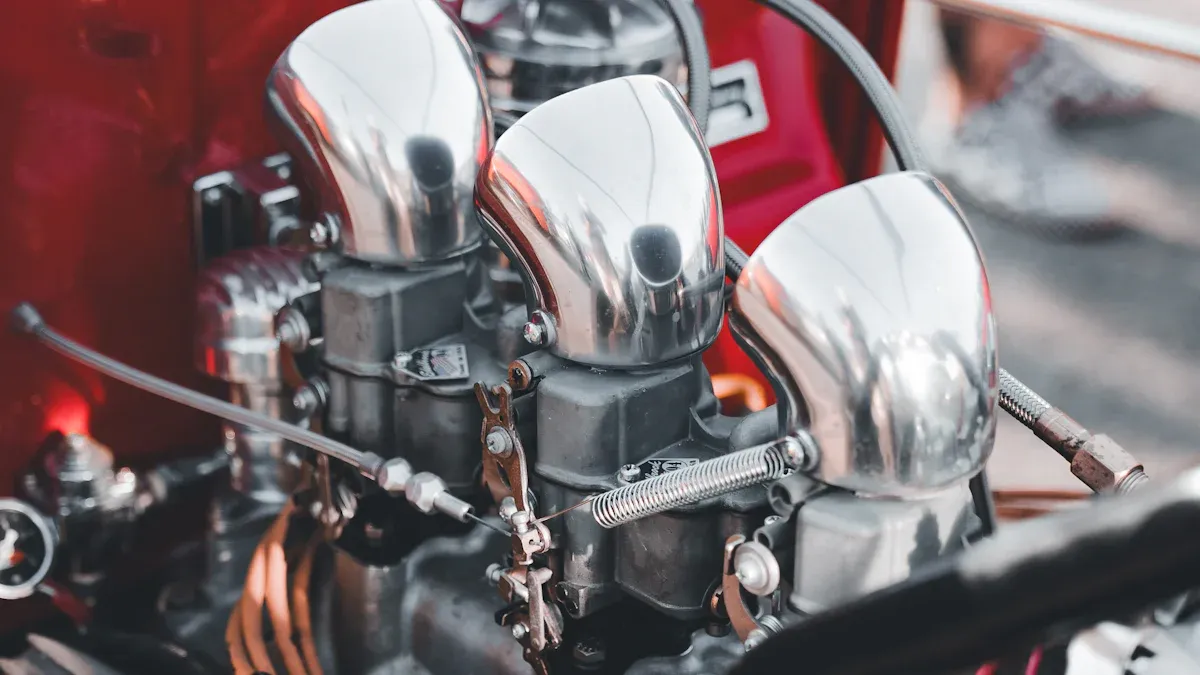
Think about your daily commute or a weekend road trip. What powers that journey? It is often the incredible gasoline engine. This marvel converts fuel into the motion that moves you. Gasoline engines power a vast majority of personal transportation. Consider these facts:
Category | Percentage/Detail |
|---|---|
Overall Transportation Fuel | Over 90% fueled by oil |
Gasoline-Powered Cars, Light Trucks, Motorcycles | 97% of these vehicles run on gasoline |
This blog will demystify how a gasoline engine works. You will discover its key internal workings and hidden “secrets.”
Key Takeaways
A gasoline engine turns fuel into motion. It uses parts like pistons, connecting rods, and a crankshaft. These parts work together to power your car.
The engine works in four steps: intake, compression, power, and exhaust. Air and fuel enter, get squeezed, explode to create power, and then waste gases leave.
Many systems help the engine run well. These include fuel delivery, ignition, air intake, and cooling. They make sure the engine gets fuel, sparks, clean air, and stays cool.
The Engine Control Unit (ECU) is the engine’s brain. It uses sensors to check everything. It adjusts fuel and spark timing. This makes the engine powerful and efficient.
Modern engines use smart technologies. Variable valve timing and turbochargers boost power. Direct injection makes fuel use better. These help engines perform well and save fuel.
Engine Core Components
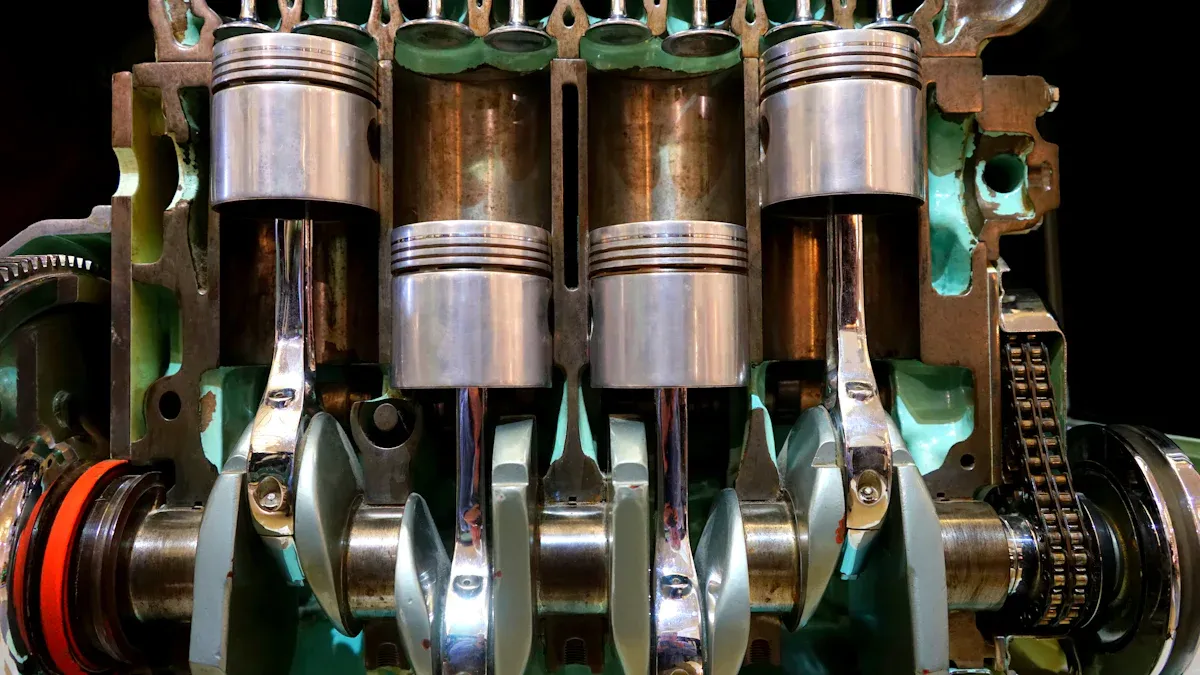
You find the heart of any gasoline engine in its core components. These parts work together to create the power that moves your vehicle. Understanding these basic elements helps you grasp how a gasoline engine works.
Cylinder and Piston Assembly
Imagine a strong metal tube. This is the cylinder. It forms the main workspace for the engine. Inside each cylinder, a movable part called a piston slides up and down. This piston fits snugly within the cylinder. When you look at modern engines, you see cylinders made from tough materials. Manufacturers often use steel, aluminum, or composite materials for cylinder construction. Pistons, on the other hand, are primarily made from various aluminum alloys. These alloys differ in their silicon content.
For example, hypereutectic alloys have high silicon, up to 20%. You find these in 390 aluminum cast pistons, common in gasoline engines. They allow for tighter clearances and perform well at high temperatures. Hypoeutectic alloys contain very little silicon. The 2618 alloy, with only 0.23% silicon, offers higher malleability. Race engines often use this for high boost and cylinder pressure, though it is less wear-resistant.
Eutectic alloys sit in the middle, with about 12.2% silicon. The 4032 alloy provides solid all-around performance, good wear resistance, and stable thermal expansion. Piston coatings also improve material properties. These include skirt coatings with graphite, Teflon, and molybdenum, ceramic-metallic crown coatings, abradable coatings, and hard-anodized ring lands. This cylinder and piston assembly forms a crucial part of the combustion chamber.
Connecting Rod and Crankshaft
The piston does not work alone. A strong metal arm, the connecting rod, links the piston to the crankshaft. Think of the connecting rod as the bridge between the up-and-down motion of the piston and the spinning motion of the crankshaft.
The crankshaft is a large, rotating shaft. It converts the linear (straight-line) movement of the pistons into rotational (spinning) energy. This rotational energy then powers your wheels. During combustion, a single stroke can exert “tons of force” on the connecting rod. It must withstand both compressive and tensile pressures.
For instance, during the power stroke, a connecting rod in a Chrysler Race Hemi engine experiences a minimum load of approximately 1000 pounds at 7200 rpm. The rod is also compressed with a maximum force of about 2600 pounds shortly after the piston reaches Top Dead Center (TDC). This happens because of increasing cylinder pressure within the combustion chamber. This incredible force highlights the robust design needed for every part of a car engine.
Engine Valves and Camshaft
For the engine to breathe, it needs valves. You have two main types: intake valves and exhaust valves. Intake valves open to let the air-fuel mixture into the combustion chamber. Exhaust valves open to let burned gases out. A component called the camshaft controls these valves.
The camshaft has egg-shaped lobes that push against the valves, opening and closing them at precise times. This timing is critical for engine performance. Engine valves must endure extreme conditions. They face high temperatures and pressures. Manufacturers use specific materials to handle this stress.
Carbon steel and stainless steel offer improved strength and significantly higher resistance to thermal stress compared to older materials like bronze or brass. For exceptional corrosion resistance and strength at very high temperatures, you might find Inconel, titanium, or tungsten valves. Inconel is ideal for high-stress, high-temperature applications like turbocharged or diesel engines. It has high nickel content and an austenitic structure, preventing distortion. Stainless Steel (21-4N) balances strength and affordability for high-RPM and mildly boosted engines.
A more budget-friendly option, Stainless Steel (21-2N), suits street or mild racing engines. Titanium is used in high-RPM race engines for its low mass and high strength, contributing to quick and efficient engine response.
Piston Rings: Sealing the Power
Piston rings are small but vital components. They fit into grooves around the piston. You typically find two types: compression rings and oil control rings. Compression rings create a tight seal between the piston and the cylinder wall.
This seal prevents gases from escaping the combustion chamber during the power stroke. It ensures maximum pressure builds up to push the piston down. Oil control rings scrape excess oil from the cylinder walls, preventing it from entering the combustion chamber and burning. These rings expand outward due to spring tension and gas pressure, pressing against the cylinder walls.
This expansion is crucial for maintaining the seal. Piston rings operate under intense heat. For passenger car pistons, the top ring groove temperature with spray-jet cooling or a salt-core cooling channel typically ranges from 200–280°C (392–536°F). When a cooled ring carrier is used, the top ring groove temperature generally stays between 180–230°C (356–446°F). This high-temperature environment demands durable materials and precise engineering for these rings to effectively seal the internal combustion engine.
Internal Combustion Engine: Power Generation
An internal combustion engine creates power by burning a fuel-air mixture inside a cylinder. This combustion generates energy. It causes gases to expand, pushing the piston downward. This process converts chemical energy into mechanical force. You will see how this happens through four distinct stages, making it a four-stroke engine. This entire cycle repeats many times each second. It is how your car engine continuously generates power.
Intake Stroke: Air-Fuel Entry
The first step in generating power is getting the fuel and air into the engine. During the intake stroke, the intake valve opens. The piston moves down inside the cylinder. This downward motion creates a vacuum. This vacuum pulls the air-fuel mixture into the combustion chamber. The amount of air and fuel must be precise for optimal performance.
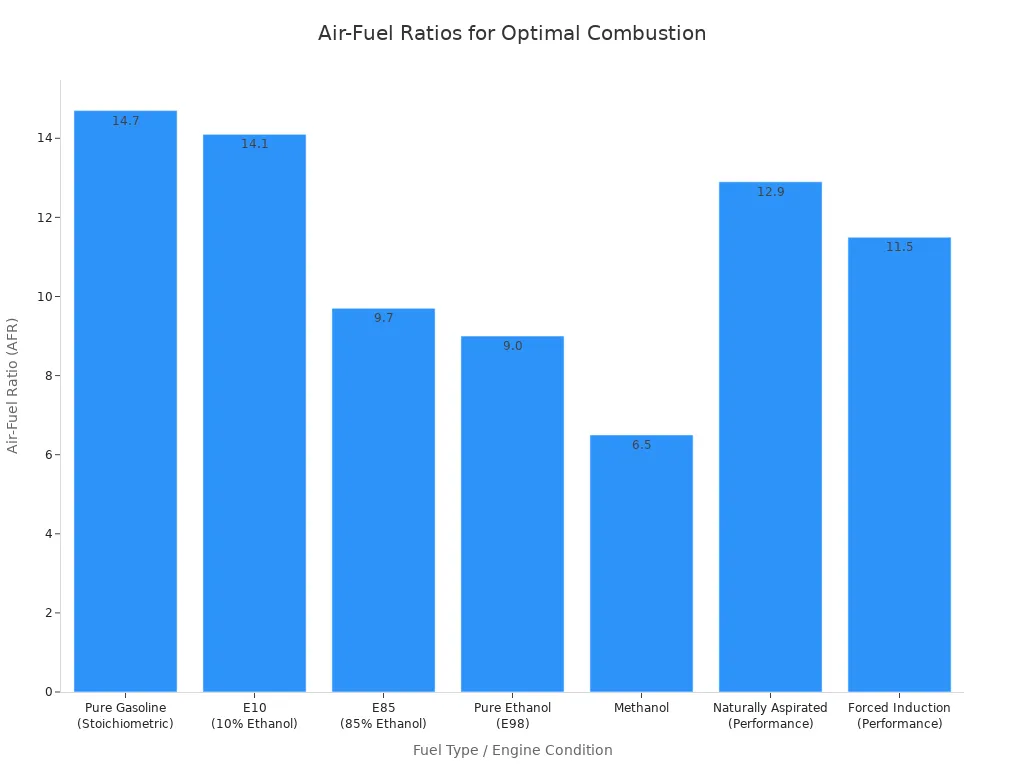
The air-fuel ratio (AFR) is very important. It determines how efficiently your engine burns fuel. For pure gasoline, the ideal stoichiometric ratio is 14.7 parts air to 1 part fuel. This ratio ensures complete combustion. However, for maximum power, you often need a slightly richer mixture.
Fuel Type / Engine Condition | Air-Fuel Ratio (AFR) |
|---|---|
Pure Gasoline (Stoichiometric) | 14.7:1 |
E10 (10% Ethanol) | 14.1:1 |
E85 (85% Ethanol) | 9.7:1 |
Pure Ethanol (E98) | 9:1 |
Methanol | 6.5:1 |
Naturally Aspirated (Performance) | 12.8:1 to 13:1 |
Forced Induction (Performance) | 11.5:1 |
Idle and Part Throttle | Stoichiometric (e.g., 14.7:1 for pure gasoline) |
You can see how different fuels and conditions require different ratios. For example, a naturally aspirated engine aiming for performance often runs between 12.8:1 and 13:1. This slightly rich mixture ensures all available air burns, preventing power loss.
Compression Stroke: Mixture Squeeze
After the air-fuel mixture enters the combustion chamber, the intake valve closes. The piston then moves back up the cylinder. This upward motion compresses the mixture. Squeezing the mixture increases its temperature and pressure. This prepares it for a powerful ignition. The compression ratio measures how much the mixture is squeezed.
Modern gasoline engines use high compression ratios for better efficiency.
Modern GM LS engines can have a static compression ratio of 10.5:1.
For 91 octane pump gas, the dynamic compression ratio is typically 8.0 to 8.5:1.
Later model engines with improved combustion chamber designs can achieve a dynamic compression ratio of up to 9.0:1.
A higher compression ratio means more power from the same amount of fuel. This is a key factor in how a gasoline engine works efficiently.
Power Stroke: Controlled Explosion
This is where the real power comes from. Once the piston reaches the top of its compression stroke, the spark plug fires. It ignites the compressed air-fuel mixture. This creates a controlled explosion within the combustion chamber. The rapidly expanding gases push the piston forcefully downward. This downward force is the power stroke. It converts the chemical energy of the fuel into mechanical energy. This mechanical energy then turns the crankshaft.
The pressure inside the cylinder during this stroke is immense. It pushes the piston with great force.
Engine Type | Peak Cylinder Pressure (approx.) |
|---|---|
Marine Gasoline (Naturally Aspirated) | 110 bar |
Turbocharged SI Engine (rough estimate) | 850 psi (60 bar) |
Near-stoichiometric Homogeneous Charge SI (Turbocharged) | 70 to 90 bar |
Turbocharged F1 Engines (1980s) | 100 bar |
High BMEP Turbocharged Heavy-Duty Natural Gas (Design Point) | 1500-2000 psi |
High BMEP Turbocharged Heavy-Duty Natural Gas (Incipient Knock) | 2000-2500 psi |
High BMEP Turbocharged Heavy-Duty Natural Gas (Heavy Knock) | Over 3000 psi |
Peak pressures in automotive gasoline engines typically range from 7 to 10.5 MPa (1015-1523 psi) after firing. This incredible force drives the engine.
Exhaust Stroke: Waste Expulsion
After the power stroke, the piston moves back up again. This time, the exhaust valve opens. The upward motion of the piston pushes the burned gases out of the combustion chamber and into the exhaust system. This clears the cylinder for the next intake stroke. This completes one full cycle of the four-stroke engine. The process then repeats, ensuring continuous power generation in the internal combustion engine.
The gases expelled during this stroke are primarily:
Water vapor (H2O)
Carbon dioxide (CO2)
Nitrogen (N2)
Water vapor and carbon dioxide are the main products of combustion. Nitrogen is the largest component, just like in the air you breathe. Oxygen is also present, but in lower concentrations than in ambient air. Other pollutants exist in very small amounts. They are typically filtered or converted by the exhaust system.
Fuel Delivery System: Precision Secret
Your car’s engine needs a constant supply of fuel. The fuel delivery system makes sure this happens. It precisely controls how much fuel goes into the engine. This system is a key part of how a gasoline engine works.
Fuel Tank to Injectors
The journey of fuel starts in your car’s fuel tank. A fuel pump sends the gasoline from the tank. It travels through fuel lines to the engine. These lines carry the fuel under pressure. The fuel then reaches the fuel injector.
This component sprays the fuel into the engine. In many systems, the fuel pressure is carefully managed. For example, when the vacuum hose is disconnected, the fuel pressure is about 36 PSI. At idle, with the vacuum hose connected, the fuel system pressure drops to around 30 PSI. This range is typically between 28 and 32 PSI. Some systems, like the Gold Wing CFI, operate with fuel pressure between 28 and 34 PSI. This consistent pressure ensures the engine gets the right amount of fuel.
Fuel Atomization
Once the fuel reaches the fuel injector, it needs to become a fine mist. This process is called atomization. Atomization breaks the liquid fuel into tiny droplets. This fine mist mixes better with air. A good air-fuel mixture burns more completely.
This makes your engine more efficient. Observations show that the best droplet size for efficient combustion is usually between 15 and 25 micrometers. You want uniform droplet sizes. If droplets are too fine, below 25 micrometers, they need very high injection pressure. These tiny, high-momentum droplets can escape combustion. They might stick to engine surfaces. This reduces engine efficiency. It also increases harmful emissions. So, getting the droplet size just right is crucial for your engine’s performance.
Ignition System: Spark of Life

Your engine needs a spark to start the combustion process. The ignition system provides this crucial spark. It makes sure the spark happens at exactly the right moment. This system is vital for how a gasoline engine works.
Spark Plugs and Coils
Spark plugs are small but mighty components. They sit at the top of each cylinder. Each spark plug creates an electrical spark. This spark ignites the air-fuel mixture. To create this spark, you need a lot of voltage. Ignition coils boost the low voltage from your car’s battery. They turn 12 volts into a much higher voltage.
The voltage needed to jump the spark plug gap is impressive.
It can range from 6,000 to 20,000 volts.
Some systems can produce as much as 40,000 volts.
The voltage required changes constantly. It depends on your engine setup. It can go from 5,000 volts to over 40,000 volts.
This high voltage creates a powerful spark. This spark ignites the fuel mixture.
Timing the Spark
The spark must happen at the perfect time. This is called ignition timing. If the spark happens too early or too late, your engine will not run well. It might lose power or use too much fuel. The engine’s computer controls this timing very precisely.
As your engine’s speed (RPM) increases, the ignition timing needs to change. The spark must happen earlier. This gives the fuel enough time to burn completely. Higher RPMs mean less time for combustion. An earlier spark ensures you get the most power from each controlled explosion. This precise timing is a secret to your engine’s efficiency.
Air Intake and Filtration
Your engine needs clean air to burn fuel efficiently. The air intake and filtration system ensures your engine gets this clean air. It also controls how much air enters the engine. This system is crucial for how a gasoline engine works.
Air Filter’s Role
Think of the air filter as your engine’s lungs. It cleans the air before it enters the engine. This filter traps dust, dirt, pollen, and other particles. Without a good filter, these particles could damage internal engine parts. A clean air filter helps your engine perform its best.
Automotive air filters are very effective. They prevent harmful particles from reaching your engine. Look at how well different filter types perform:
Filter Element Type | Initial Separation Efficiency (%) | Stable Separation Efficiency (%) |
|---|---|---|
Cellulose (A) | 96.3 | 99.7 |
B | N/A | 99.9 |
C | N/A | 99.9 |
D (Cellulose+Polyester+Nanofibers) | 99.8 | 99.9 |
E (Polyester+PTFE membrane) | 99.97 | N/A |
Initially, a new filter might let some larger dust particles pass. These particles can be up to 28 micrometers in size. However, advanced materials like nanofiber layers or PTFE membranes greatly improve this initial efficiency. They also shorten the time it takes for the filter to reach its full cleaning power. This reduces wear on your engine.
Throttle Body Control
The throttle body acts like a gate for the air entering your engine. It sits in the air intake system. This component controls the amount of air that goes into the engine. Inside the throttle body, you find a butterfly valve. This valve is also called the throttle plate.
When you press the accelerator pedal, this plate rotates. It opens the passage. This allows more air to flow into the intake manifold. In modern cars, an electric actuator manages the throttle plate’s position. It uses your pedal input and other sensor data. A mass airflow sensor measures the change in airflow. This information goes to the engine’s computer, the ECU. The ECU then adjusts the fuel injection. This keeps the air-fuel ratio correct for optimal performance.
Exhaust System: Emission Control
Your engine creates exhaust gases after burning fuel. The exhaust system manages these gases. It cleans them and reduces noise. This system is very important for how a gasoline engine works.
Manifold to Muffler
Exhaust gases leave the engine through the exhaust manifold. This part collects gases from all cylinders. Then, the gases travel through pipes. They go to the muffler. The muffler reduces engine noise. It uses different methods to quiet the sound.
Reactive Mufflers: These mufflers have special chambers and tubes. They make sound waves bounce and cancel each other out. This design targets specific loud sounds.
Absorptive Mufflers: These mufflers use packing material. Sound energy hits this material. Friction turns the sound energy into heat. This makes the engine quieter.
Catalytic Converter Function
After the muffler, gases often go to the catalytic converter. This device is a hero for clean air. It changes harmful pollutants into less harmful substances. It uses special metals like platinum, palladium, and rhodium. These metals act as catalysts.
Here are the main chemical changes that happen:
Nitrogen oxides (NOx) change into nitrogen gas and oxygen gas. For example, (2NO rightarrow N_2 + O_2).
Carbon monoxide (CO) changes into carbon dioxide (CO2). For example, (2CO + O_2 rightarrow 2CO_2).
Unburned hydrocarbons (HC) change into carbon dioxide and water. For example, (HC + O_2 rightarrow CO_2 + H_2O).
These reactions clean the exhaust. They make your car much better for the environment.
Cooling System: Temperature Regulation
Your engine generates a lot of heat. This heat comes from burning fuel and friction. Without a proper cooling system, your engine would quickly overheat and seize. The cooling system keeps your engine at its ideal operating temperature. This system is essential for how a gasoline engine works.
Radiator and Water Pump
The water pump starts the cooling process. It circulates coolant, a special fluid, through your engine’s passages. This coolant absorbs heat from the engine. After picking up heat, the coolant flows to the radiator. The radiator looks like a large, thin heat exchanger. Air flows through its fins, cooling the hot coolant. The cooled fluid then returns to the engine to absorb more heat.
Maintaining the correct temperature is crucial. Your engine’s normal operating temperature is typically around 195 to 220 Fahrenheit (approximately 90°C). Temperatures outside this range can cause problems. For example, operating temperatures below 85°C (185°F) can hinder proper engine warm-up. This might cause excessive wear. Conversely, temperatures exceeding 105°C (220°F) risk engine overheating and potential failure.
Thermostat’s Role
The thermostat acts as a gatekeeper for the coolant flow. It is a spring-loaded valve. This valve regulates the amount of coolant flowing from the engine block to the cooling radiator. When your engine is cold, the thermostat stays closed. This prevents coolant from flowing to the radiator. It helps your engine reach its optimal operating temperature quickly.
Once your engine warms up, the thermostat gradually opens. This allows coolant to flow to the radiator for cooling. The thermostat balances opening and closing. It maintains a stable temperature and prevents overheating. A properly working thermostat ensures efficient operation. It promotes optimal combustion, reduces wear, and extends engine life. If a thermostat gets stuck closed, it stops coolant flow to the radiator. This causes overheating. If it gets stuck open, your engine runs too cool. This impacts fuel efficiency and emissions.
Lubrication System: Engine’s Lifeblood
Your engine has many moving parts. These parts rub against each other. This creates friction and heat. The lubrication system is like your engine’s lifeblood. It keeps everything moving smoothly. It prevents wear and tear. This system is vital for how a gasoline engine works.
Oil Pump and Circulation
The oil pump starts the lubrication process. It draws oil from the oil pan. This pan sits at the bottom of your engine. The pump then sends this oil under pressure. It travels through special passages. These passages go to all the moving parts. The oil creates a thin film between surfaces. This film stops metal from touching metal. The oil then drains back into the oil pan. It waits for the pump to send it again. This constant circulation protects your engine.
Engine Oil Properties
Engine oil has special properties. These properties help it do its job well. You need to understand these to know how a gasoline engine works efficiently.
Lubrication and Friction Reduction: Motor oil minimizes friction between engine parts. This reduces the heat generated by their movement.
Heat Absorption and Dissipation: The oil absorbs heat from the combustion process. It transports this heat away from critical engine components. This prevents overheating.
Viscosity: This is the most crucial property. It measures the oil’s resistance to flow. Viscosity influences how well the oil circulates and carries heat. It changes with temperature and pressure.
Thermal Stability: High thermal stability ensures the oil maintains its viscosity and performance. It works well even at elevated temperatures.
Film Strength: This property shows the lubricant’s load-carrying capacity. It means the oil can maintain a protective film between moving parts. This is essential for reducing friction and wear.
These properties ensure your engine stays cool and protected. They help it last longer.
Engine Management: ECU’s Brain
Your car has a very smart computer. This computer is the Engine Control Unit, or ECU. Think of the ECU as your engine’s brain. It constantly monitors and adjusts many things. This ensures your engine runs smoothly and efficiently.
Sensors and Actuators
The ECU needs information to do its job. It gets this information from many sensors. These sensors act like the ECU’s eyes and ears. They send data about what is happening inside and around the engine.
Crankshaft Sensor: This sensor tells the ECU how fast your engine is spinning. It also helps time the spark.
Camshaft Sensor: This sensor tracks the camshaft’s position. It helps the ECU know when to inject fuel and spark.
Manifold Air Pressure (MAP) Sensor: This sensor measures air pressure in the intake. It helps determine how much work your engine is doing.
Throttle Position Sensor (TPS): This sensor tells the ECU how much you are pressing the gas pedal.
Intake Air Temperature (IAT) Sensor: This sensor measures the temperature of the air entering the engine. This helps calculate air density.
Coolant Temperature Sensor: This sensor checks your engine’s temperature. It helps control the cooling fan and fuel delivery.
Mass Air Flow (MAF) Sensor: This sensor measures the amount of air entering the engine. It ensures precise fuel delivery.
Oxygen (O2) Sensors: These sensors check oxygen in the exhaust. They help keep the air-fuel mixture just right.
Knock Sensor: This sensor listens for unusual noises. It tells the ECU to adjust timing if it hears knocking.
The ECU also has “muscles” called actuators. These parts carry out the ECU’s commands. For example, the ECU tells fuel injectors when to spray fuel.
Optimizing Performance
The ECU uses all this sensor data. It makes constant adjustments to keep your engine running its best. It precisely controls fuel delivery and ignition timing. For fuel delivery, the ECU determines the perfect fuel-to-air ratio. It injects the exact amount of fuel needed. It considers engine temperature, how much you press the throttle, and even altitude. This precise control makes your car use less fuel. It also reduces harmful emissions. This improves overall engine performance.
The ECU also adjusts when the spark plug fires. It watches engine speed, load, and temperature. When you accelerate, the ECU can make the spark happen earlier. This gives you more power. When you are cruising, it can delay the spark. This saves fuel. These dynamic adjustments give you both great power and good fuel efficiency.
Advanced Technologies: Boosting Power
Engineers constantly look for ways to make engines stronger and more efficient. Modern gasoline engines use clever technologies to boost power and save fuel. These advancements show how a gasoline engine works even better today.
Variable Valve Timing
Imagine your engine’s valves as doors. Variable Valve Timing (VVT) lets your engine open and close these doors at different times. This depends on how you drive. At low engine speeds, VVT helps your engine use less fuel. It reduces the energy wasted when drawing air into the cylinders. This makes your fuel economy better. It also makes burning fuel more stable at low speeds. This allows for leaner air-fuel mixtures. When you drive faster, VVT changes the intake valve timing. This lets more air and fuel enter the cylinders. This gives you higher horsepower. It also improves low-end and mid-range torque. Your car feels smoother and more responsive across all speeds.
Turbocharging and Supercharging
Sometimes, your engine needs more air to make more power. Turbochargers and superchargers are like air pumps for your engine. They force more air into the cylinders. This allows your engine to burn more fuel and create more power.
Turbochargers use your engine’s exhaust gases to spin a turbine. This turbine then powers a compressor. The compressor pushes extra air into the engine.
Superchargers use a belt connected to the engine to power their compressor. They provide instant power because they are directly linked to the engine.
Both systems significantly increase your engine’s power output. Turbochargers in modern passenger vehicles typically provide a boost pressure of 6 to 8 pounds per square inch (psi). This extra pressure means your engine gets a powerful boost. It makes a smaller engine perform like a much larger one.
Direct Injection: Fuel Efficiency in a Car Engine
Direct injection is a modern technology. It significantly boosts fuel efficiency in your car engine. This system changes how fuel gets into the engine. It delivers fuel with incredible precision.
High-Pressure Fuel Delivery
In a direct injection system, fuel does not mix with air before entering the cylinder. Instead, a special pump sends fuel directly into the combustion chamber. This pump works at very high pressures. A ‘low side’ pump first supplies fuel at about 58 psig to a ‘high side’ pump. The ‘high side’ pump then dramatically increases these pressures. It can range between 500-2800 psig. This high pressure ensures fine atomization of the fuel. This is much higher than older systems. This precise delivery helps your car engine use fuel more effectively.
Combustion Efficiency
Direct injection greatly improves how efficiently your engine burns fuel. It places fuel directly into the combustion chamber. This is unlike systems where fuel mixes with air before the valve. This design uses a fuel injection assembly. It delivers a continuously variable injection flow rate. It controls the injector needle position. An iterative learning control feedback circuit controller ensures the optimum fuel injection rate at all times. This increases fuel combustion efficiency. It also improves fuel economy. This system overcomes injection quality inconsistencies. You get a more complete and controlled burn. This optimizes power output. It also reduces emissions.
You can achieve enhanced fuel efficiency without losing performance. Fuel delivers with pinpoint accuracy. Engines can operate with leaner air-fuel ratios. This reduces fuel consumption. It also lowers emissions. Direct injection improves throttle response. It increases torque at lower RPMs.
This makes it suitable for performance applications. This technology supports higher compression ratios. Your engine generates more power per cycle. It maintains efficiency through better atomization. Automakers use direct injection to downsize engines. They do not sacrifice performance. Smaller engines produce impressive horsepower and torque. This is comparable to larger engines. This precise control in the combustion chamber is a key secret. It makes your car engine more powerful and efficient.
You now understand how a gasoline engine works. Each part plays a vital role. This intricate dance of components powers your car engine. It is truly a marvel of engineering. Appreciate the hidden complexities that move your vehicle. The internal combustion engine continues to evolve. It remains a relevant and powerful machine.
You see how a gasoline engine works every day. This complex internal combustion engine is a testament to human ingenuity. Internal combustion engines will drive us forward for years to come. Your car engine relies on this amazing system. This is how a gasoline engine works.



