Modern vehicle safety features are vital. Airbag systems are a key part of vehicle safety. You see air bags, but many hidden parts make them work. These parts start a precise, milliseconds-long sequence. Approximately 98.40% of vehicles in America have airbags. These airbags protect you. This blog is a life-saving guide. It shows you the 10 essential components. These components work together to protect you during collisions. They form a supplementary restraint system, or SRS. This system offers many safety features.
Key Takeaways
Airbag systems have many hidden parts. These parts work together to protect you in a crash.
Crash sensors detect impacts. They tell the Airbag Control Unit (ACU) when to deploy airbags.
The ACU is the brain of the airbag system. It decides when and how airbags should deploy.
Seatbelt pretensioners tighten seatbelts during a crash. This helps position you safely for the airbags.
The Occupant Classification System (OCS) detects who is in the seat. It adjusts airbag deployment for different people, like adults or children.
Crash Sensors: Detecting Impact
Impact Detection and Severity Assessment
You rely on crash sensors to detect a crash. These sensors are vital parts of your car’s safety system. They work quickly to sense when a collision happens. Different types of sensors exist. Accelerometers detect rapid deceleration. Impact sensors are in your car’s bumpers or crumple zones. They detect the force of a contact. Pressure sensors track sudden air pressure changes. You find these in doors and panels. They are important for side airbags. Gyroscopic sensors detect rotational movement. These help with rollover accidents. Some sensors are also classified by function. Collision intensity sensors measure the degree of the collision. They sense acceleration or deceleration. This helps determine if the collision is minor or major.
Your car’s system uses this information. It decides if it needs to activate the airbags. Mechatronics collision sensors use mechanical motion. They control the airbag circuit by opening and closing electrical contacts during a collision.
Initiating the Deployment Sequence
Once sensors detect a significant impact, they send signals. These signals go to the Airbag Control Unit (ACU). This unit is the brain of the system. It processes all the sensor data. If the impact meets certain thresholds, the ACU makes a decision. It decides to initiate the airbag deployment sequence. This sequence happens in milliseconds. Collision protection sensors also play a role. They prevent accidental airbag inflation. They have a low deceleration threshold. This stops the airbags from activating during small bumps. The entire srs relies on this precise timing. It ensures your airbags activate only when truly needed. This rapid inflation creates a protective barrier for you.
Airbag Control Unit (ACU): System’s Brain
The Airbag Control Unit (ACU) is the central brain of your car’s safety system. It makes all the critical decisions. This unit ensures your airbags deploy only when necessary. It acts as the command center for all airbag systems.
Processing Sensor Data
The ACU constantly receives information from all the crash sensors. It processes this data very quickly. You can think of it as a super-fast computer. The ACU uses smart logic to understand the crash. For example, it has a deployment threshold algorithm. This algorithm makes sure airbags deploy only in serious crashes. It looks at the force of impact, not just your speed. The ACU also analyzes data from many sensors at once. This happens in milliseconds. An Occupant Classification System (OCS) logic helps too. It uses weight sensors. This stops the passenger airbag from deploying for small children or empty seats. The system also avoids deployment in minor crashes. It checks your seatbelt use. This helps adjust how airbags deploy.
Making Deployment Decisions
After processing all the sensor data, the ACU makes a crucial decision. It decides if it needs to deploy the airbags. This decision happens in a fraction of a second. If the ACU determines a crash is severe enough, it sends an electrical signal. This signal goes to the correct airbag inflators. This starts the rapid inflation process. The ACU also monitors the entire srs for any issues. If you ever need to replace the ACU, you must use genuine OEM parts. This keeps the entire system working correctly and safely. Using non-genuine parts can compromise the integrity and life-saving capability of your airbags.
Inflator: Rapid Gas Production
Generating Gas for Airbag Inflation
You need a fast way to fill an airbag. The inflator makes this happen. It creates a large amount of gas in a very short time. Early airbag systems used sodium azide (NaN3) with potassium nitrate (KNO3). This reaction made nitrogen gas. This gas then inflated the airbag. However, sodium azide was toxic. Manufacturers changed these formulas in the 1990s. Newer systems use different chemicals. Some use nitroguanidine or phase-stabilized ammonium nitrate (NH4NO3). Others use nitrogen-rich fuels like tetrazoles and triazoles.
Modern airbags often use guanidinium nitrate. This combines with a copper nitrate oxidizer. When ignited, guanidinium nitrate breaks down. It produces nitrogen gas, water, and carbon. The copper nitrate helps cool the exhaust gas. First-generation airbags also used sodium azide. When ignited, it produced nitrogen gas and sodium metal. This sodium metal then reacted with potassium nitrate and silicon dioxide. This created potassium silicate and sodium silicate. This process stopped the sodium from reacting with moisture. It prevented corrosive sodium hydroxide from forming.
Ensuring Quick Airbag Deployment
The inflator’s job is to deploy the airbags incredibly fast. This speed is crucial for your safety. An igniter within the airbag module starts the process. It triggers the chemical reaction. This reaction quickly generates the gas. The gas then fills the airbag cushion. This entire inflation process happens in milliseconds. Airbags typically deploy within 20 to 30 milliseconds after a crash is detected. A typical driver frontal airbag inflates in about 30 milliseconds. Some airbags deploy in 30 to 60 milliseconds. The inflator ensures this rapid expansion. It creates a protective barrier for you before you can move forward in the crash. This quick action is a key part of the srs. It helps protect you from serious injury.
Airbag Cushion: The Protective Barrier

Providing a Soft Landing Surface
You rely on the air bag cushion to provide a soft landing. This cushion is the part you see. It inflates rapidly during a crash. Manufacturers make these cushions from strong materials. Nylon textiles, specifically Nylon 6.6, are very common. These fabrics are woven to be impermeable to gases. They are also flame resistant. Some airbags use ARMATEX® Coated Fabrics. These combine high-performance fabrics with silicone coating. Specialty fabrics like Kevlar®, nylon, Nomex®, carbon, and aramid blends are also used. These can have coatings for high temperature, chemical, and abrasion resistance. Talcum powder or corn starch helps prevent the fabric from sticking. This also aids assembly. Newer silicone and urethane coated materials need less heat shield coating. This entire system is part of your vehicle’s srs.
Preventing Head Injuries and Blunt Trauma
The airbag cushion prevents serious injuries. It stops your body from hitting hard surfaces inside the car. Frontal airbags specifically reduce head injuries and blunt trauma. They deploy in front of you. Side airbags also offer crucial protection. Side airbags, especially those with head protection, significantly reduce driver fatalities. For cars, these side airbags reduce driver death risk by 37%. For SUVs, this reduction is 52%. Implementing head-protecting side airbags for drivers and front passengers could prevent about 2,000 fatalities each year in the United States. Curtain airbags deploy from the roofline. They provide head protection during side impacts and rollovers. These curtain airbags are vital for your safety. Another type, frontal airbags, also protect you. These curtain airbags contribute greatly to overall safety.
Clock Spring: Steering Wheel Connection
Maintaining Electrical Continuity
You might not see the clock spring, but it is a vital part of your car’s steering system. This component is a coiled flat cable. It sits inside your steering column. Its main job is to maintain electrical connections. It allows electricity to flow from your car’s main wiring to the components on your steering wheel. This happens even when you turn the wheel. Without this constant connection, many steering wheel functions would not work.
When a clock spring fails, you will notice problems. For example, a faulty clock spring can trigger the airbag warning light. This light tells you there is a potential failure in the airbag system. This could prevent deployment or cause delayed deployment during a collision. You might also find your horn does not work. A broken clock spring disrupts the electrical current to the horn. Your turn indicators might also stop working. The clock spring connects the steering wheel switches to these lights. Issues with power steering can also happen. The power steering pump needs an electrical current. A faulty clock spring can make steering much harder.
Enabling Steering Wheel Airbag Function
The clock spring plays a critical role in your safety. It ensures the steering wheel airbag can always deploy. This component allows the steering wheel to rotate freely. At the same time, it keeps the electrical circuit to the airbag intact. This constant connection is essential. If a crash happens, the airbag needs to receive the deployment signal instantly. The clock spring makes sure this signal reaches the airbag inflator. This allows the airbag to inflate and protect you. It is a key part of your car’s supplementary restraint system (srs). This continuous electrical path is why the clock spring is so important for your safety. It ensures your airbags are ready to work when you need them most.
Wiring Harness: System’s Nervous System
Connecting All Airbag Components
You can think of the wiring harness as your car’s central nervous system. It is a complex network of electrical wires and specialized connectors. This harness links every single part of your airbag system together. It connects the crash sensors, which detect impacts, to the Airbag Control Unit (ACU). The harness also connects the ACU to the inflators for all the various airbags in your vehicle. This includes the frontal airbags, side airbags, and even curtain airbags that protect your head during side impacts or rollovers. This intricate system ensures electricity flows smoothly. It carries vital signals throughout the entire safety system. Without this well-organized web of wires, no component could communicate with another. This connection is fundamental for the system’s operation. Manufacturers design these harnesses to withstand vibrations, extreme temperatures, and moisture. They also protect them from potential damage.
Ensuring Reliable Communication
Reliable communication is absolutely crucial for your safety during a crash. The wiring harness makes sure signals travel quickly and accurately between all components. These signals include sensor data, power supply, and deployment commands. When crash sensors detect an impact, they immediately send data through these dedicated wires. The ACU receives this critical data instantly. Then, the ACU processes the information and sends precise deployment commands back through the harness to the correct inflators. This rapid exchange of information allows the airbags to deploy in mere milliseconds. This speed is vital for effective protection. Any damage to the wiring harness, such as a frayed wire or a loose connection, can disrupt these vital signals. This disruption could delay or even prevent airbag deployment when you need it most. Therefore, the integrity and quality of this “nervous system” are essential. It ensures your srs works perfectly and protects you effectively during a collision. You rely on this reliable communication for immediate protection.
Diagnostic Module: System Health Monitor
Monitoring Airbag System Status
You rely on the diagnostic module to keep your car’s safety features working. This module constantly checks every part of your vehicle’s safety system. It monitors all sensors, wiring, and the airbag control unit. It looks for any problems. The module runs self-tests every time you start your car. It makes sure everything works correctly. If it finds an issue, it stores a diagnostic trouble code (DTC). These codes help mechanics find the exact problem. For example, airbag codes often start with ‘B’.
B0001 – B00XX codes relate to airbag deployment, like driver or passenger frontal stages.
B0100 – B0104 codes point to front impact sensor faults.
B0111 – B0114 codes indicate side impact sensor faults.
B0125 – B0126 codes relate to seatbelt pretensioner faults.
B1XXX codes often signify circuit issues, such as an open circuit or a short. The module also looks for codes like B1239, which means the airbag diagnosis sensor unit is malfunctioning. It even detects if an airbag has deployed with B1499. These codes ensure precise fault identification.
Alerting Drivers to Malfunctions
When the diagnostic module finds a problem, it tells you. It illuminates a special warning light on your dashboard. This light typically shows a seated passenger with an airbag symbol. Sometimes, it simply displays the words “AIRBAG” or “SRS”. You should pay attention if this light stays on after your vehicle’s startup self-test. This signals a system fault. The Airbag Malfunction Light is a critical safety indicator. When this light comes on, it means a potential problem exists within the airbag systems. You need to get this checked. A non-working airbag cannot protect you in a crash. You must address these warnings quickly. This ensures your airbags are ready to deploy when you need them.
Seatbelt Pretensioners: Optimizing Protection
Tightening Seatbelts Upon Impact
You rely on seatbelt pretensioners for crucial safety. These devices work with your seat belts. They tighten the seat belts instantly during an impact. This action removes any slack in the seat belts. Modern cars often use pyrotechnic pretensioners. Here is how they work:
A central control processor detects sudden deceleration from an impact.
The processor sends an electrical current to igniter material.
This spark ignites the material, which then burns to ignite gas.
The burning gas creates pressure, pushing a piston upward quickly.
A rack gear on the piston engages a gear. This gear connects to the retractor spool.
The rotating spool forcefully winds up any slack in the seatbelt webbing. Other types exist too. Mechanical pretensioners use an inertial wheel. Electrical pretensioners use an electrical sensor. All these systems ensure your seat belts secure you tightly. This immediate tightening is vital for your safety in collisions.
Positioning Occupants for Airbag Effectiveness
Tightening your seat belts does more than just hold you back. It also positions you correctly for the airbags. When pretensioners pull the seat belts snug, you move into the optimal position. This means you are not too close or too far from the deploying airbags. Proper positioning maximizes the protection these airbags offer. Your three-point harnesses work with the pretensioners. They keep you firmly in your seat. This prevents you from “submarining” under the lap belt. It also stops you from moving forward too much before the airbags deploy. This combined action of seat belts and airbags forms a powerful srs. It significantly reduces the risk of serious injury during an impact. You get the best possible protection when your seat belts are tight and your airbags deploy correctly.
Occupant Classification System (OCS): Smart Deployment
Detecting Occupant Presence and Position
You might wonder how your car knows who sits in the passenger seat. The Occupant Classification System (OCS) uses smart sensors for this. These systems detect who is there. For example, a popular OCS uses a pressure sensor and a silicone-filled ‘bladder’ inside the seat. When someone sits down, the pressure sensor sends the occupant’s weight to an electronic control unit (ECU). This is a crucial step. Beyond weight, the OCS also checks the passenger’s seating position. It even determines if you wear a seat belt. A seat belt tension sensor helps it interpret pressure from child seats or heavy objects. Other OCS technologies use weight sensors in seats. Infrared cameras and ultrasonic sensors also play a role. These sensors gather data. They continuously collect information. This includes weight, size, and sometimes even posture or movement patterns. Onboard processors then analyze this data. Algorithms classify the occupant. This often uses machine learning models. This detailed information helps the car understand your presence and specific needs, ensuring a tailored safety response.
Optimizing Airbag Deployment Force
The OCS does more than just detect you. It also optimizes how your airbags activate. This system, sometimes called Passenger Weight Systems (PWS) or Occupant Detection Systems (ODS), finds your approximate weight and seating position. This data is very important. It ensures the correct deployment of airbags, including side airbags. The system adjusts the airbag force. It differentiates between adults, children, and objects. For instance, it can disable the airbag if it detects a child seat in the front passenger seat. This prevents injury to the child. The system also measures your weight and position. This allows for customized safety responses. It can adjust seatbelt tension. It can also optimize side airbag activation. This happens based on factors like a heavier occupant’s closeness to the door. This smart system makes sure the airbags react correctly for everyone. It provides the right level of protection. It ensures you receive the best possible safety during a crash. This intelligent adjustment is key to modern vehicle safety.
Safing Sensor: Preventing Accidental Inflation
Providing a Secondary Deployment Check
You have a safing sensor in your car. This sensor acts as a crucial backup. It provides a secondary check for airbag deployment. The safing sensor’s role is to confirm that a detected deceleration is a genuine crash event. It prevents an erroneous signal from other crash sensors. This verification step is crucial. It prevents accidental airbag deployment. It ensures inflation only occurs when a true crash is confirmed. This sensor works with the main crash sensors. It makes sure the system does not deploy the airbags by mistake. Imagine hitting a large pothole. The safing sensor helps determine if this is a real crash or just a bump. It adds an extra layer of security.
Enhancing System Reliability
The safing sensor significantly enhances the overall reliability of your car’s safety system. It reduces the chance of an unwanted deployment. This makes the entire system more trustworthy. Reliability prediction helps analyze how well systems work. It calculates failure rates. It also determines the Mean Time Between Failures (MTBF). For on-demand emergency systems like airbag controllers, reliability prediction evaluates the probability of the system being available when needed. Safety-related systems need very high reliability. They often require 0.9999 or higher. This aligns with high Safety Integrity Levels (SIL 3–4) or Automotive Safety Integrity Levels (ASIL C–D). The average life of the system is approximately 8410 hours. This guides equipment replacement and safety performance evaluation.
Time (h) | Failure Probability (BN Method) | Failure Probability (BDD Method) |
|---|---|---|
1000 | 0.1054 | 0.1057 |
5000 | 0.4336 | 0.4380 |
10,000 | 0.6868 | 0.6951 |
15,000 | 0.8302 | 0.8389 |
20,000 | 0.9095 | 0.9167 |
25,000 | 0.9524 | 0.9576 |
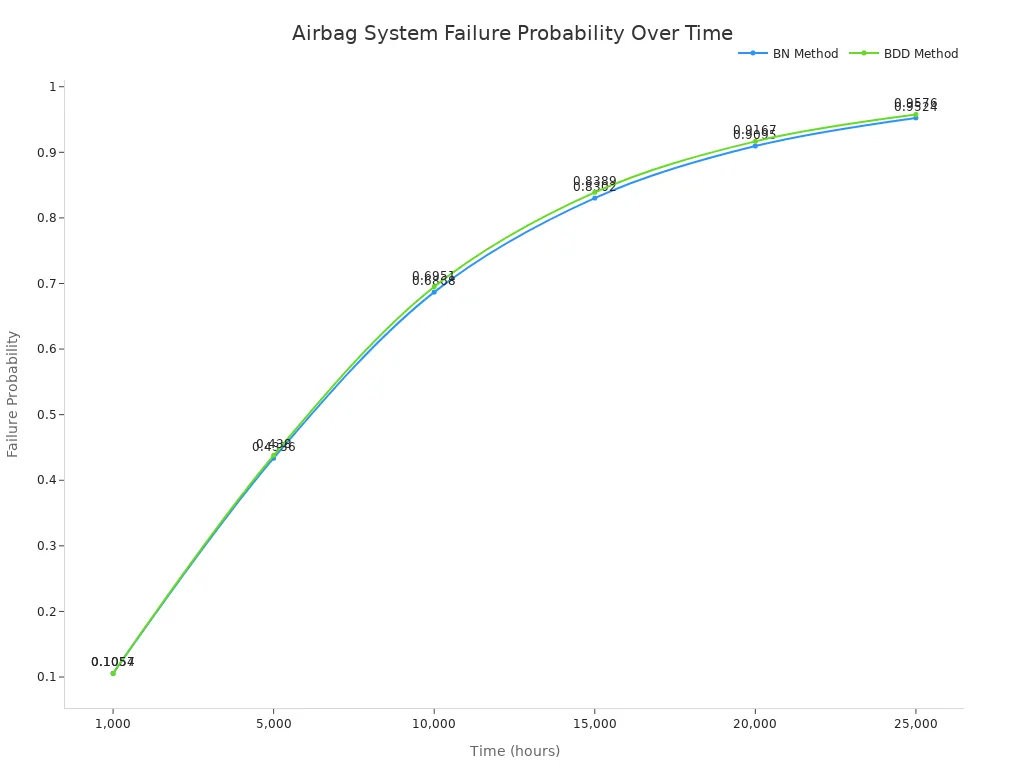
This chart shows how the probability of failure increases over time. The safing sensor helps maintain this high reliability. It ensures your airbags work only when you truly need them.
These 10 components form an indispensable safety net with their collective life-saving properties. Airbag systems are a testament to sophisticated engineering, providing a crucial lifeline with life-saving results. Each part plays a vital, synchronized role in occupant protection. You see continuous evolution in these safety features, enhancing vehicle safety and reducing fatalities. Adaptive, curtain, central, pedestrian, and knee airbags offer specialized protection. Honda’s new front passenger airbag technology even manages lateral crash forces, reducing serious injuries from impact in collisions. These advancements provide maximum protection, making vehicles safer and significantly reducing fatalities, improving overall road safety.
FAQ
How do airbags know when to deploy?
Crash sensors detect impacts. They send signals to the Airbag Control Unit (ACU). The ACU decides if the crash is severe enough. It then deploys the airbags. Your seat belts also play a role in this decision.
Can airbags deploy if you are not wearing your seat belts?
Yes, airbags can deploy even if you do not wear your seat belts. However, wearing your seat belts significantly increases your safety. Seat belts position you correctly for airbag protection. Always wear your seat belts.
How often should you check your airbag system?
Your car’s diagnostic module constantly monitors the airbag system. It alerts you with a warning light if there is a problem. You should address any warning lights immediately. Regular vehicle maintenance also helps ensure your seat belts and airbags work.
What is the purpose of seatbelt pretensioners?
Seatbelt pretensioners tighten your seat belts instantly during a crash. This removes slack. It positions you optimally for airbag deployment. This action works with your seat belts to maximize protection.
Are airbags safe for children?
Airbags are designed for adults. Children should always ride in the back seat in appropriate child restraints. The Occupant Classification System can disable the passenger airbag for small children. Always use proper seat belts and car seats for children.