


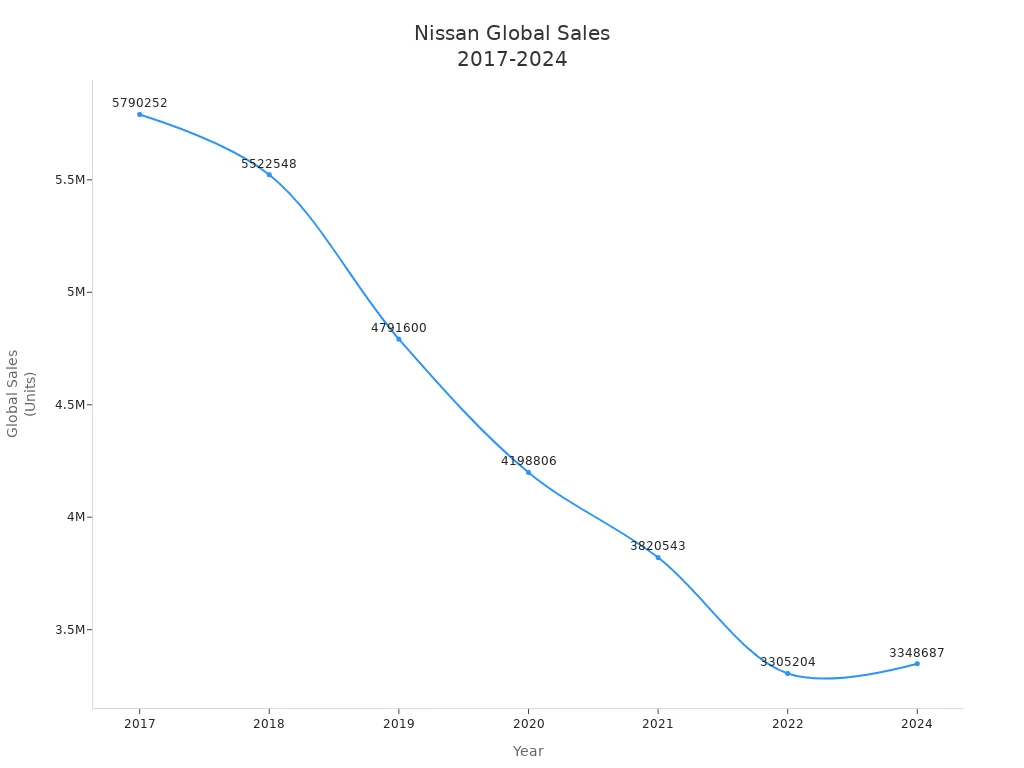
Nissan is currently facing significant financial challenges, but it is important to clarify that Nissan is not going out of business. Recent data indicates a slight decline in global sales, with 3,348,687 vehicles sold in 2024, marking a decrease of 0.8% from the previous year. To truly understand Nissan’s situation, one must look beyond the numbers.
Despite these challenges, Nissan’s operating profit margin remains at 7.0%, which is competitive within the automotive industry. These factors should be taken into account when evaluating whether Nissan is going out or if it can navigate through these tough times.
Key Takeaways
Nissan is not going out of business despite facing financial challenges and a recent net loss of $4.5 billion.
The company is implementing a recovery plan called Re:Nissan, focusing on cost reduction and aligning strategies with market demand.
Nissan’s debt-to-equity ratio is higher than the industry average, indicating a need for improved financial stability.
Innovations in electric vehicles, like the Nissan ARIYA, aim to enhance competitiveness and attract consumers.
Nissan targets a global sales volume of 3.5 million units annually by fiscal 2026 to achieve profitability.
Financial Challenges for Nissan

Recent Financial Losses
Nissan has faced significant financial losses recently. For the fiscal year ending March 2025, the company reported a staggering net loss of $4.5 billion. This loss translates to approximately 671 billion yen. Such a substantial decline raises concerns about Nissan’s long-term viability. You should consider the implications of these losses, as they indicate a pressing need for the company to implement effective recovery strategies.
Key Points on Recent Losses:
Nissan’s annual net loss was confirmed at $4.5 billion.
The company has experienced an 85% drop in operating profit during the third quarter of 2023.
Executives warn that Nissan may only have 12 to 14 months to survive without a long-term investor.
Debt and Liabilities
Nissan’s financial situation is further complicated by its outstanding debt and liabilities. As of March 2025, the total debt stands at $54.03 billion USD. This high level of debt poses a risk to the company’s stability and raises questions about its ability to recover from its current situation.
Description | Amount |
|---|---|
Total debt as of March 2025 | $54.03 Billion USD |
To put this into perspective, Nissan’s debt-to-equity ratio is 1.63, which exceeds the industry average of 1.2. This indicates that Nissan relies heavily on debt financing compared to its equity. Additionally, the company’s current ratio is 1.23, while the quick ratio stands at 0.82. These metrics suggest that Nissan may struggle to meet its short-term obligations, further complicating its financial recovery.
Metric | Nissan | Industry Average |
|---|---|---|
Debt-to-Equity Ratio | 1.63 | 1.2 |
Current Ratio | 1.23 | N/A |
Quick Ratio | 0.82 | N/A |
In light of these financial challenges, you should remain aware of the potential risks associated with Nissan’s situation. The company is undergoing major cost-cutting moves, including workforce reductions and plant closures. These actions aim to stabilize operations but may also impact customer service and support.
Leadership Changes at Nissan

Executive Changes
Nissan has experienced significant executive changes recently. The departure of key leaders, such as CFO Stephen Ma and COO Ashwani Gupta, has raised concerns about the company’s stability. These exits relate directly to Nissan’s financial struggles and ongoing leadership instability. You should note that operating income projections have dropped by 70%, and market capitalization has significantly declined.
Recent executive departures include:
CFO Stephen Ma
COO Ashwani Gupta
The company faces a need for a new leadership team to address ongoing challenges.
CEO Makoto Uchida remains the only top-level executive, increasing pressure on his leadership.
These changes have sparked debates about their necessity. Some believe they are essential for revitalization, while others worry about employee morale. The restructuring efforts, including job cuts and reduced manufacturing capacity, aim to streamline operations. However, public sentiment remains mixed. Some view layoffs as necessary for efficiency, while others criticize them as a failure of corporate responsibility.
Strategic Direction
Nissan’s strategic direction has shifted significantly since the appointment of new executives. The company has launched a recovery plan named Re:Nissan. This plan focuses on profitability, cost reduction, and aligning strategies with market demand.
Initiative Type | Description |
|---|---|
Cost Reduction | Mobilizing 3,000 people to focus on cost reduction initiatives, aiming to reduce fixed costs by 250 billion yen by FY26. |
Manufacturing Restructuring | Consolidating vehicle production plants from 17 to 10 by fiscal year 2027. |
Workforce Reduction | Targeting a total reduction of 20,000 employees between fiscal years 2024 and 2027. |
Development Revamp | Revamping development processes to reduce engineering costs and complexity. |
Market & Product Strategy Redefinition | Tailoring product strategy to align with local customer needs, focusing on key markets like the U.S., Japan, and China. |
These strategic initiatives demonstrate Nissan’s commitment to restoring stakeholder confidence. The company aims to enhance operational efficiency while adapting to evolving market demands.
Competition and Market Trends
Key Competitors
Nissan operates in a highly competitive automotive market. You should be aware of its primary competitors, which include:
Subaru
Renault Group
Honda Motor
Mitsubishi Auto Leasing
Citroen
Chevrolet
Lexus
Mahindra
Nandu Motor
These companies pose significant challenges to Nissan’s market position. Each competitor offers unique products and innovations that attract consumers.
Sales Decline
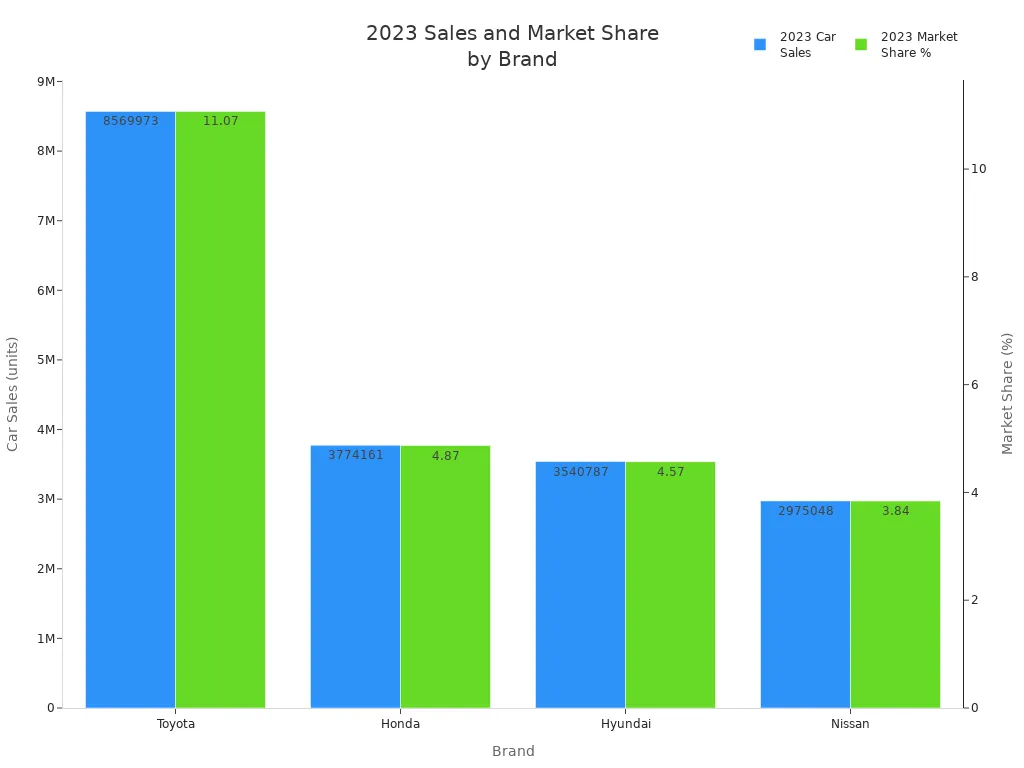
Nissan has experienced a notable decline in sales over the past few years. In the U.S. market, Nissan’s share dropped from 7.7% to 5.8%, reflecting a decline of 1.9 percentage points. This decrease in market share indicates poor sales figures and highlights the need for Nissan to adapt quickly.
The following table illustrates how Nissan’s sales compare to its key competitors:
Brand | 2023 Car Sales | 2023 Market Share % |
|---|---|---|
Toyota | 8,569,973 | 11.07% |
Honda | 3,774,161 | 4.87% |
Hyundai | 3,540,787 | 4.57% |
Nissan | 2,975,048 | 3.84% |
Several external market trends contribute to Nissan’s sales decline:
Aging Product Lineup: Older models like the Altima and Sentra struggle against newer competitors.
Tarnished Brand Image: Scandals, including the arrest of former CEO Carlos Ghosn, have hurt consumer trust.
Challenges within the Alliance: Strained relationships within the Renault-Nissan-Mitsubishi Alliance hinder strategic effectiveness.
Despite these challenges, the automotive industry is projected to grow. Nissan’s revenue is expected to rise at a CAGR of 4.5% from 2023 to 2026, driven by demand for electric vehicles and increased market share in emerging markets.
Recovery Strategies for Nissan
Nissan is actively pursuing several recovery strategies to stabilize its financial situation and regain market confidence. You should pay attention to how these strategies focus on innovation and technology, as well as market expansion opportunities.
Innovation and Technology
Nissan recognizes the importance of innovation in the automotive industry, especially in the electric vehicle (EV) segment. The company has introduced several advancements to enhance its product offerings. Here are some key innovations:
Innovation Type | Description |
|---|---|
Enhanced Energy Range | The Nissan ARIYA can exceed 300 miles on a single charge, addressing range anxiety for drivers. |
Faster Charging Capabilities | The ARIYA can achieve up to 80% charge in just 30 minutes with a DC fast charger, enhancing convenience for users. |
Autonomous Driving Features | ProPILOT Assist helps maintain lane position and adjusts speed, reducing driver fatigue and enhancing safety. |
Smartphone Integration | Features like Apple CarPlay and Android Auto allow seamless access to apps and navigation, keeping drivers connected. |
Advanced Infotainment Systems | The ARIYA includes a dual-screen setup for easy access to real-time traffic updates and entertainment options. |
These innovations not only improve the driving experience but also position Nissan as a competitive player in the EV market. You should note that Nissan’s investment in research and development (R&D) is significant, amounting to $4.42 billion. This investment is higher than that of competitors like Tesla and Hyundai, which spend $3 billion and $2.5 billion, respectively.
Market Expansion Opportunities
Nissan is also exploring various market expansion opportunities to enhance its global presence. The company has formed strategic partnerships and joint ventures to support its growth. Here are some notable collaborations:
Partnership | Description |
|---|---|
Dongfeng-Nissan Joint Venture | Launched to create an export-focused entity with a 40-60 equity split, aiming to export 100,000 vehicles by 2025, including new energy vehicle models. |
Zhengzhou Nissan and Zhongjiang International | Signed a memorandum to expand pickup truck business overseas, targeting 3,000 vehicle sales in three emerging regions by 2025. |
These partnerships allow Nissan to tap into new markets and diversify its product offerings. Additionally, the company is implementing cost-cutting measures to improve profitability. You should be aware that Nissan plans to cut 20,000 jobs, which represents 15% of its total workforce. The company also aims to reduce production capacity by 20% and consolidate operations both in Japan and abroad.
Key Points on Cost-Cutting Measures:
Nissan plans to cut 9,000 jobs globally.
The company aims to close seven factories.
Nissan has implemented 1,600 cost-saving measures across its operations.
These actions are crucial for stabilizing profits and ensuring long-term sustainability. Nissan targets a global sales volume of 3.5 million units annually by fiscal 2026, which is essential for achieving profitability.
In summary, Nissan faces significant challenges, including recent financial losses and high debt levels. However, it is crucial to recognize that Nissan is not going out of business. The company has launched the Re:Nissan plan, aiming for profitability and positive cash flow by fiscal 2026. Analysts predict cautious optimism for Nissan’s future, with a focus on cost-saving initiatives and successful product strategies.
Stay informed about Nissan’s developments as the company works to stabilize its operations and regain market confidence.
Key Takeaways:
Operating margin improved to 0.0%.
Ordinary profit reached 65.1 billion yen.
The company aims for a net revenue outlook of 12.5 trillion yen for FY2025.
FAQ
What caused Nissan’s recent financial losses?
Nissan’s financial losses stem from declining sales, high debt levels, and increased competition. The company also faced challenges from an aging product lineup and a tarnished brand image, which affected consumer trust.
How is Nissan addressing its debt issues?
Nissan is implementing cost-cutting measures, including workforce reductions and plant closures. The company aims to reduce fixed costs and improve its debt-to-equity ratio to stabilize its financial situation.
What is the Re:Nissan plan?
The Re:Nissan plan focuses on profitability and cost reduction. It includes restructuring manufacturing, revamping development processes, and aligning product strategies with market demands to restore stakeholder confidence.
How does Nissan plan to compete in the EV market?
Nissan invests heavily in innovation, particularly in electric vehicles. The company aims to enhance energy range, improve charging capabilities, and integrate advanced technology to attract consumers in the growing EV market.
What are Nissan’s future sales targets?
Nissan targets a global sales volume of 3.5 million units annually by fiscal 2026. This goal is crucial for achieving profitability and regaining market confidence amid ongoing challenges.



