


Does your car drift or do your tires wear unevenly? You might notice your vehicle pulling to one side. These are common signs your car needs attention. Alignment on a car refers to how your wheels connect to the vehicle and the road. Car alignment ensures your wheels point in the correct direction. This guide explains car alignment and the critical importance of car alignments for your vehicle’s performance, safety, and lifespan. Proper alignment immediately improves your driving experience and saves you money.
Key Takeaways
Car alignment adjusts wheel angles. This ensures your tires meet the road correctly. It helps your car drive straight.
Proper alignment improves safety. It makes your car handle better. It also saves you money on tires and gas.
Look for signs of misalignment. These include uneven tire wear or your car pulling to one side. A crooked steering wheel is another sign.
Caster, camber, and toe are key alignment angles. Each angle affects how your wheels touch the road. They impact steering, grip, and tire wear.
Get regular alignment checks. Do this after hitting potholes or replacing tires. Professional tools are needed for correct adjustments.
What is Alignment on a Car?
Alignment on a car means adjusting the angles of your wheels. You want these angles to match the exact specifications set by your car’s manufacturer. Think of it this way: wheel alignment is about how your car’s suspension system connects to its wheels. This connection ensures your tires meet the road correctly. Manufacturers provide a ‘preferred’ angle for your wheels. They also give acceptable ‘minimum’ and ‘maximum’ angles for settings like camber, caster, and toe. For example, caster angles are measured in degrees, often four degrees plus or minus half a degree. Camber angles are read in degrees and minutes, where 30 minutes equals half a degree. Toe specifications might be in fractions of an inch, like negative one-quarter of an inch plus or minus one-eighth of an inch, or sometimes in degrees.
Understanding Wheel Angles
Your car’s wheels do not just sit straight. They have specific angles that affect how they touch the road. These angles are crucial for good handling and tire wear. When these angles are off, you might notice problems. For instance, your car might pull to one side, or your steering wheel might not be straight when you drive in a straight line. You could also see uneven tire wear, where one side of your tire wears down faster than the other. This happens because misaligned wheels cause irregular tread wear. For example, the outer edge wears from too much toe-in or positive camber, and the inner edge wears from too much toe-out or negative camber. Sometimes, your steering feels loose, or you might feel a vibration in the steering wheel. These are all signs that your wheel angles are not correct.
The Suspension System’s Role
The suspension system is the network of parts that connects your car’s body to its wheels. It allows your wheels to move up and down over bumps while keeping the car stable. This system plays a huge role in your car alignment. The alignment angles are not fixed; the suspension system’s parts and design constantly influence them. Your suspension absorbs weight shifts, and its parts—like control arms, springs, and shocks—work to keep your tires flat on the road. These components directly affect how your camber and caster angles change as you drive. Engineers design alignment settings using computer models that consider how your suspension moves, including weight transfer and body roll.
Many parts of your suspension system are adjusted during a car alignment. Tie rods, for example, connect your steering to the wheels. Their adjustable sleeves help set the ‘toe’ angle of your front wheels. Ball joints keep suspension parts connected, but if they wear out, they can cause misalignment. Shock absorbers and struts also matter. If they are bad, they can lead to steering problems. Replacing them can even change your car’s height, throwing off your alignment. Almost every suspension component, including rubber bushings, affects your car’s tracking. Wear in any of these parts can change how your car sits, rides, and handles.
Key Alignment Angles
You have three main alignment angles to understand. These angles are crucial for your car’s performance and tire life. They are caster, camber, and toe. Each angle plays a specific role in how your wheels interact with the road.
Caster: Steering Stability
Caster refers to the angle of your steering axis when you view your car from the side. Imagine a line running through your upper and lower ball joints. Caster measures if this line tilts forward or backward. Positive caster means the top of this line tilts backward. This helps your steering wheel return to the center after a turn. It also improves straight-line stability. Negative caster means the top of the line tilts forward. This can make your steering feel light and less stable. Proper caster ensures your car drives straight and handles predictably.
Camber: Tire Contact
Camber is the inward or outward tilt of your wheels when you look at your car from the front. If the top of your wheel tilts outward, you have positive camber. If it tilts inward, you have negative camber. Neutral camber means your wheel stands perfectly straight.
Negative camber helps your car grip better during turns. It increases the tire’s contact area when you corner. This improves responsiveness and control. However, too much negative camber can cause the inner edge of your tire to wear out faster. It can also make your car less stable when driving straight. Positive camber reduces steering effort and increases stability on uneven roads. It gives you a larger tire contact patch in these conditions. But positive camber can reduce grip and responsiveness, making steering less precise. Neutral camber gives you a large contact patch on flat, straight roads. Yet, during cornering, the tire rolls onto its sidewall. This reduces the contact patch and grip, hurting handling. For everyday driving, many vehicles use a slight negative camber. This helps with turns.
Toe: Tire Wear
Toe refers to how much your wheels turn inward or outward when you look down at them from above. Imagine your feet. If your toes point inward, that is toe-in. If they point outward, that is toe-out. Toe-in means the front of your wheels points slightly towards each other. Toe-out means they point slightly away from each other.
Correct toe settings ensure your tires roll straight down the road. Incorrect toe causes your tires to scrub sideways as you drive. This leads to rapid and uneven tire wear. You can often see toe wear as an uneven pattern between the inner and outer edges of the tire. This wear usually appears on one tire or a pair on the same axle. It shows your tire is not tracking correctly. Feathering is another sign. You will feel moderate to severe wear on the edges of the tire tread. The edges may feel ‘fuzzy’ when you touch them in one direction. This feathering strongly indicates toe misalignment. Proper toe settings are vital for good tire life and overall wheel alignment. They ensure your car’s tire alignment is correct, improving tracking.
Signs You Need an Alignment

You should regularly check your car for specific signs. These signs tell you when your car needs an alignment. Ignoring them can lead to bigger problems.
Uneven Tire Wear
You should regularly check your tires. Look for specific patterns. These patterns are clear signs you need an alignment. For example, you might see center wear. This means the middle of your tire tread wears down too much. The outer edges look fine. Misaligned wheels can cause this. Another sign is camber wear. Here, one side of your tire wears unevenly. It creates a slanted look. This happens when your camber angle is wrong. You might also notice feathering. This means the tire tread feels smooth when you rub it one way. It feels sharp when you rub it the other way. This often points to misaligned wheels. Also, check for wear on just the outer or inner edge of your tire. This also suggests improper alignment.
Steering Wheel Off-Center
Your steering wheel should be straight when you drive straight. If your steering wheel off-center when you go straight, you have a problem. It might be crooked to the left or right. This is a strong indicator your car needs an alignment check.
Vehicle Pulling
Does your car pull to one side? You might feel your vehicle constantly drifting. You have to hold the steering wheel firmly to keep it straight. This requires more effort to control your car. Sometimes, you might even feel vibrations in the steering. This happens when your car is pulling. A shaking steering wheel can also accompany this pulling sensation.
Loose Steering
Your steering should feel responsive. If your steering feels loose, it is a concern. You might turn the wheel a little, but the car does not respond right immediately. This can make your car feel less stable. It makes driving less safe.
Squealing Tires
Do your tires squeal often? This can happen when you turn corners. It can also happen when you drive straight. Squealing tires often mean they are not making proper contact with the road. This can be due to incorrect alignment angles.
Consequences of Misalignment
Ignoring alignment issues can lead to several costly and dangerous problems for your vehicle. You will experience negative impacts on your tires, handling, fuel economy, and even your car’s components.
Reduced Tire Lifespan
Misalignment directly attacks your tires. When your wheels point incorrectly, they do not make full and even contact with the road. This causes uneven tire wear. You will see one part of the tire tread wear down much faster than the rest. This uneven wear significantly shortens your tires’ lifespan. You will need to replace your tires much earlier than expected. This means you do not get the full expected life out of your tires, costing you more money over time. Regular tire rotation helps, but it cannot fix the premature aging caused by misaligned wheels.
Compromised Handling and Safety
Misalignment seriously affects how your car handles. Your vehicle’s ability to respond to steering inputs becomes compromised. This can lead to instability, especially when you drive around curves or at higher speeds. You might experience a loss of traction, particularly on wet or uneven roads. Improper alignment can also interfere with your braking performance, making it harder to stop quickly in an emergency. Your car might pull to one side, making it difficult to drive in a straight line. Poor handling is very dangerous during emergency maneuvers, where you need precise control. Reduced responsiveness can increase your stopping distances and make it harder to avoid obstacles, creating a severe safety risk.
Decreased Fuel Efficiency
Your car works harder when its wheels are out of alignment. Misaligned wheels cause extra drag. This forces your engine to use more fuel to maintain speed. A misaligned vehicle can decrease your gas mileage by as much as 10%. Think about it: if you spend $3,000 on fuel each year, poor alignment could waste up to $300 of that money. Proper alignment can improve your fuel efficiency, saving you hundreds of dollars annually.
Increased Suspension Wear
Misalignment puts extra stress on your car’s suspension system. When wheels are not aligned correctly, components like ball joints, tie rods, and bushings work harder than they should. This constant strain causes these parts to wear out faster. You might face expensive repairs sooner than expected. Keeping your alignment correct helps protect your suspension system, extending the life of these critical parts.
The Wheel Alignment Process
Professional Inspection
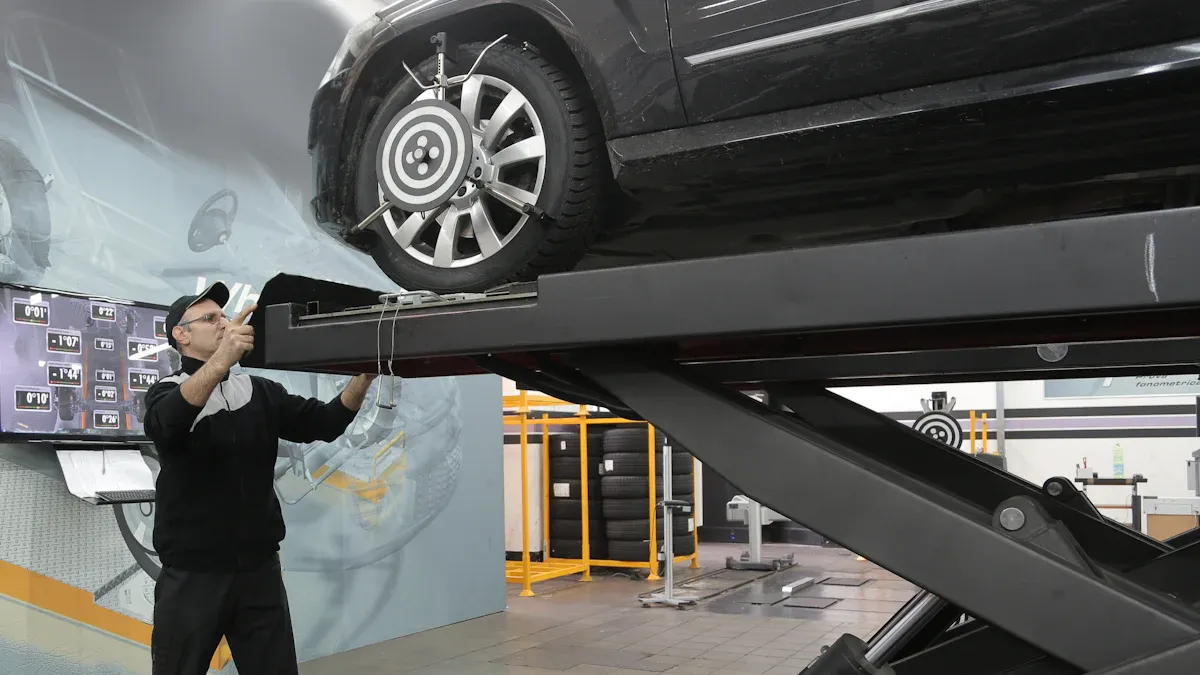
When you take your car for a car alignment, a skilled technician starts with a detailed inspection. They use specialized computer-aided equipment. This system has sensors that attach to each of your wheels. It precisely measures the current angles of your wheels. The technician also carefully checks for any worn or damaged parts in your suspension system. They look at components like ball joints, tie rods, and rubber bushings. These parts must be in excellent condition. This ensures a proper wheel alignment can even happen. This initial check is crucial. It makes sure that adjusting the angles will truly fix your car’s issues.
Adjusting Angles
After the thorough inspection, the technician begins to adjust the angles. They use the precise data provided by the alignment machine. They make very specific changes to your car’s suspension components. This process brings the caster, camber, and toe angles back to your car manufacturer’s exact specifications. Adjusting the toe angle often involves turning specific tie rod sleeves. Camber and caster adjustments might require adding shims or using eccentric bolts. The main goal of this car alignment is to ensure your wheels are perfectly straight. They must also be parallel to each other. This ensures correct tire alignment for optimal performance.
How Long it Takes
A standard wheel alignment service typically takes between 45 to 60 minutes. This applies specifically to a four-wheel alignment. While the average process lasts about an hour, several factors can slightly affect the total duration. Your car’s specific make and model can influence the time. The overall condition of its suspension system also plays a role. For instance, if the technician discovers worn or damaged components, they might need to replace these parts first. This will add extra time to the service. Generally, you can expect the entire process to take about 1 to 1.5 hours. This time ensures all your wheels are precisely aligned. It leads to improved vehicle handling and significantly extends your tire longevity.
The Importance of Car Alignments
Maintaining proper alignment offers many benefits. It protects your investment. It also makes your driving experience better. Understanding the importance of car alignments helps you keep your vehicle in top condition.
Maximized Tire Life
Proper alignment directly extends your tires’ life. When your wheels are correctly aligned, your tires make even contact with the road. This prevents uneven wear patterns. You avoid premature wear on one side or the other. This means you get the full mileage out of your tires. You save money because you replace tires less often. Good alignment ensures your tires wear down slowly and evenly.
Improved Handling and Control
A correctly aligned car handles much better. You will notice improved responsiveness. Your steering becomes more precise. A correctly aligned steering wheel naturally centers. You do not need constant corrections. This gives you a more precise feel for the road. Proper toe angle ensures your vehicle tracks straight effortlessly. This improves directional stability. It also makes your car more responsive. Balanced camber angles enhance tire contact with the road during turns. This leads to smoother cornering. Your car feels more predictable. Correcting misalignment reduces rolling resistance. This makes your car feel lighter. It becomes more responsive during acceleration, steering, and braking.
Enhanced Driving Safety
Proper car alignment is crucial for your safety. It ensures your car responds predictably in all driving conditions. This is especially true during emergencies. A car with good alignment maintains better traction. It stops more effectively. While road design plays a big role in accident rates, your car’s condition is also vital. For example, steep gradients and sharp curves on roads can increase accident risks. A properly aligned car helps you navigate these challenging road geometries safely. It gives you better control. This reduces the likelihood of losing control. Good alignment helps your car perform as designed. This keeps you safer on the road.
Better Fuel Economy
You can save money on gas with proper alignment. Misaligned wheels create extra drag. Your engine works harder to move the car. This uses more fuel. When your wheels are aligned correctly, your car rolls more efficiently. This reduces the strain on your engine. You get better gas mileage. This means fewer trips to the gas station. You save money every time you drive.
Smoother Ride
Proper alignment gives you a much smoother and more comfortable ride. It eliminates issues like your car pulling to one side. It also minimizes tire noise. You will notice less vibration. Noise from misalignment often comes from abnormal tire wear. Proper alignment helps prevent this uneven wear. This reduces the source of noise. You experience a quieter cabin. You also feel fewer vibrations through the steering wheel and seats. This makes every drive more enjoyable.
When to Get a Car Alignment
You might wonder how often you need a car alignment. Several factors determine the best time for this service. You should consider manufacturer advice, specific incidents, and general recommendations.
Manufacturer Recommendations
Your car’s manufacturer provides specific guidelines for maintenance. They often suggest wheel alignment checks every 6,000 miles or every 6 months. This is part of your routine service. These checks involve inspecting and adjusting your steering and suspension system. Technicians set them to original equipment manufacturer (OEM) specifications. They also check your tire air pressure levels during this service. Following these recommendations helps keep your car running well.
After Specific Events
Certain events make an alignment check absolutely necessary. You should get an alignment after you buy new tires. This ensures your new tires wear evenly from the start. If you have any accident, even a small fender bender, get an alignment. Even a minor impact can throw off your wheel angles. Replacing suspension parts, like tie rods or control arms, also requires an alignment. These new parts change the geometry of your suspension. Finally, if you hit a large pothole or curb, you should get your alignment checked. Such impacts can easily knock your wheels out of place.
General Guidelines
Beyond specific events, general guidelines exist for alignment checks. Many experts suggest a wheel alignment check every 1 to 2 years. Another common recommendation is every 10,000 miles or once a year, whichever comes first. This frequency can change based on how you drive. If you often drive on rough roads or in busy cities with many potholes, you might need more frequent checks. Always pay attention to signs like your car pulling to one side or uneven tire wear. These signs tell you it is time for an alignment.
Proper alignment on a car ensures your wheels point correctly. This is vital for every vehicle owner. You gain safety, save money, and enjoy driving more. Remember, good alignment means your tires last longer. It also gives you better control.
Look for misalignment signs like uneven tire wear or a pulling sensation. Schedule regular car alignment checks.
This proactive step ensures a smoother, safer, and more economical journey for you. Maintain proper alignment for a truly better driving experience.
FAQ
How often should I get a car alignment?
You should check your alignment every 6,000 miles or 6 months. Also, get it checked after buying new tires or hitting a large pothole. Your car’s manufacturer also provides specific recommendations.
What causes a car to lose its alignment?
Hitting potholes, curbs, or speed bumps can knock your alignment off. Minor accidents also cause misalignment. Worn suspension parts, like ball joints or tie rods, can also lead to alignment issues over time.
Can I perform a car alignment myself?
No, you cannot perform a car alignment yourself. It requires specialized computer equipment and expert knowledge. Professional technicians use precise tools to adjust your wheel angles correctly. Trust this job to certified mechanics.
What is the difference between wheel alignment and tire balancing?
Wheel alignment adjusts your wheel angles for proper road contact. Tire balancing ensures your tire and wheel assembly spins without vibration. You need both for a smooth, safe ride and long tire life.



