

Boating offers incredible freedom and fun. However, safely transport your watercraft is a critical step many boat owners overlook. Improper boat trailering can lead to serious accidents, costly damage to your boat, and legal issues. This guide helps you master boat trailer safety, ensuring peace of mind on every journey. You might feel anxious about connecting your boat to your vehicle or wonder about the right trailer setup. This comprehensive resource addresses those concerns, guiding you toward a hassle-free towing experience.
Key Takeaways
Choose the right trailer for your boat’s weight and size. This ensures safe towing.
Prepare your tow vehicle and hitch correctly. Always check your vehicle’s towing capacity.
Load your boat onto the trailer with care. Secure it tightly with straps and tie-downs.
Drive slower and make wider turns when towing a boat. This helps you stay safe on the road.
Check your trailer’s tires, bearings, and brakes often. Good maintenance prevents problems.
Selecting the Right Boat Trailer
Choosing the right trailer is crucial for safe and efficient boat transportation. You need a trailer that perfectly matches your watercraft. This section guides you through selecting the best option.
Matching Trailer Capacity to Your Boat
First, you must know your boat’s total weight. This includes the boat itself, its engine, fuel, gear, and any water in the bilge. Your trailer’s Gross Vehicle Weight Rating (GVWR) must exceed this total weight. This ensures you have enough capacity for safe towing.
For motorized boats, the recommended tongue weight is typically 6% to 10% of the total trailer weight. This percentage is lower than for other trailers. The heavy outboard engine sits at the back of the boat, behind the trailer’s axle. This weight distribution needs a different balance point for stability during towing. Some experts suggest 5% to 7% for boat trailers with large outboard motors.
Understanding Trailer Axle Types
Trailer axle types affect stability and weight distribution. Single-axle trailers are good for lighter boats. They are easier to maneuver. Tandem-axle trailers offer more stability and higher weight capacity. They distribute the load over more tires. This reduces stress on each tire.
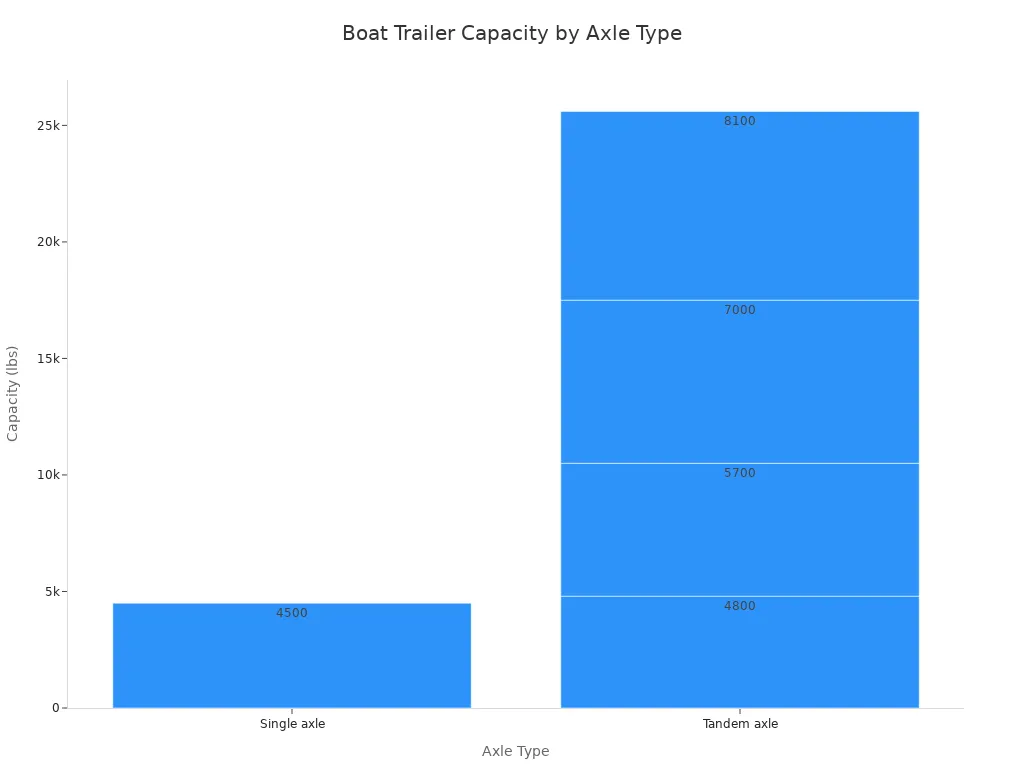
Axle Type | GVWR (lbs) | Capacity (lbs) |
|---|---|---|
Single axle | 5500 | 4500 |
Tandem axle | 6000 | 4800 |
Tandem axle | 7000 | 5700 |
Tandem axle | 8400 | 7000 |
Tandem axle | 10000 | 8100 |
Essential Trailer Brake Systems
Brake systems are vital for safety. Many states require them based on your trailer’s weight. You must check local regulations.
A secondary braking system is often legally required if a trailer exceeds a specific weight.
Surge brakes engage automatically when your tow vehicle slows down. They provide extra stopping power.
Electric brakes need a brake controller in your tow vehicle. This connects to the trailer’s brakes.
You must consult local laws to ensure compliance with braking system regulations.
Gross Trailer Weight Rating (GVWR) | States Requiring Brakes |
|---|---|
1,500 Pounds or More | California, Idaho, Nevada, New Hampshire, Oregon |
2,000 Pounds or More | Kansas, Ohio |
3,000 Pounds or More | Alabama, Arizona, Arkansas, Colorado, Connecticut, Florida, Georgia, Hawaii, Illinois, Indiana, Iowa, Kentucky, Louisiana, Maine, Maryland, Michigan, Minnesota, Mississippi, Montana, Nebraska, New Jersey, New Mexico, New York, North Dakota, Oklahoma, Pennsylvania, South Carolina, South Dakota, Tennessee, Utah, Vermont, Virginia, Washington, West Virginia, Wisconsin, Wyoming |
4,000 Pounds or More | Delaware, North Carolina, Rhode Island |
4,500 Pounds or More | Texas |
5,000 Pounds or More | Alaska |
10,000 Pounds or More | Missouri |
Trailer brake regulations differ by state. They mainly depend on the Gross Vehicle Weight Rating (GVWR). Most states mandate a trailer braking system with a breakaway cable. This activates brakes if the trailer detaches.
Trailer Material and Construction Options
Trailer frames come in different materials. Each has pros and cons.
Feature | Galvanized Steel | Aluminum |
|---|---|---|
Durability/Strength | Ultimate strength and durability for heavy loads | Requires thicker components to match steel’s strength; welded points can develop stress fractures under heavy loads |
Corrosion Resistance | Commendable, but requires periodic inspections and touch-ups to zinc coating | Commendable, but essential to keep away from galvanic corrosion and regularly rinse salt residue |
Maintenance | Periodic inspections and touch-ups to zinc coating | Keep away from dissimilar metals, regularly rinse salt residue |
Weight | Heavier | Lighter, but difference might not be as substantial as expected due to need for thicker components |
Ideal Use | Heavy loads, ultimate strength | Appealing design, moderate weight savings |
Galvanized Steel Boat Trailers:
Pros: Strong and heavy-duty. They carry large boats. They have a lower initial cost.
Cons: They are heavy and less fuel-efficient. They add significant weight to your towing setup. They can rust over time. They need consistent rinsing and maintenance, especially after saltwater use.
Welded Aluminum Trailers:
Pros: They are lightweight and fuel-efficient. They reduce towing weight. They resist corrosion and are safe for saltwater.
Cons: Welded points can develop stress fractures over time. This happens especially under heavy loads.
Vehicle and Hitch Preparation for Boat Trailering
Proper preparation of your tow vehicle and hitch is essential for safely transport your watercraft. This step ensures a secure connection and a safe journey.
Confirming Tow Vehicle Capacity
You must first check towing capacity for your vehicle. This information is in your owner’s manual. Never exceed your tow vehicle‘s maximum capacity. This prevents damage and ensures safety. Different types of boat trailers have varying weights. For example:
Canoe / Kayak Trailer Weight: Typically 100-400 pounds unloaded. Maximum weights range from 200 to 800 pounds.
Jet Ski Trailer Weight: Average empty weight is 300 pounds. Loaded, these trailers can range from 800 to 3,000 pounds.
Fishing Boat Trailer Weight: Usually weighs 200 to 1,100 pounds unloaded. Combined boat and trailer weights range from 900 to 6,000 pounds.
Selecting the Correct Hitch and Ball
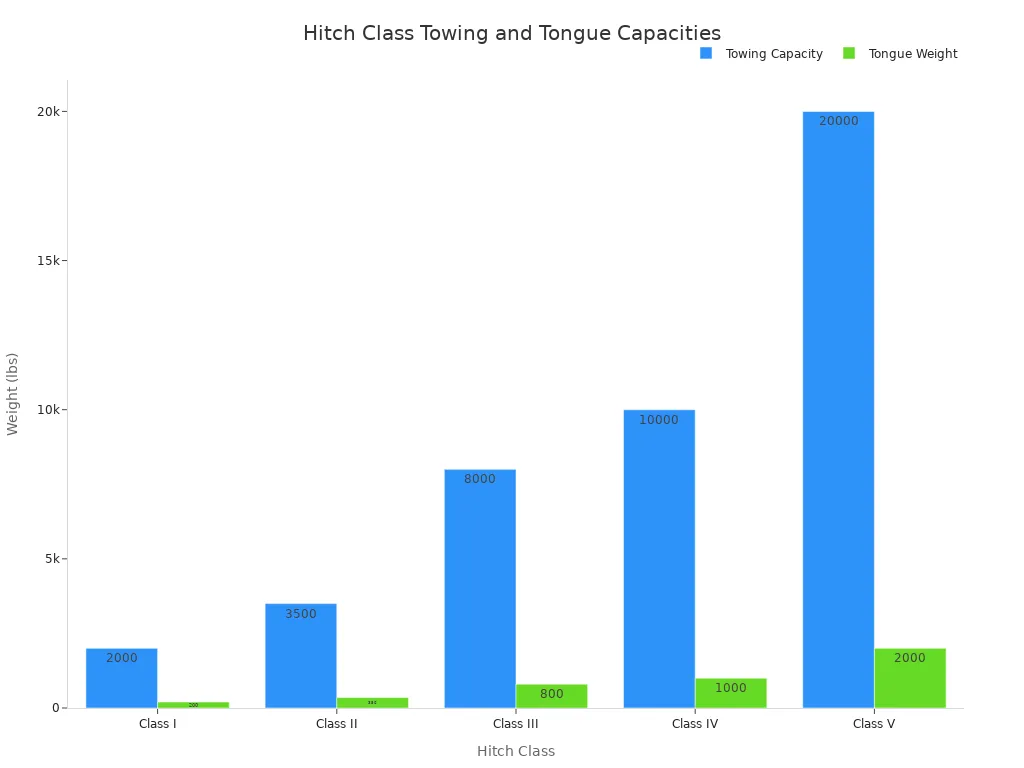
Your hitch must match your tow vehicle’s capacity and your trailer’s weight. Hitches come in different classes. Each class has a specific towing limit.
Hitch Class | Towing Capacity (lbs) | Tongue Weight (lbs) | Typical Vehicles | Example Use (Boats) |
|---|---|---|---|---|
Class I | Up to 2,000 | 200 | Small/Midsize Cars, Crossovers | Personal watercraft |
Class II | Up to 3,500 | 350 | Large Cars, Crossovers, Minivans | Small boat on a trailer |
Class III | Up to 8,000 | 800 | Vans, SUVs, Pickup Trucks | N/A |
Class IV | Up to 10,000 | 1,000 | Full-size Vans, Trucks, SUVs | Large boat |
Class V | Up to 20,000 | 2,000 | Full-size Trucks/SUVs (configured for heavy towing) | N/A |
Match the ball size to your trailer’s coupler. This ensures a secure connection when hitching the trailer.
Connecting the Trailer and Safety Chains
Connect the trailer coupler to the hitch ball. Make sure it locks securely. Then, attach your safety chains. These chains are a critical backup. They keep the trailer connected if the hitch fails. Always cross the safety chains under the trailer tongue.
Cross safety chains under the trailer tongue before connecting them to the hitch receiver.
This crossing creates a cradle shape. It supports the trailer tongue if the hitch fails.
The cradle prevents the tongue from dropping to the ground. This minimizes potential damage.
Verifying Trailer Wiring and Lights
Check all electrical connections. Your tow vehicle must power the trailer lights. This includes brake lights, turn signals, and running lights. Working lights are crucial for road safety. Common issues can arise:
Burned-Out Bulb: This is the most frequent cause of lighting system failure.
Dirty or Corroded Plug/Socket: This prevents even good bulbs from working.
Damaged Wiring: You often find this within frame rails. It can cause complete system failure.
Weak/Poor Connection: Malformed or corroded wire-end connectors can block current.
Ensure all lights work before you start your boat trailering trip.
Proper Boat Loading and Securing
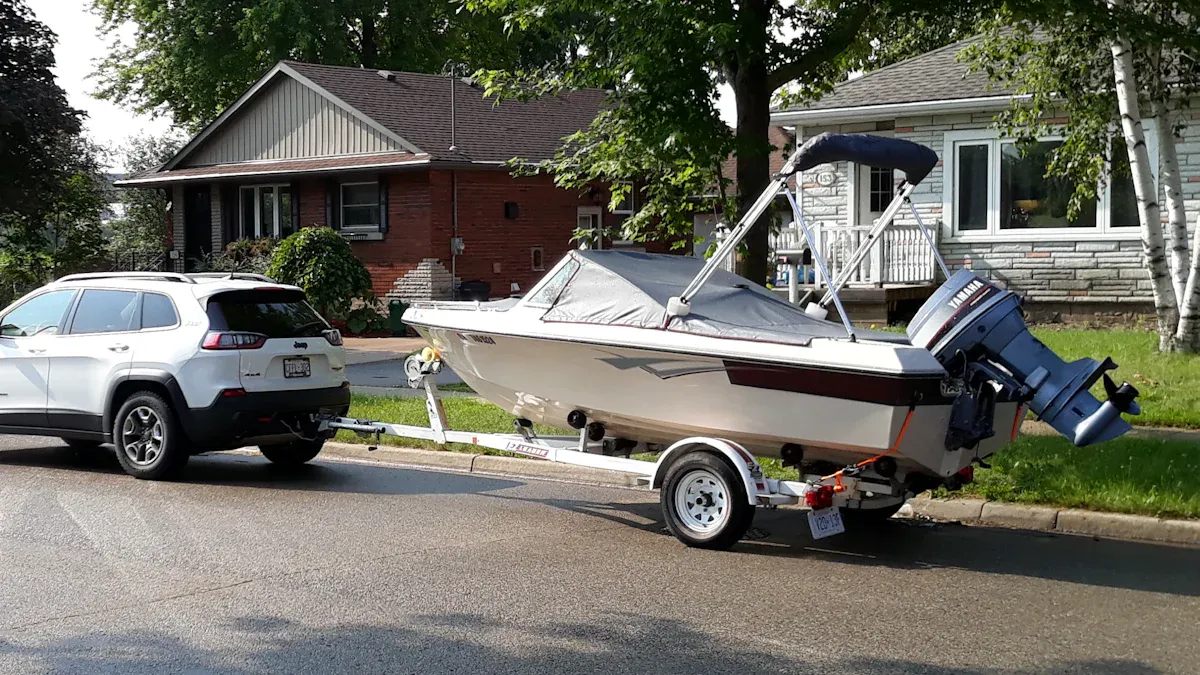
You need to properly load your boat onto the trailer and secure it. This ensures safe transport. This section gives you techniques for doing just that.
Effective Boat Loading Techniques
Guiding your boat onto the trailer correctly is important. You will often back the trailer into the water. Your tow vehicle’s wheels should almost reach the water’s edge. The trailer itself needs to be submerged. This wets the bunks or rollers. The boat can then float onto the trailer easily. Once your vehicle is in position, engage the emergency brake. Place chocks behind the wheels for extra security.
Backing a trailer can be tricky. Here are steps to help you:
Position Your Vehicle: Start with your vehicle and the trailer in a straight line. Align them with the path you want to take.
Begin Slowly: Gently reverse. Watch the trailer’s movement using your side mirrors.
Use Small Steering Movements: Make small steering inputs. Turn the wheel in the direction you want the trailer to go. Remember, turning the wheel right makes the trailer go left, and vice versa.
Check Your Progress: Continuously use your side mirrors. Adjust your steering to keep the trailer on track.
Practice: Practice in an empty parking lot or open space. This helps you hone your skills.
Use Landmarks: Use visual markers. A dock spot or cones help you judge distances. They help you make precise adjustments.
Take It Slow and Steady: Avoid fast, reactive steering. Make small adjustments. This prevents swaying or jackknifing. If you lose control, stop. Pull forward and realign.
Use a Spotter: A spotter gives you extra eyes. They guide you and tell you about obstacles. Establish clear hand signals for communication.
Prepare for Launch: Choose the right ramp. Inspect it for hazards. Secure the boat to the trailer. Have your gear ready.
Backing Up the Trailer (Launch): Align your vehicle and trailer straight with the ramp. Use your mirrors. Go slowly. Use hand signals with a spotter.
Launching Your Boat: Loosen the straps but keep them attached. Ensure the drivetrain is in position. Gradually back the trailer until the boat floats off the bunks. This completes the boat launch and retrieval process.
Achieving Optimal Trailer Balance
You need to achieve optimal trailer balance. This means having the right tongue weight. Tongue weight is the downward force the trailer tongue puts on your hitch ball.
The ideal tongue weight for boat trailers is typically 6% to 10% of the total trailer weight. This is a bit lower than other trailers. A heavy outboard engine sits at the back of the boat. This weight distribution needs a different balance point for stability. For boat trailers with large outboard motors, a recommended tongue weight range is often 5% to 7%. Some manuals suggest 5% to 10%. Many users aim for 7% to 8%. You must check the load balance to ensure stability.
Trailer Type | Recommended Tongue Weight (% of Total Trailer Weight) |
|---|---|
Boat Trailers | 6% – 10% |
Travel Trailers | 10% – 15% |
Cargo/Utility Trailers | 10% – 15% |
Car Haulers | 10% – 15% |
Securing Your Boat and Gear
You must secure the boat firmly to the trailer. This prevents movement during travel. Use straps and tie-downs. A winch hook or bow strap secures the front of the boat. Use two or three other tie-downs for the rest of the boat. Inspect these for wear and tear. Make sure the winch’s locking mechanism is engaged. You also need to secure all internal equipment. This includes coolers, fishing gear, and life jackets. Close and latch all compartments. Secure boat covers tightly. This prevents them from flapping or coming loose.
Final Pre-Departure Checks
Before you leave, perform a final check. This ensures everything is ready for the road.
Receiver/draw bar/pin/ball: Ensure all hitch components are in good condition. They must be rated for the total weight of the trailer and boat.
Coupler latched: Verify the coupler is properly engaged. It must be latched and secured with a hitch pin or padlock.
Safety chains: Hook up your safety chains. Cross them under the tongue. This prevents the trailer from running away if it detaches.
Jack stowed: Make sure the trailer jack is raised. Swing it back and stow it securely before travel.
Boat straps and winch hook: Use a winch hook/bow strap and two or three other tie-downs to secure the boat. Inspect them for wear and tear. Ensure the winch’s locking mechanism is engaged.
Tire condition, pressure, date: Check tires for wear, cracks, bulges, and tread depth. Replace tires every six years. Verify tire pressure using the recommended PSI on the sidewall.
Lug nuts: Confirm all lug nuts are present. Tighten them securely.
Bearings greased: Check for minimal play (about 1/8 inch) when you tug the wheel. If you hear squeaking or grinding, add grease. Consider a bearing overhaul.
Trailer lights: Test all lights. This includes taillights, brake lights, turn signals, side markers, and the license-plate light.
Transom saver and bunks: Use a transom saver if you haul with an outboard motor. Ensure bunks are in good condition. They must be correctly placed to support the hull.
Here is a quick checklist:
Component | Status |
|---|---|
All Lights and Indicators | Checked |
Tyre Pressure and Tread | Checked |
Brake Connections and Response | Checked |
Trailer Coupling & Safety Chains | Checked |
Suspension & Axle Alignment | Checked |
Load Balance & Security | Checked |
Final Walk-Around | Checked |
Safe Boat Trailering Practices
You have prepared your vehicle and trailer. Now, you must understand how to drive with your boat attached. This section focuses on driving techniques and precautions. You will learn how to safely transport your watercraft on the road.
Pre-Trip Inspection for Your Trailer
Before every trip, you must perform a thorough inspection. This pre-trailering checklist ensures everything is in working order. It helps prevent problems on the road.
Brakes: Test your brake controller. Visually inspect brake pads, shoes, drums, or rotors for wear. Check hydraulic brake lines for cracks or leaks. If you have electric brakes, inspect their electrical connections.
Hitch System: Examine the coupler for damage or rust. Verify the hitch ball size and ensure it is tight. Check your safety chains for integrity. Test the emergency breakaway switch if your trailer has one.
Tires: Inspect your tires thoroughly. Check tire pressure, tread depth, and sidewall integrity. Note the age of your tires. Tire failure causes many trailer accidents.
Hitch and Coupler: Look for rust and wear on the ball. Make sure it fastens tightly. Inspect safety chains, hitch clips, pins, locks, and cotter pins. Check the coupler itself. Lubricate these parts as needed.
Trailer Lights and Wiring: Test all lights. This includes turn signals, hazards, and brake lights. Inspect wiring connectors for corrosion, dirt, or damage. Clean them if necessary. Use dielectric grease. Ensure the ground wire is secure.
Bow Tethering Points: Examine the bow roller, bow eyes, and trailer winch. Look for wear, damage, or fraying straps. This ensures your boat remains securely tethered.
This comprehensive checklist helps you identify potential issues before they become serious problems.
Driving with a Towed Boat
Driving with a trailer requires adjustments to your normal driving habits. The added weight changes how your vehicle performs.
Increased Stopping Distance: Your stopping distances will be significantly longer. This is true even if your trailer has surge or electric brakes. You must account for the extra distance needed to slow down or stop the entire rig. Allow for extra space when accelerating into traffic or passing. Maintain a greater distance from vehicles ahead of you. Real-world tests show that even trailers with brakes increase stopping distances. This happens due to factors like different tires on the trailer, improperly adjusted brakes, or inefficient brake-force distribution.
Wider Turns: When you approach a turn, position your towing vehicle on the outside of the lane. Do not turn the steering wheel until your vehicle’s rear wheels pass the inside curb. Provide extra room when turning, especially at slower speeds. This includes parking lots or stoplights. At higher speeds, like on highways, still give yourself a little extra room. Take corners slowly. Ensure you have ample room. This prevents the trailer from hitting curbs or drifting into other lanes.
Reduced Speed: Drive slower than usual. The added weight makes your vehicle less agile. Reduced speed gives you more time to react to road conditions.
Acceleration and Passing: The added weight of the trailer means it takes longer to accelerate. Allow plenty of extra space when entering traffic or passing. Only pass if the vehicle in front moves very slowly. Wait for a long, unobstructed section of road.
Maneuvering and Backing Up
Maneuvering a trailer can be challenging. Backing up requires practice and patience.
Adjust Your Mirrors: Adjust your side mirrors. You should see the trailer‘s side in the inner third or half of the mirror. Use the outer half for hazards. Add wide-angle or blind-spot mirrors if you need them. Turn on your hazard lights.
Understand the Physics: The trailer moves in the opposite direction of your vehicle‘s rear. If you turn the steering wheel clockwise, your vehicle‘s rear goes right. The trailer‘s rear goes left.
Steering Wheel Grip: Grasp the steering wheel at the 6 o’clock position. To move the trailer left, move your hand left (clockwise). To move the trailer right, move your hand right (counterclockwise).
Backing Straight: Pull up with plenty of room. Ensure your wheels are straight. Check your mirrors for obstructions. Shift to reverse. Grip the wheel at 6 o’clock. Gently apply gas. Keep your wheels straight for a straight line. If the trailer drifts, move your hand in the opposite direction to correct it. Then, return your hand to the center.
Backing Through a Turn: Pull up with enough room. Straighten your wheels. Align your vehicle and trailer. Grasp the wheel at 6 o’clock. Shift to reverse. Watch your mirror. Move your hand on the steering wheel to the right (counterclockwise) to move the trailer right. Once the trailer arcs, bring your vehicle’s wheels back to center. Continuously check the front, back, and both mirrors. If the trailer oversteers past 90 degrees, pull forward to straighten and restart.
Don’t Rush: Back down slowly. This helps you maintain better control. It allows for immediate steering adjustments. This prevents the trailer from swinging too far.
Start Straight: Ensure your vehicle and trailer are straight when you enter the launching lane. If the trailer becomes misaligned, pull forward to straighten and try again.
Use a Spotter: A spotter provides extra eyes. They can guide you and warn you about obstacles. Establish clear hand signals for communication.
Handling Towing Emergencies
Emergencies can happen. Knowing how to react keeps you and others safe. This is crucial for boat trailering.
Trailer Sway: If your trailer begins to sway at highway speeds, stay calm. Maintain a steady grip on the steering wheel. Do not brake suddenly. This can lead to jackknifing. Gently ease off the accelerator. Gradually reduce your speed. This helps stabilize the trailer and towing vehicle. If your trailer has brakes, apply them gradually. This assists in stabilizing the sway. If sway continues, keep reducing speed. Pull over when it is safe. Once stopped, inspect your trailer and towing setup. Look for loose components, tire pressure issues, or hitch connections.
Flat Tire: If you get a flat tire on your trailer, pull well off the road. Find a level shoulder or area. Engage your emergency brake. Use blocks or chocks on the opposite side of the flat tire. You might need a piece of wood or the spare tire to raise the flat tire for jack clearance.
Use the proper size wrench to loosen the lug nuts. Do this before jacking up the trailer.
Place the jack under the trailer frame. Position it on the back side of the damaged tire.
Jack up the trailer until you can remove the wheel. Ensure you can put a fully inflated tire back on.
Place the spare tire on the lug bolts. Hand-tighten the lug nuts.
Slowly lower the jack until the tire contacts the road. Then, tighten the lug nuts in an alternating pattern.
Release the jack completely. Allow the tire to support the trailer side. Re-check all lug nuts for tightness.
Get the flat tire repaired or replaced as soon as possible. You will need a lug wrench, a jack, a spare tire, blocks or chocks, and gloves for this task.
Essential Boat Trailer Maintenance
You must perform critical maintenance tasks to keep your boat trailer in top condition. This ensures safe operation for every trip.
Tire Care and Spare Readiness
Proper tire care is vital for your trailer. Always check your tire pressure before you drive. The correct pressure is usually the maximum-rated PSI molded onto the tire’s sidewall. This pressure often ranges between 50 and 65 psi. Maintaining proper tire pressure is crucial. It directly affects the load your tires can safely bear. Underinflation reduces the trailer’s weight capability. It is a main cause of tire failure due to overheating. For example, reducing tire pressure from 50 psi to 40 psi can lower a tire’s load rating significantly. Always inspect your tires for tread wear and damage. Carry a spare tire and the tools to change it.
Wheel Bearing Inspection and Lubrication
Wheel bearings need regular attention. They ensure your wheels spin smoothly. You should inspect them often. Look for signs of wear.
Symptom | What It Means | Recommended Action |
|---|---|---|
Grinding Noise | Metal-on-metal contact; lubrication failed. | Stop driving immediately. Replace bearings. |
Humming or Roaring Noise | Bearing is wearing out or lacks lubrication. | Inspect bearings. Repack with grease or replace. |
Loose Wheel / Play in the Wheel | Excessive play in the bearing assembly. | Tighten retaining nut. Replace bearings if play persists. |
Excessive Heat from the Hub | Too much friction due to lack of lubrication or damage. | Let it cool. Inspect and repack bearings. Replace if heat returns. |
For lubrication, use a high-quality marine grease. Sta-Lube Marine Boat Trailer and 4×4 Wheel Bearing Grease is a good choice. It uses a calcium sulfonate complex. This grease is heavy-duty and resists water. It protects against corrosion and rust from salt and moisture.
Brake System Maintenance
Your trailer’s brake system needs regular checks. Inspect brake pads and shoes for wear. Look at rotors or drums for corrosion. For hydraulic systems, check brake fluid levels. Replace murky fluid. After each trip, especially in saltwater, rinse your brakes with fresh water. This flushes out salt. Allow them to air dry completely.
Frame and Component Protection
Protecting your trailer frame from rust is important. Keep the trailer clean and dry. Rinse it with fresh water after every use. Allow it to dry thoroughly before storage. For hard-to-reach areas inside frame rails, use a cavity coater. Products like KBS Klean can clean dirt and grease. RustBlast neutralizes existing rust. RustSeal provides a strong barrier against moisture and oxygen. This prevents chips, cracks, and peeling.
You can safely transport your watercraft. This guide showed you how. You learned about selecting the right trailer, preparing your vehicle, loading your boat correctly, driving safely, and maintaining your equipment. Investing time in these steps protects your valuable boat. It also ensures enjoyable, worry-free adventures. Apply these boat trailering principles for your next trip. You will safely transport your watercraft with your vehicle every time.
FAQ
What is tongue weight?
Tongue weight is the downward force your trailer’s tongue puts on your vehicle’s hitch ball. It helps keep your trailer stable. For boat trailers, aim for 6% to 10% of the total trailer weight. This prevents swaying and ensures safe towing.
What is the most common cause of trailer tire failure?
Underinflation is the most common cause of trailer tire failure. It makes your tires overheat. Always check your tire pressure before you drive. Use the PSI listed on the tire’s sidewall. Proper pressure prevents blowouts.
What should you do if your trailer starts to sway?
If your trailer sways, stay calm. Do not brake suddenly. Gently ease off the accelerator. This helps stabilize the trailer. Reduce your speed gradually. Pull over when it is safe. Check your setup for issues.
What is a transom saver?
A transom saver supports your outboard motor’s lower unit. It connects the motor to the trailer frame. This prevents stress and damage to your boat’s transom during transport. You use it when you haul your boat with an outboard motor.


