I know proper bike sizing is crucial. It enhances comfort, prevents injuries, and improves cycling performance. A well-fitted bike transforms your ride. It goes from frustrating to enjoyable and efficient. You must learn to measure bike size correctly. Understanding your correct bike size is key. This is because bike sizing is not one-size-fits-all. Your body measurements and the type of bike you ride determine the perfect fit. I believe a proper bike fit makes all the difference for your bike size.
Why Correct Bike Sizing Matters
Comfort and Injury Prevention
I know a correctly sized bike prevents pain and keeps me comfortable. An incorrect bike size can cause many problems. I have seen riders suffer from head and neck injuries from a bad fit or static posture. This strains neck muscles. Shoulders also get injured when the saddle or handlebars are wrong, putting stress on the shoulder joint. My wrists and hands can hurt from too much pressure.
A low saddle or small frame increases weight on my hands. Low back pain is common; a poor fitting bike often causes it. My knees are the most injured body part. Tendinitis is common, and Patella Femoral Syndrome occurs. A seat that is too low is a primary cause. Incorrect saddle height is a big issue. Going too high causes hip rocking; going too low strains my knee. Slamming the stem can cause back problems, reducing core engagement. Improper cleat positioning leads to knee and ankle pain and poor pedaling.
Performance and Efficiency Gains
I believe proper bike sizing boosts my performance and makes me more efficient. A poor fit hinders my power, slows my progress, and increases injury risk. A well-fitted bike helps my body work correctly. It activates my muscles and aligns my joints. This directly helps me generate power. Comfort is a performance tool. It lets me maintain posture and generate power easily.
Small adjustments in saddle height, reach, and cleat position boost my power and efficiency. Proper bike sizing is key for this. For aerodynamic efficiency, especially on TT bikes, an aggressive setup is common. It positions my body far forward and low. But, a closed hip angle reduces my power output. This happens because a sharp bend in my hips strains joints and decreases power. I find the solution is to use the crankset as the bike fit axis. This allows an open hip angle and ensures proper saddle position. My handlebars must be high enough to keep my hip angle open while I pedal. My saddle position correctly aligns my knee over the ball of my foot. This supports power generation and comfort. This precise fit is essential for optimal performance.
Confidence and Control
I know a bike that fits me well gives me confidence and control. When my bike size is right, I handle it better. I can steer precisely and brake effectively. This makes me feel safer on the road or trail. I enjoy my rides more. I focus on the scenery and my effort. I do not worry about discomfort or instability. A good bike fit empowers me. It makes me a better rider. The correct bike size truly transforms my experience. This proper bike sizing ensures I have the best control. I find that good bike sizing is fundamental to my riding enjoyment.
Essential Body Measurements to Measure Bike Size
I know getting the right bike size starts with accurate body measurements. These numbers are my foundation. They help me understand which bike size chart to consult. I use them to find my perfect fit.
Measuring Your Height
I always start by measuring my height. This is a basic but crucial step. I stand against a wall with my feet flat on the floor. My heels touch the wall. I make sure I stand up straight. Then, I place a book or a ruler flat on top of my head. I mark the wall with a pencil at the bottom of the book or ruler. I step away from the wall. Then, I measure from the floor to the mark. This gives me my total height. This measurement helps me find the general range on a bike size chart. It is the first step to measure height for bike size.
Accurate Inseam Measurement
My inseam measurement is perhaps the most critical number for bike sizing. It directly impacts saddle height. I need to measure inseam for bike size carefully. Here is how I do it:
I stand in my socks on a hard, flat surface. My feet are about 6-8 inches apart.
I place a large, hardcover book or a ruler between my legs. I press it firmly against my crotch. This simulates how a bike saddle feels.
I make sure the book or ruler is level with the ground. I can ask a partner to help me ensure it is level. They can also record the measurement.
I measure the distance from the top of the book or ruler to the floor. This is my accurate inseam.
I find it helpful to have a partner for this step. They can ensure the book stays level. They can also get an accurate reading. This measurement is vital for finding the correct bike size. It helps me match my body to the right bike size chart.
Torso and Arm Length
My torso and arm lengths are also important. They influence how I reach the handlebars. They affect my overall comfort. My upper body length, especially my torso, helps determine handlebar reach. While I can easily adjust my seat height, handlebar reach has limits. If I have a proportionally shorter torso, I might need a smaller frame size. This helps me achieve the correct top tube length. It prevents me from overstretching. This is true even if my overall height suggests a larger frame.
My arm length also influences my handlebar reach. It affects the stem length I need. Stem length is critical. It positions my handlebars naturally under my upper body. This allows for comfortable arm reach. It prevents overextension. I know individuals with shorter arms often have shorter torsos. This usually balances out the fit. I use a bike-fitting calculator. I input my torso and arm lengths. This helps me determine my ideal reach. It also suggests a recommended top tube length. This ensures I get a correct riding position. I avoid overstretching. These measurements help me fine-tune my bike size. They ensure I pick the right bike size from any bike size chart.
My torso length helps determine my bike’s top tube length and handlebar reach.
My arm length influences my handlebar reach and stem length.
Matching Measurements to Your Bike Size
I know my body measurements are crucial. They help me find the right bike size. Historically, mountain bikes and hybrids often used inches for sizing. Road bikes used centimeters. This has changed since around 2000. Now, most US mountain and road bikes measure from the center of the bottom bracket shell to the top of the seat tube. This determines the frame size. I use this method to measure the bike frame for size. This helps me match my measurements to a specific bike size.
Road Bike Frame Sizing
I find road bike sizing often uses centimeters. A common formula helps me determine my road bike size. I multiply my leg inseam by 0.7. For example, if my leg inseam is ‘A’, my frame size would be A * 0.7. Another common formula for road bikes is to multiply my inseam measurement by 0.67. This gives me a frame size in centimeters. I also consult the manufacturer’s size chart for further guidance. This helps me find the perfect road bike size chart.
Here is a general road bike size chart I use:
Rider Measurement (cm) | Frame Size (cm) | Frame Size (Standard) |
|---|---|---|
Inseam: 64-67, Height: 140-150 | 45-46 | XXS |
Inseam: 67-71, Height: 144-157 | 47-49 | XS |
Inseam: 71-74, Height: 153-166 | 50-52 | S |
Inseam: 74-78, Height: 162-174 | 53-54 | M |
Inseam: 78-82, Height: 170-183 | 55-57 | L |
Inseam: 82-85, Height: 178-188 | 58-59 | XL |
Inseam: 85-89, Height: 184-198 | 60-62 | XL |
Inseam: 89-93, Height: 193-205 | 63-64 | XXL |
Inseam: 93+, Height: 199+ | 65-67 | XXL |
I also refer to this road bike size chart in inches:
Rider Measurement (inches) | Frame Size (inches) | Frame Size (Standard) |
|---|---|---|
Inseam: 25.0-26.4, Height: 4’7″-4’11” | 18 | XXS |
Inseam: 26.4-27.9, Height: 4’8″-5’1″ | 19 | XS |
Inseam: 27.9-29.3, Height: 5’0″-5’5″ | 20 | S |
Inseam: 29.3-30.7, Height: 5’3″-5’8″ | 21 | M |
Inseam: 30.7-32.2, Height: 5’6″-6’0″ | 22 | L |
Inseam: 32.2-33.6, Height: 5’10”-6’2″ | 23 | XL |
Inseam: 33.6-35.0, Height: 6’0″-6’5″ | 24 | XL |
Inseam: 35.0-36.4, Height: 6’3″-6’8″ | 25 | XXL |
Inseam: 37.2+, Height: 6’6″+ | 26 | XXL |
If I fall between sizes, I know a smaller frame generally supports a more dynamic riding style. A larger frame offers more comfort. This is important for adult bike sizing.
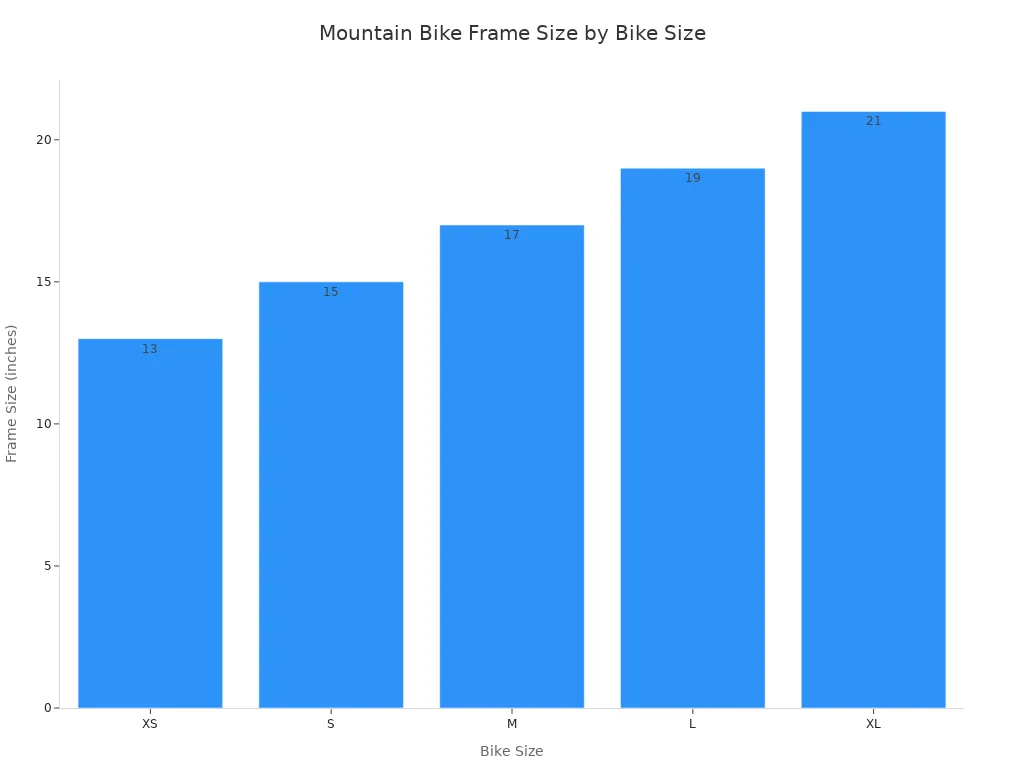
Mountain Bike Frame Sizing
Rider height is the primary factor for mountain bike sizing. Size charts serve as an excellent starting point. However, frame geometry and individual body proportions vary. These charts may not always give a definitive answer. If I fall between suggested sizes, or I want a precise fit, I recommend additional measurements and test rides. This helps me find the right mountain bike size chart.
Here is a common mountain bike size chart:
Bike Size | Frame Size (Imperial) | Rider Height (Imperial) |
|---|---|---|
XS | 13 inches | 4’8″ – 5’2″ |
S | 15 inches | 5’2″ – 5’6″ |
M | 17 inches | 5’6″ – 5’10” |
L | 19 inches | 5’10” – 6’1″ |
XL | 21 inches | 6’1″ – 6’4″ |
I also find this chart helpful for mountain bike sizing:
This alpha size chart also guides me:
Alpha Size | Frame Size | Rider Height (Imperial) |
|---|---|---|
XS | 13-14” | 4’9”-5’1” |
S | 15-16” | 5’2”-5’5” |
M | 17-18” | 5’6”-5’10” |
L | 19-20” | 5’11”-6’1” |
XL | 21-22” | 6’2”-6’4” |
XXL | 23” | 6’4”+ |
While rider height is a primary factor, body measurements like inseam, torso length, and arm length offer a general idea of suitable frame sizes. Riding style, test rides, and professional bike fitting are also crucial for achieving the perfect fit.
Hybrid Bike Frame Sizing
Bike manufacturers aim for a comfortable fit for every rider. They design bikes that fit people. They consider rider proportions with their recommendations. This is especially true when size charts overlap. This allows for suggested sizing adjustments. It accounts for varying limb lengths. This ensures an optimal fit. I use a hybrid bike size chart to guide my choice.
Here is a typical hybrid bike size chart:
Size | Rider Height (cm) | Rider Height (ft/in) | Inseam (cm) | Inseam (in) |
|---|---|---|---|---|
S | 155.0 – 165.0 | 5’1.0″ – 5’5.0″ | 72.0 – 78.0 | 28.3″ – 30.7″ |
M | 165.0 – 175.0 | 5’5.0″ – 5’8.9″ | 77.0 – 83.0 | 30.3″ – 32.7″ |
L | 175.0 – 186.0 | 5’8.9″ – 6’1.2″ | 82.0 – 88.0 | 32.3″ – 34.6″ |
XL | 186.0 – 197.0 | 6’1.2″ – 6’5.6″ | 87.0 – 93.0 | 34.3″ – 36.6″ |
XXL | 197.0 – 203.0 | 6’5.6″ – 6’7.9″ | 92.0 – 95.0 | 36.2″ – 37.4″ |
Hybrid bike manufacturers typically size frames using a Small/Medium/Large system. Some may use inches. They provide charts that correlate these sizes with rider height and inseam measurements. When I am between hybrid bike sizes, manufacturers suggest considering:
A larger size if I have long arms (arm span longer than height) or long legs.
A smaller size if I have a longer torso but average or shorter arm span/inseam, or if I have mobility issues like bad hips or back.
Checking Standover Height
Standover height is just as important as top tube length and seat tube length. It helps determine proper bike fit. A bike with too tall a standover is likely too large overall. This affects my comfort and control. I know this from personal experience. I once tried riding a bike two sizes too big. Stopping and leaning it over was neither comfortable nor easy. A correctly sized bike is significantly more comfortable. This is contrary to the ‘just lean it over’ mentality.
A proper standover height allows me to place both feet flat on the ground. This reduces the risk of groin injury during sudden stops or unexpected dismounts. It is especially vital for mountain bikers and beginners. They navigate rough terrain. Quick foot placement can prevent accidents and improve overall confidence. Inadequate clearance impairs my ability to react and balance. This is particularly true on uneven surfaces or during quick stops. New riders benefit from correct standover height. It provides peace of mind. It enables quick foot placement. It prevents falls. This makes learning safer and more enjoyable.
Correct standover height creates a relaxed, natural riding position. This reduces strain on my back, knees, and hips. It makes it easier to mount, dismount, and stop the bike comfortably. Ensuring proper clearance contributes to a smoother and safer ride. This enhances my overall cycling enjoyment. Improper standover height can cause strain and reduce control over time.
Sizing Kids’ Bikes: How to Size a Bike for Children
I know sizing bikes for children works differently. We primarily size kids’ bikes by their wheel diameter. We do not use frame size like adult bikes. This is a key difference when you learn how to size a bike for a child.
Understanding Wheel Diameter
I find wheel diameter is the most important factor for kid bike sizing. Kids’ bikes come with various wheel sizes. These range from small 10-inch wheels for balance bikes. They go up to 26-inch wheels for older children. This range helps match the bike to a child’s growth.
Age and Height Guidelines
I use age and height guidelines to pick the right bike size. While age gives an estimate, a child’s height is more accurate. Children grow at different rates. I always check a kids bike size chart. This helps me find the best fit.
Here is a general kids bike size chart I use:
Wheel Size | Age Range | Height Range (cm) |
|---|---|---|
Balance bikes | 1.5–2 years | N/A |
12-inch | 2–4 years | 85–100 |
14-inch | 3–5 years | 95–110 |
16-inch | Around 6 years | 105–115 |
20-inch | 5–8 years | N/A |
24-inch | 7–11 years | N/A |
26-inch | 10–14 years | N/A |
I also refer to this detailed bike size chart for more precision:
Age Range | Inseam Length (cm) | Wheel Size (cm) |
|---|---|---|
2–3 years | 35–42 (14–17″) | 30 (12″) |
3–4 years | 40–50 (16–20″) | 36 (14″) |
4–5 years | 45–55 (18–22″) | 41 (16″) |
5–8 years | 55–63 (22–25″) | 51 (20″) |
8–11 years | 60–72 (24–28″) | 61 (24″) |
11+ years | 70+ (26″+) | 66 (26″) |
This chart helps me choose the correct bike size.
Ensuring a Safe Fit
I always prioritize a safe fit for children. A child’s feet must touch the ground when they sit on the bike seat. This is crucial for confidence and safety. For new riders, I adjust the seat low. Their feet can rest flat on the ground. This helps them get on and off easily. For experienced riders, I can raise the seat for better pedaling. They can touch the ground with their toes. It is important to buy a bike that fits now. Do not buy one they will grow into. The correct bike size prevents accidents.
Fine-Tuning Your Bike Fit for Comfort
I know finding the right bike size is a great start. However, fine-tuning your bike fit makes a huge difference. Small adjustments can greatly improve comfort and performance. I always focus on these key areas.
Adjusting Saddle Height
I always start with saddle height. It is crucial for pedaling efficiency and preventing knee pain. I use a few methods to get it right. The heel method is simple. I sit on the saddle with my cycling shoes on. I place my heel on the pedal at its lowest point. My leg should be fully extended. My knee should be straight but not hyperextended. If my heel loses contact or my hips rock, the saddle is too high. If my knee is bent, it is too low.
Another way I check is the inseam measurement method, also known as the LeMond Formula. I measure my inseam in centimeters. Then, I multiply this by 0.883. This gives me a suggested saddle height. I measure from the center of the bottom bracket to the top of the saddle. While these formulas provide a starting point, they do not always account for individual differences. I find the heel-on-the-pedal method effective. I pedal backward with my heel on the pedal. This ensures my knee straightens fully without hip rocking. For more accuracy, I sometimes use video motion capture with my phone. When I adjust, I make small changes, about 3-4 millimeters at a time. It is easier to increase height gradually. For optimal results, especially if I have pain, I consider professional bike fitting. A certified fitter considers my unique anatomy and riding style.
Saddle Fore/Aft Position
After setting the saddle height, I adjust its fore/aft position. This affects how my weight distributes over the bike. It also impacts my pedaling stroke. I make sure the saddle is generally level. For fore-aft, I use the plumb line method. I align my forward kneecap vertically with the pedal axle. This happens when the cranks are horizontal, at 3 and 9 o’clock. This helps me find a balanced position. This adjustment fine-tunes my overall bike fit.
Handlebar Reach and Stem
My handlebar reach and stem length are next. They determine my riding posture. I evaluate my current comfort first. I note any aches or pains. I measure my existing stem length and handlebar width. I also check my spacer stack. I adjust one variable at a time.
For example, I might add a spacer or swap to a shorter stem. I test these adjustments by riding in various conditions. I ride on flats, hills, and moderate distances. I record my observations. I refine and repeat adjustments until I achieve the ideal handlebar position. I reassess periodically. A sizing stem helps test different stem lengths efficiently. Stem length and angle are key. I use a shorter stem to reduce reach. A longer one extends it. Changing the stem angle can raise or lower the handlebar. Spacer stack also fine-tunes handlebar height. More spacers give an upright position. Fewer create an aggressive stance. Handlebar shape and size also influence posture and control. This helps me achieve a comfortable fit.
Handlebar Width
Handlebar width is a personal preference. It influences steering control and upper body comfort. Wider handlebars generally increase steering leverage. They offer more control, especially on rough terrain. However, they can be challenging in tight spaces.
Narrower bars might suit my shoulder width better. For upper body comfort, handlebars with a 15-degree sweep or more can reduce wrist pressure. They also ease shoulder tension. This helps prevent numbness over long distances. Proper handlebar width aligns my wrists, elbows, and shoulders. This creates an efficient riding position. The ideal width depends on my body dimensions. Taller riders with broader shoulders usually need wider bars. This fine-tuning completes my bike size adjustments. I always consult a bike size chart for initial guidance. This helps me get the best bike fitting.
I know investing time to measure bike size is crucial. It ensures a truly enjoyable and effective cycling experience. These guidelines offer a great starting point for your bike sizing journey. Proper bike sizing makes a difference. Do not hesitate to seek professional bike fitting if you need a precise fit. A perfectly fitted bike boosts my confidence. It makes me love riding even more. I feel great on my bike.